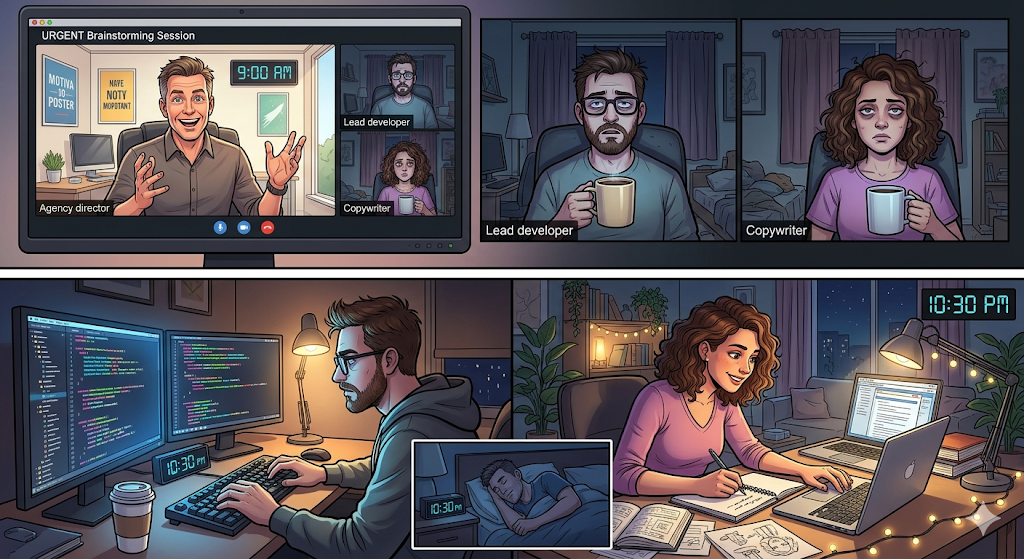
Imagine this daily scenario in thousands of companies: It’s 9:00 AM. The agency director—an enthusiast of waking up at 5:00 AM after reading a self-help book—calls for a brainstorming video meeting for a new project.
On screen, the director is full of energy. Meanwhile, the lead developer and top copywriter sit with oversized coffee mugs, blank stares, and zero participation. The director thinks: “My team isn’t motivated.”
Hours later, at 10:30 PM, that same developer is writing the cleanest, most brilliant code of the month, while the copywriter drafts a winning campaign. By then, the director is already asleep.
What went wrong? Lack of commitment? Not at all.
This is a collision between traditional project management and human biology. Your team doesn’t have an attitude problem—it has a chronotype conflict.
In the era of remote work and flexibility, forcing everyone into a rigid 9-to-5 schedule isn’t just outdated—it’s operationally inefficient. Understanding your team’s energy peaks and aligning tasks, meetings, and reminders accordingly is one of the most overlooked productivity advantages today.
What Are Chronotypes and Why Do They Matter?
Chronobiology is the science that studies the body’s natural rhythms. A chronotype is your body’s natural tendency to be awake, asleep, and experience energy peaks at specific times of the day.
Dr. Michael Breus popularized four main chronotypes:
1. Lions (15%)
Natural early risers. High analytical focus between 8:00 AM and 12:00 PM. Energy drops sharply in the afternoon.
2. Bears (55%)
Aligned with the sun. Most productive mid-morning (10:00 AM – 12:00 PM), with a dip after lunch (2:00 PM – 4:00 PM).
3. Wolves (15%)
Night-oriented. Mornings are cognitively weak. Peak creativity and deep work happen between 4:00 PM and 10:00 PM.
4. Dolphins (10%)
Light sleepers with irregular energy. Productivity comes in short, unpredictable bursts, often mid-morning.
The Problem with Traditional Management
Corporate structures were designed for Bears—and biased toward Lions. But if your company relies on creativity, design, or complex problem-solving (where Wolves dominate), forcing early meetings destroys their best work hours.
The “Energy First” Framework
To unlock your team’s full potential, you must stop managing time and start managing energy.
1. Kill the “Surprise Meeting”: Use Appointments Strategically
A 9:30 AM call is torture for a Wolf. A 5:30 PM review is useless for a Lion.
Solution: Replace “I schedule you” with “you choose when.”
Use Appointments so team members pick meeting times during their energy peaks. A Wolf might choose 4:00 PM. A Lion might choose 10:00 AM.
This simple shift ensures both sides show up mentally sharp—not just physically present.
2. Separate Deep Work from Shallow Work
Not all work is equal:
- Deep Work: Coding, design, writing, strategy
- Shallow Work: Emails, updates, admin tasks
Solution: Protect energy peaks for deep work.
- Lions → mornings
- Wolves → late afternoons/evenings
Shallow work should fill low-energy periods.
3. Smart Reminders: The Silent Equalizer
In mixed chronotype teams, real-time communication breaks down.
If a Wolf sends a message at 11:00 PM, they might wake a Lion—or get ignored until morning.
Solution: Move operational communication to systems with automated reminders.
A Wolf finishes work at night, assigns the task, and logs off. The system notifies the Lion at 8:00 AM.
Work flows 24/7—without invading personal time.
4. Total Visibility Through Dynamic Boards
If everyone works at different times, how does a manager track progress?
Solution: Rely on visibility—not interruptions.
With Kanban boards or Gantt charts, progress is always visible. Even if a developer is asleep, the manager can see that tasks were completed and moved forward overnight.
Visibility replaces micromanagement.
Technology Must Adapt to Biology
Understanding chronotypes is useless if your tools force rigid schedules.
If your workflow depends on emails, scattered chats, and fixed meetings, friction will persist.
That’s why GGyess has been redesigned as a flexible WorkSuite that adapts to human energy—not the other way around.
How GGyess Supports Biological Productivity
- Fully Asynchronous Workflows: Create tasks, upload files, and collaborate anytime—2:00 AM or 6:00 AM—with full context preserved.
- Built-in Appointments: Let clients and teammates schedule meetings at their optimal times—and launch calls directly from the project workspace.
- Stress-Free Smart Reminders: Notifications are structured and non-intrusive, avoiding late-night interruptions.
- Flexible Views: Managers can use Gantt views at midday, while creatives organize work in Kanban at night—same data, different perspectives.
Stop Fighting Nature—Design Around It
The biggest productivity hack isn’t waking up earlier—it’s aligning work with biology.
Let your team work when they perform best. Give them systems that support that flexibility.
Revolutionize how your team communicates, schedules, and executes projects. Discover GGyess at ggyess.com.
Frequently Asked Questions (FAQ)
Can you change someone’s chronotype?
Not permanently. Chronotypes are heavily influenced by genetics and age. You can adjust habits slightly, but underlying energy patterns remain.
How do you handle urgent issues in async teams?
Define what’s truly urgent (e.g., system outages). Use escalation channels like phone calls only for real emergencies. Everything else should flow through task systems.
What about team culture if people rarely overlap?
Async work doesn’t eliminate human connection. Schedule periodic cultural sync calls (e.g., midday) focused on bonding—not task tracking.