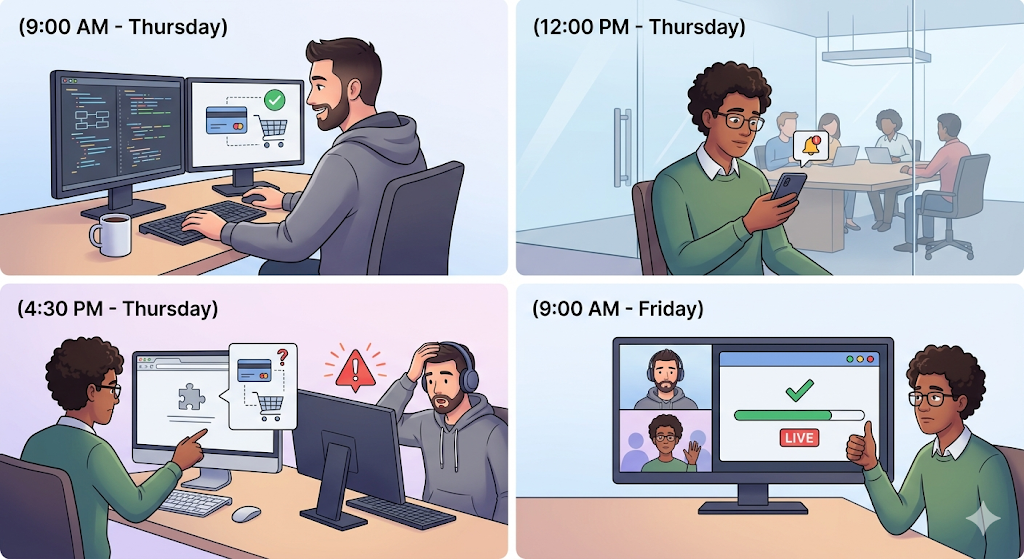
It’s Thursday morning. Your top developer has just finished building a new feature for a client’s platform. It took exactly two hours of deep, uninterrupted work. Satisfied, they drop a message in the Slack channel: “Done. Payment feature is live in staging. @Carlos, let me know when you review it so we can push to production.”
Carlos, the QA lead, is in another meeting. He sees the message three hours later. He checks the staging environment but realizes a configuration file is missing. He replies at 2:00 PM: “The .env file is missing—can you send it?”
The developer—who already mentally closed that task and moved on—sees the message at 4:30 PM. Sends the file. Carlos reviews it Friday morning.
What was two hours of actual work took two days to complete.
This is why so many leaders feel their remote teams are “slow” despite being busy all day. It’s not a talent problem or laziness—it’s a systemic failure known as Response Latency.
In a world where asynchronous work is the norm, minimizing this latency is the difference between a high-performing team and one drowning in bottlenecks.
What Exactly Is “Response Latency”?
In technology, latency is the time it takes for data to travel from one point to another. In team management, Response Latency is the waiting time between when one person completes their part of a task and when the next person receives, understands, and acts on it.
It’s the “white space” in your Gantt chart. The dead time where nothing moves because work is stuck in someone’s inbox.
The Productivity Illusion Trap
Many teams measure productivity by Execution Time (how long a task takes to complete). But in collaborative work, the real metric is Cycle Time: the total time from request to final delivery.
Key insight: In poorly managed async teams, up to 80% of Cycle Time isn’t work—it’s waiting time. It’s latency.
The 3 Drivers of Asynchronous Bottlenecks
If your team suffers from high response latency, you’re likely dealing with one (or all) of these issues:
1. Incomplete Handoffs
The biggest latency generator is passing work without full context. Missing files, unclear instructions, or absent links force the next person to ask questions—triggering a back-and-forth loop that adds hours or days.
2. Relying on Memory for Follow-Ups
“I sent it yesterday—they’ll probably reply today.”
That mindset creates bottlenecks. When follow-ups depend on human memory, tasks get forgotten. By the time you check in, you’ve already lost 24–48 hours.
3. The Emotional Cost of “Chasing”
There’s a real psychological barrier in teams. No one likes to be the person who says, “Hey, I need your approval to move forward.” To avoid seeming pushy, people wait silently. That politeness kills speed.
Toxic Fixes: What NOT to Do
When leaders notice delays, they often react in ways that make things worse:
- Bad Fix #1: “Always be online.” Forcing instant replies kills deep work and creates distracted, anxious teams.
- Bad Fix #2: “Let’s just hop on a quick call.” Turning everything into meetings leads to Zoom fatigue and blocks real work time.
The Zero-Latency Framework: Automation + Context
To reduce waiting time without harming team well-being, you need systems—not pressure.
Step 1: The “Complete Handoff” Rule
A task isn’t “done” unless it’s fully ready for the next person. That means:
- Final files attached
- Clear summary of what was done
- Tagged next owner
- Specific deadline
No context = guaranteed delay.
Step 2: Delegate Friction to Smart Reminders
Stop relying on people to chase people. Let systems do it.
Automated reminders notify task owners before deadlines or when action is required. This removes emotional friction—no one has to “nag” anyone.
Step 3: Micro-Sync via Appointments
Sometimes async isn’t enough. If context is complex, schedule a quick 10-minute handoff call instead of writing long messages.
This short synchronous moment eliminates confusion instantly—and resets latency to zero.
The Role of Dynamic Visibility
Latency thrives in the dark.
When work lives in private chats or emails, no one sees where things are stuck. But with visual systems like Kanban boards or Gantt charts, bottlenecks become obvious.
If a task sits in “Waiting for Approval” for three days, everyone sees it. That visibility—combined with automated reminders—naturally pushes progress forward.
Eliminate Latency at the Source with GGyess
Fixing response latency requires more than task assignment—it requires a system that actively drives workflows forward.
If your files are in Google Drive, tasks in Trello, and reminders in your head, latency will always win.
That’s why GGyess was built to eliminate these operational blind spots:
- Frictionless handoffs: All files, context, and history live inside each task. When you assign it, the next person has everything instantly.
- Smart reminders that protect focus: No more manual follow-ups. The system ensures deadlines are respected.
- Built-in Appointments & video calls: When async breaks down, jump into a quick call directly from the task—no switching tools.
- Dynamic views (Kanban, Gantt, Calendar): Instantly spot bottlenecks and rebalance workload before delays escalate.
Remote work doesn’t have to be slow. With the right systems, your team can move fast—without sacrificing focus or sanity.
Accelerate your workflow and eliminate async latency today at ggyess.com.
Frequently Asked Questions (FAQ)
What’s the difference between synchronous and asynchronous work?
Synchronous work happens in real time (calls, meetings). Asynchronous work happens independently, with people contributing at different times within set deadlines.
How do I know if my team’s latency is too high?
If small tasks (under an hour of work) consistently take days to complete due to approvals or delays, you have a latency problem.
Why are automated reminders better than manual follow-ups?
They remove emotional friction. Instead of people chasing people, the system enforces deadlines neutrally—improving speed without harming relationships.