

This guide focuses on comparing the expected result with a repeatable observation. The worked example follows three units: “lead form”, “confirmation page” and “sales notification”.
Reference input: offer and form journey. Expected output: a landing-page test map. Before assigning work, confirm the current input version and who will review the result.
Prepare repeatable test cases
Tests for the lead-generation landing page release should compare produced work with an expected outcome. Use offer and form journey as the reference and retain the version under test. For each case, describe the starting condition, action, expected result and evidence. Include a normal journey and a case capable of revealing a material failure. Avoid designing a test that only confirms the easiest example. If the executor must ask what passing means, refine the definition before treating the result as quality evidence. Another colleague should be able to repeat the test with the same conditions and understand what observation would constitute failure.
Compare expected and observed results
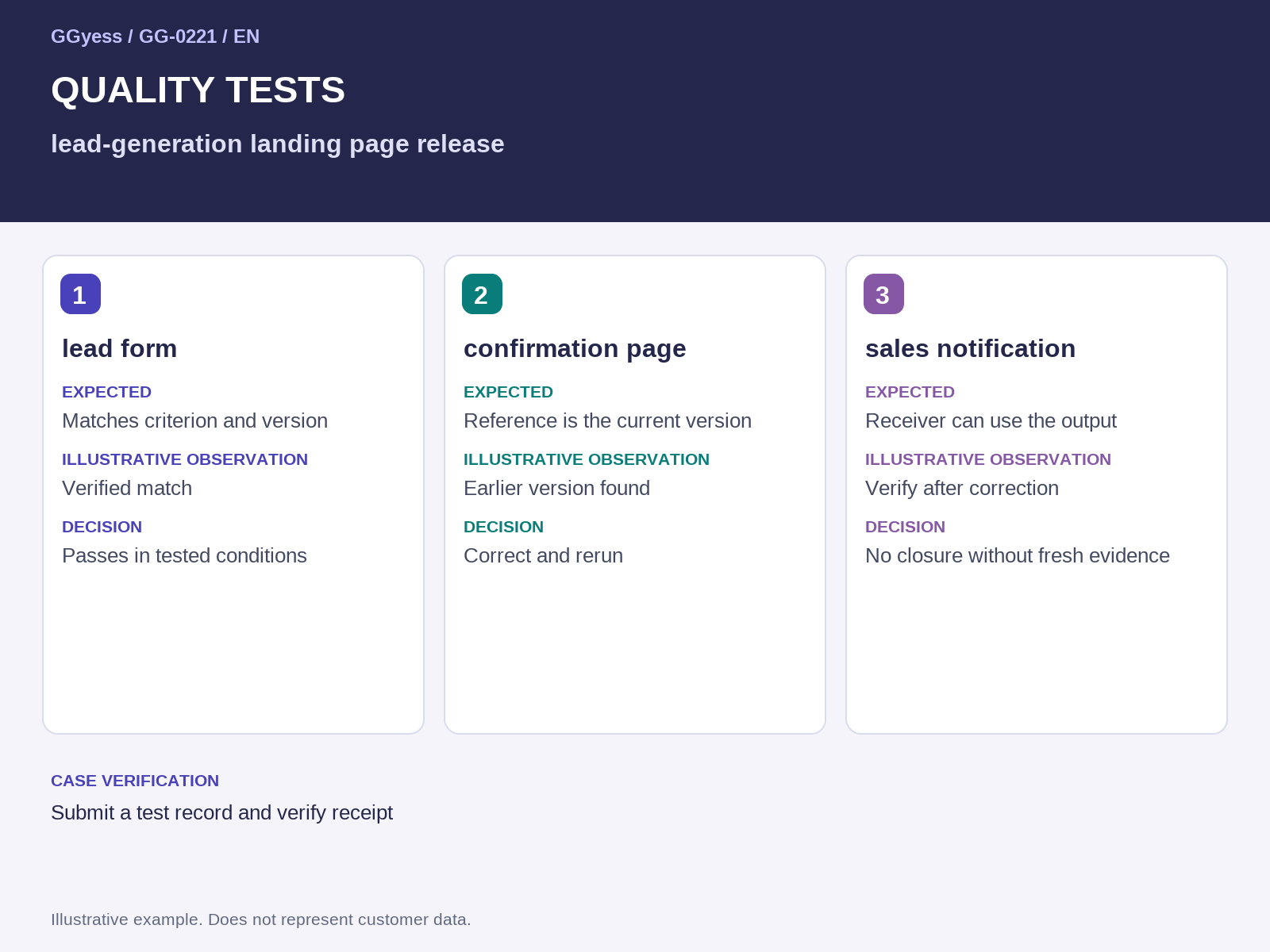
When reviewing lead form, record what you expected and what you actually observed. An approval label alone does not make the check reconstructable. For confirmation page, retain enough material and environment detail to repeat the observation. For sales notification, confirm the outcome the next person receives, rather than checking only production activity. The specific failure to watch is confirming submission without checking its destination. The central test is to submit a test record and verify receipt. If observation differs from expectation, record a concrete defect that someone can correct without guessing what happened or needing to reconstruct the entire review conversation.
Worked example
The fictional offer is an initial assessment for B2B teams. The form requests agreed information and the confirmation explains the next step. The case requires checking that a test submission reaches the correct sales recipient.
The example involves Alex, Mateo and Leo. Names, situations and numbers are illustrative and do not represent customer results. The three units let you test the proposed approach before extending it to other work.
| Test case | Expected | Illustrative observation | Decision |
|---|---|---|---|
| lead form | Matches criterion and version | Verified match | Passes in tested conditions |
| confirmation page | Reference is the current version | Earlier version found | Correct and rerun |
| sales notification | Receiver can use the output | Verify after correction | No closure without fresh evidence |
Correct the failure and run the test again
In this illustrative example, the normal case passes and a second case reveals a version mismatch. The owner corrects the material, identifies the new version and reruns the failed case. They then check whether the correction affects the case that previously passed. Do not mark the check successful simply because a modification was made. Closure evidence should come from a new observation of the corrected result. This small loop distinguishes an intention to fix the problem from verification that the problem no longer appears under the tested conditions.
Close with evidence and clear limits
The goal is to deliver a landing-page test map with traceable tests. Retain what was tested, on which version, when and with what outcome. If a case could not run, leave it pending and explain its effect on acceptance. An omitted test does not become an implicit approval. Where a limitation does not prevent delivery, request an explicit decision about the remaining risk. Test coverage describes observed conditions; it does not establish correctness for every possible case. This precision lets the team reuse evidence without giving it a wider meaning than the observations support.
What to check before closure
The risk to control in this case is confirming submission without checking its destination. A completed label needs a supporting observation. Keep the following beside the decision so the receiver can establish what was checked:
- Input and version used: offer and form journey.
- Case check: submit a test record and verify receipt.
- Outcome under review: a landing-page test map.