

This guide focuses on comparing the expected result with a repeatable observation. The worked example follows three units: “LATAM team delivery”, “US team review” and “handoff confirmation”.
Reference input: local hours and review windows. Expected output: a handover matrix with explicit time zones. Before assigning work, confirm the current input version and who will review the result.
Prepare repeatable test cases
Tests for the Latin America-US delivery coordination should compare produced work with an expected outcome. Use local hours and review windows as the reference and retain the version under test. For each case, describe the starting condition, action, expected result and evidence. Include a normal journey and a case capable of revealing a material failure. Avoid designing a test that only confirms the easiest example. If the executor must ask what passing means, refine the definition before treating the result as quality evidence. Another colleague should be able to repeat the test with the same conditions and understand what observation would constitute failure.
Compare expected and observed results
When reviewing LATAM team delivery, record what you expected and what you actually observed. An approval label alone does not make the check reconstructable. For US team review, retain enough material and environment detail to repeat the observation. For handoff confirmation, confirm the outcome the next person receives, rather than checking only production activity. The specific failure to watch is assuming a fixed time difference for every participant. The central test is to record the date and time zone for the agreed window. If observation differs from expectation, record a concrete defect that someone can correct without guessing what happened or needing to reconstruct the entire review conversation.
Worked example
The fictional handoff crosses teams with different review windows. Each commitment retains date, time zone and receiver. Both sides confirm that day's window before promising a response instead of assuming a permanent time difference.
The example involves Sofia, Valeria and Camila. Names, situations and numbers are illustrative and do not represent customer results. The three units let you test the proposed approach before extending it to other work.
| Test case | Expected | Illustrative observation | Decision |
|---|---|---|---|
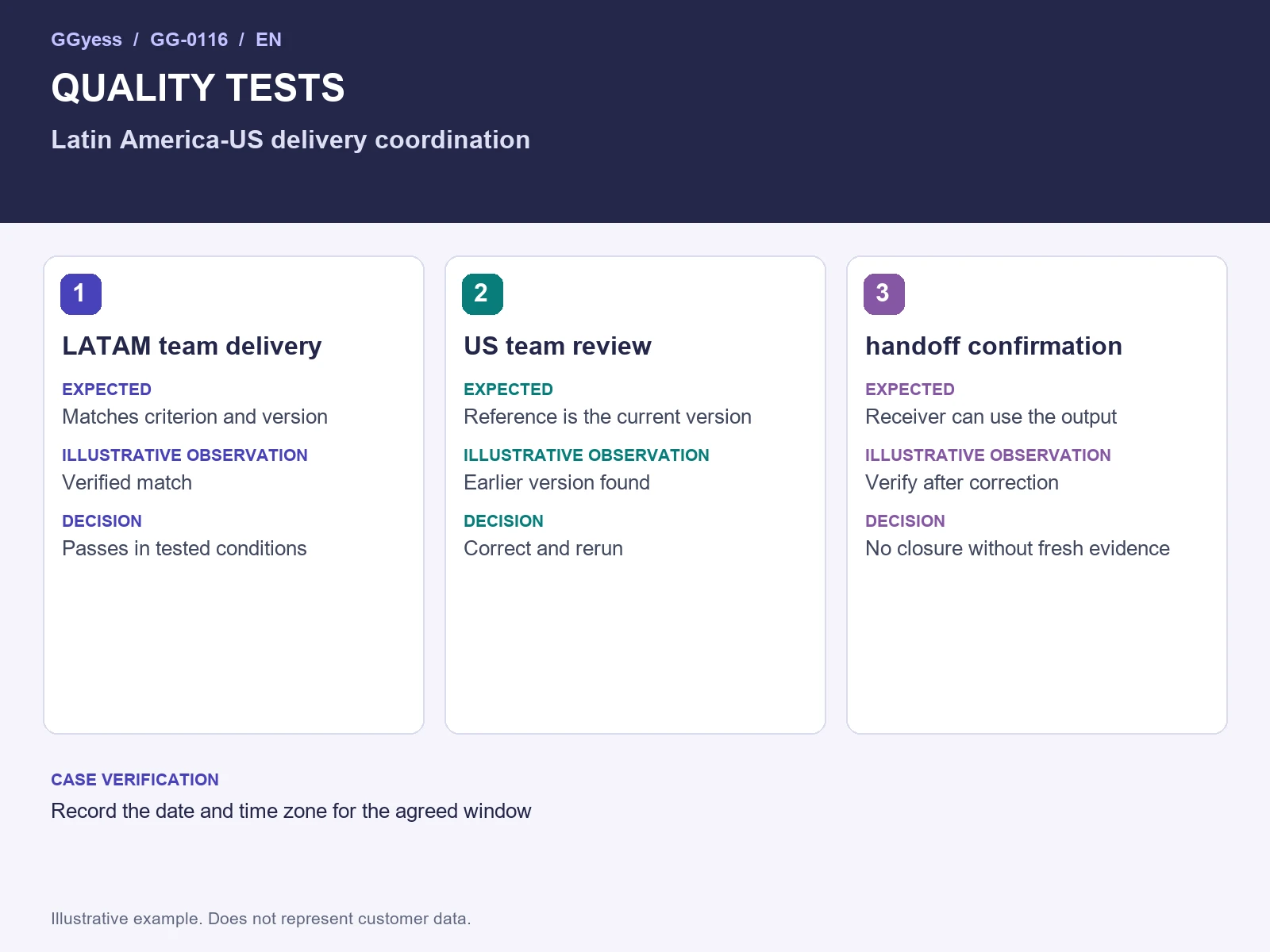
| LATAM team delivery | Matches criterion and version | Verified match | Passes in tested conditions |
| US team review | Reference is the current version | Earlier version found | Correct and rerun |
| handoff confirmation | Receiver can use the output | Verify after correction | No closure without fresh evidence |
Correct the failure and run the test again
In this illustrative example, the normal case passes and a second case reveals a version mismatch. The owner corrects the material, identifies the new version and reruns the failed case. They then check whether the correction affects the case that previously passed. Do not mark the check successful simply because a modification was made. Closure evidence should come from a new observation of the corrected result. This small loop distinguishes an intention to fix the problem from verification that the problem no longer appears under the tested conditions.
Close with evidence and clear limits
The goal is to deliver a handover matrix with explicit time zones with traceable tests. Retain what was tested, on which version, when and with what outcome. If a case could not run, leave it pending and explain its effect on acceptance. An omitted test does not become an implicit approval. Where a limitation does not prevent delivery, request an explicit decision about the remaining risk. Test coverage describes observed conditions; it does not establish correctness for every possible case. This precision lets the team reuse evidence without giving it a wider meaning than the observations support.
What to check before closure
The risk to control in this case is assuming a fixed time difference for every participant. A completed label needs a supporting observation. Keep the following beside the decision so the receiver can establish what was checked:
- Input and version used: local hours and review windows.
- Case check: record the date and time zone for the agreed window.
- Outcome under review: a handover matrix with explicit time zones.