

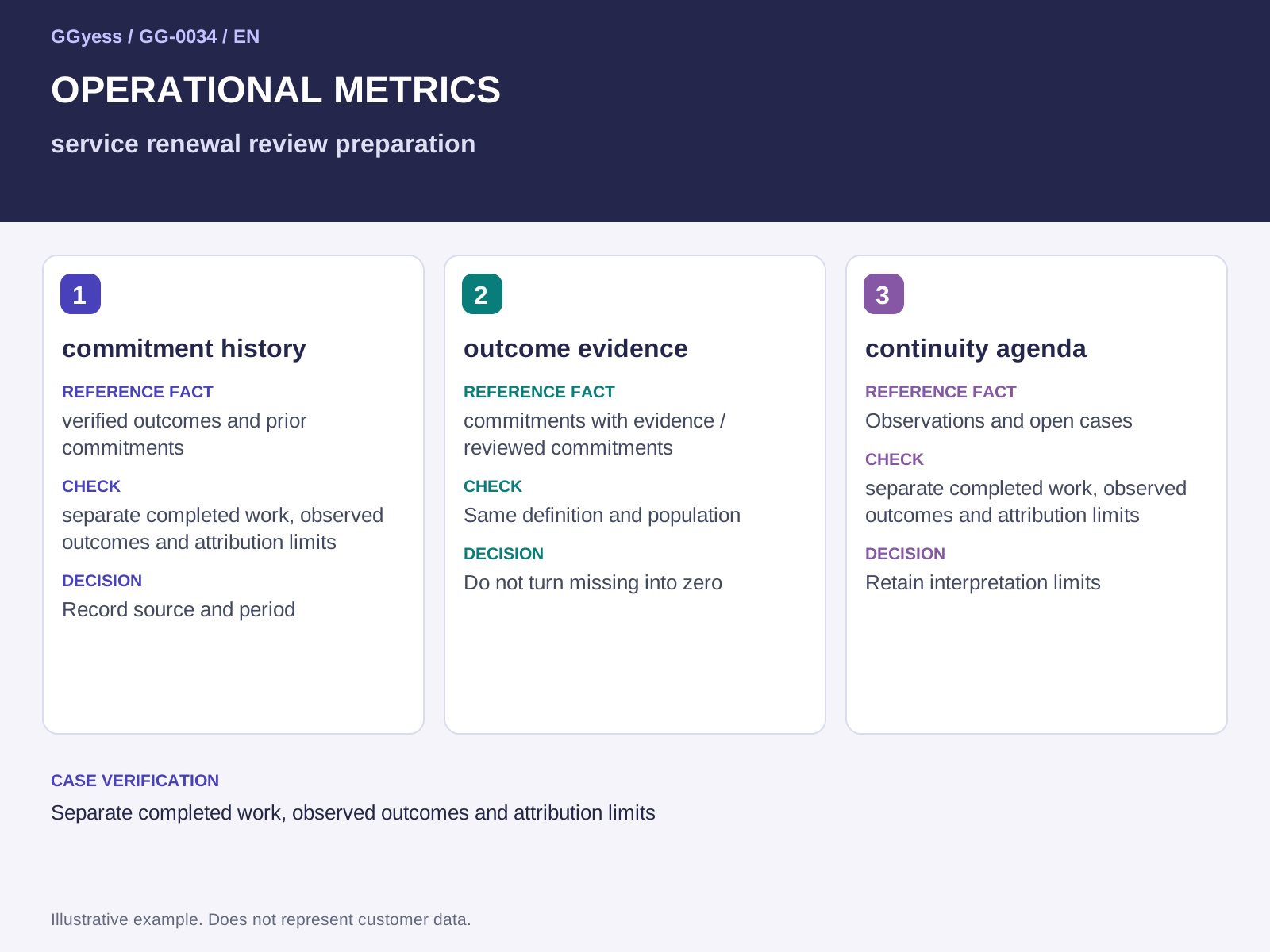
This guide focuses on defining a reproducible indicator and the decision it can support. The worked example follows three units: “commitment history”, “outcome evidence” and “continuity agenda”.
Reference input: verified outcomes and prior commitments. Expected output: a continuity dossier with next steps. Before assigning work, confirm the current input version and who will review the result.
Connect the metric to a decision
A metric for the service renewal review preparation is useful when it can change the next action. Before building a chart, establish whether you need to stop intake, reassign review or investigate waiting. Define the observation unit: asset, request, file or cycle. Do not combine those units in one percentage. The reference operational record here is a continuity dossier with next steps. The metric should describe what that record can actually establish. When evidence for one stage is missing, identify the gap before interpreting a total that appears to cover the whole process. Measurement starts with a decision and observable records, rather than a dashboard layout.
Write a reproducible definition
The measurement card should retain the name, formula, observation window, source, exclusions and update owner. For a proportion, numerator and denominator must refer to the same population of work. For waiting time, record both ends of the interval and explain how open cases are handled. Do not turn missing observations into zero. Zero means the event was measured and not found; missing means the calculation is not yet supported. This distinction changes decisions, particularly when an item looks punctual simply because its delay was never recorded. Another colleague should be able to reproduce the result from the definition.
Worked example
The fictional review collects prior commitments and period evidence. One activity was executed but its outcome remains unmeasured. The dossier preserves that distinction and prepares fact-based continuity questions without turning activity into proven success.
The example involves Leo, Diego and Alex. Names, situations and numbers are illustrative and do not represent customer results. The three units let you test the proposed approach before extending it to other work.
| Unit | Reference fact | Check | Decision |
|---|---|---|---|
| commitment history | verified outcomes and prior commitments | separate completed work, observed outcomes and attribution limits | Record source and period |
| outcome evidence | commitments with evidence / reviewed commitments | Same definition and population | Do not turn missing into zero |
| continuity agenda | Observations and open cases | separate completed work, observed outcomes and attribution limits | Retain interpretation limits |
Calculate an example and explain its limits
Proposed indicator: commitments with evidence / reviewed commitments. Define the unit, period, source and exclusions before calculating it. Retain missing observations as pending and compare periods using the same definition. Arithmetic example separate from the table’s three units: if 8 records meet the numerator condition out of 10, the ratio is 8 / 10 = 80%. This is an illustrative calculation, not a customer measurement or an outcome caused by GGyess.
Review with an action and supporting evidence
For commitment history, outcome evidence and continuity agenda, choose a review point that leaves a real opportunity to intervene. Reviewing a metric after its decision becomes irreversible offers little operational value. Guard against presenting activities as customer outcomes. The proposed check is to separate completed work, observed outcomes and attribution limits. When the indicator changes, inspect its source and the cases behind it before turning a small fluctuation into a success or failure story. Record the decision, action owner and observation expected at the next check. That keeps measurement connected to work instead of allowing the report to become a separate administrative exercise.
What to check before closure
The risk to control in this case is presenting activities as customer outcomes. A completed label needs a supporting observation. Keep the following beside the decision so the receiver can establish what was checked:
- Input and version used: verified outcomes and prior commitments.
- Case check: separate completed work, observed outcomes and attribution limits.
- Outcome under review: a continuity dossier with next steps.