

This guide focuses on separating execution, review and authority to resolve a disagreement. The worked example follows three units: “campaign asset”, “brand criterion” and “approved correction”.
Reference input: brand guide and candidate assets. Expected output: a brand-criterion review matrix. Before assigning work, confirm the current input version and who will review the result.
Give each outcome one accountable owner
In the campaign asset brand consistency review, the task owner coordinates progress and is accountable for the next action. That does not mean personally performing every contribution. For campaign asset, name someone who can explain the state, obtain missing inputs and request a decision. Avoid assigning accountability to “marketing” or “the client”: groups can collaborate, but an individual needs to collect the decision and maintain the record. When several people contribute, distinguish their contributions from ownership of closure. Otherwise everyone may interpret shared responsibility differently, leaving the practical next step unowned despite an apparently complete assignment list.
Separate execution, review and decision authority
The person producing brand criterion may need specialist support while someone else decides whether the outcome meets the agreement. Record those roles separately. An approver needs a criterion and a review window as well as a name in a table. Confirm review availability before promising delivery. Someone who is consulted provides information; consultation does not automatically create a permanent veto. Explain which decisions require input and which the owner can resolve without reopening the whole project. This reduces avoidable waiting while preserving the controls that materially protect the outcome.
Worked example
The fictional brand guide fixes a product name, tone and representation rule. The candidate meets two criteria and needs review of the third. Feedback cites the specific rule instead of presenting a personal preference as a current requirement.
The example involves Leo, Diego and Alex. Names, situations and numbers are illustrative and do not represent customer results. The three units let you test the proposed approach before extending it to other work.
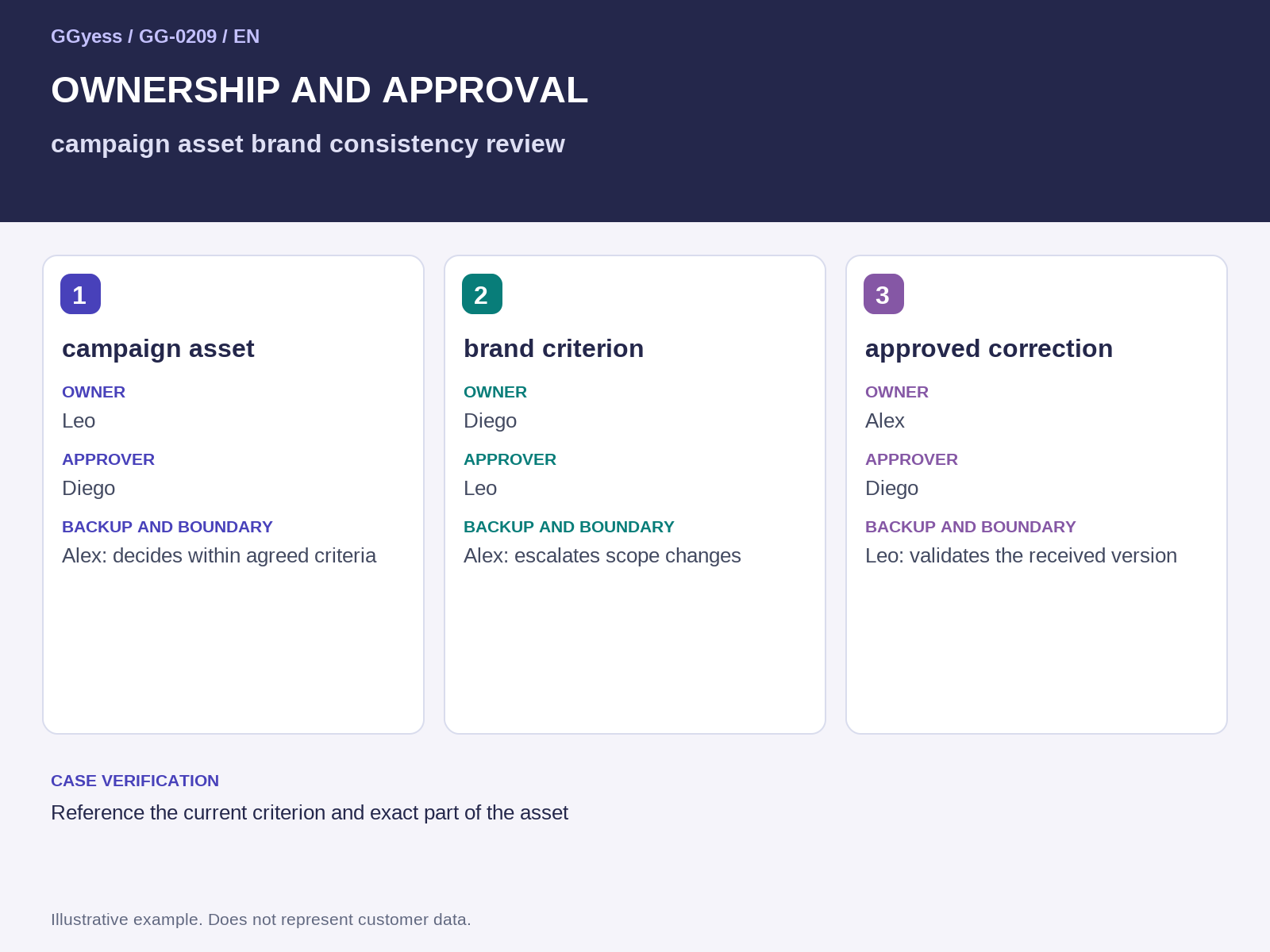
| Unit | Owner | Approver | Backup and boundary |
|---|---|---|---|
| campaign asset | Leo | Diego | Alex: decides within agreed criteria |
| brand criterion | Diego | Leo | Alex: escalates scope changes |
| approved correction | Alex | Diego | Leo: validates the received version |
Resolve incompatible instructions explicitly
Suppose two reviewers request conflicting changes to approved correction. The executor should not choose intuitively or prepare two full versions merely to avoid the conflict. Record the alternatives, affected criterion and person authorized to decide. Request a resolution that identifies the accepted version and explains the reason. If the disagreement changes the agreed result, treat it as a scope change and revisit the commitment. Retaining every comment is different from resolving comments: the record needs to establish which instruction remains valid and who closed the contradiction.
Test backup coverage before it is needed
A backup is useful when they understand the context and can act within clear authority. Before an absence, ask them to locate brand guide and candidate assets, identify the working version and explain how to verify a brand-criterion review matrix. Watch the risk of treating personal preferences as brand rules. The proposed practical check is to reference the current criterion and exact part of the asset. Resolve missing permissions or additional approvals before the handover. Define what must be escalated and to whom. Validate the ownership matrix through a reproducible decision, rather than considering it complete simply because every cell contains a person's name.
What to check before closure
The risk to control in this case is treating personal preferences as brand rules. A completed label needs a supporting observation. Keep the following beside the decision so the receiver can establish what was checked:
- Input and version used: brand guide and candidate assets.
- Case check: reference the current criterion and exact part of the asset.
- Outcome under review: a brand-criterion review matrix.