

This guide focuses on transferring the context another person needs to continue. The worked example follows three units: “used template”, “user feedback” and “currency review”.
Reference input: used templates and team feedback. Expected output: a template catalogue with owner and review date. Before assigning work, confirm the current input version and who will review the result.
Prepare a package that supports continuation
A handoff for the project template library maintenance should transfer enough context for another person to perform the next step. Include the intended outcome, current state, decisions, valid version, outstanding items and question owner. The reference input is used templates and team feedback. Identify what is accepted and what remains a proposal. Sending a folder or forwarding an entire conversation does not establish continuity. The receiver needs a brief explanation of what they can do now and which conditions they must not yet assume are satisfied. The package should preserve actionable meaning as well as access to files.
Identify the version and next action
For used template, identify the exact file or record the receiving team should use. For user feedback, preserve the reasons for relevant decisions and any unresolved questions. For currency review, describe the next step, its owner and closure criterion. When several versions exist, explain which is current and how it relates to earlier ones. A name such as “final definitive” does not replace unambiguous identification or approval. The package should support action even when the sender cannot immediately answer questions, making the handoff resilient to normal differences in schedules and availability.
Worked example
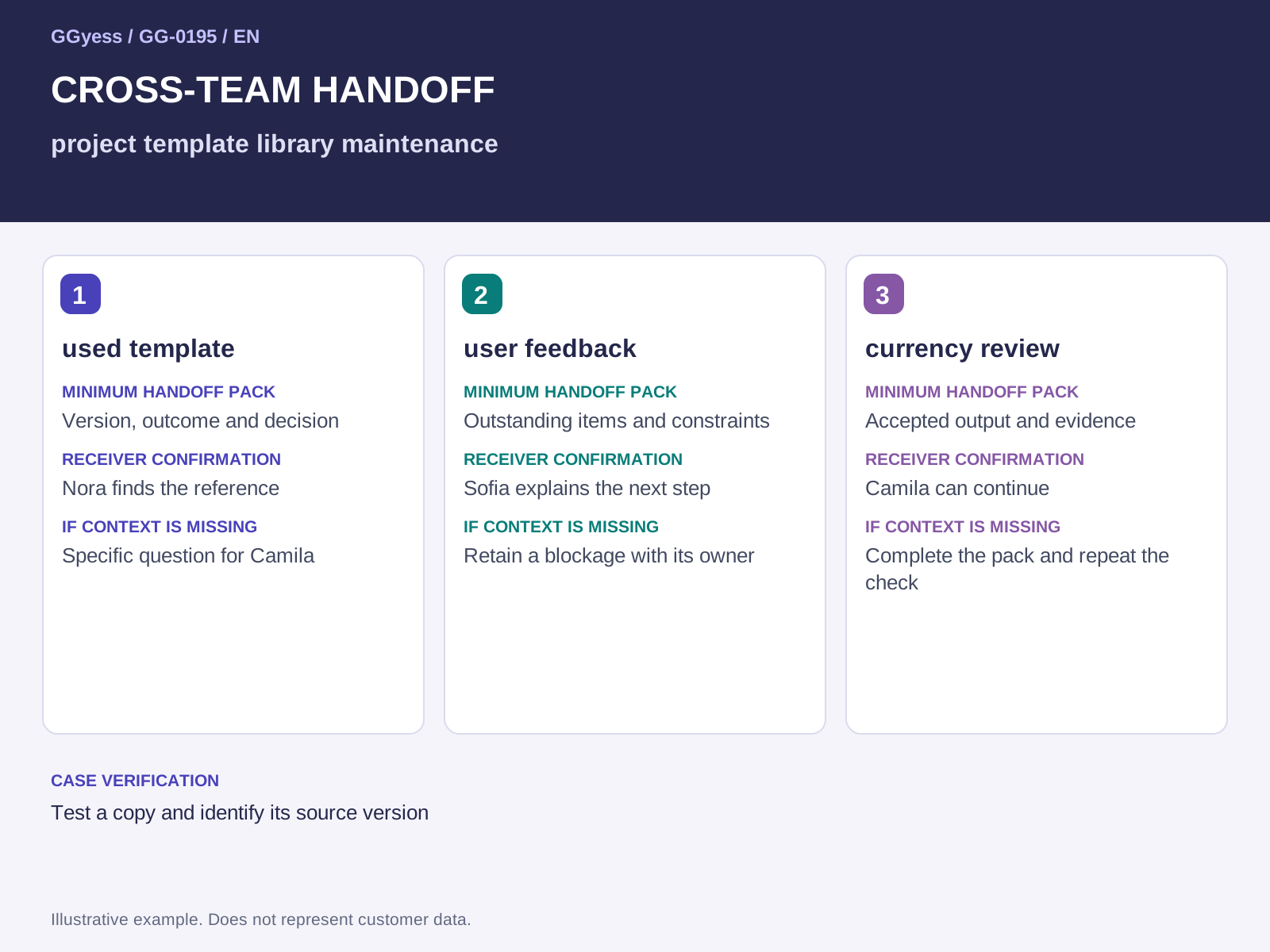
The fictional library contains two active templates and one inherited copy. Feedback reveals an outdated instruction. The catalogue identifies owner, version and currency evidence before promoting the copy as the reference for new projects.
The example involves Camila, Nora and Sofia. Names, situations and numbers are illustrative and do not represent customer results. The three units let you test the proposed approach before extending it to other work.
| Unit | Minimum handoff pack | Receiver confirmation | If context is missing |
|---|---|---|---|
| used template | Version, outcome and decision | Nora finds the reference | Specific question for Camila |
| user feedback | Outstanding items and constraints | Sofia explains the next step | Retain a blockage with its owner |
| currency review | Accepted output and evidence | Camila can continue | Complete the pack and repeat the check |
Request evidence of understanding
Receipt is established when the other person can find the material and explain how they will use it. Ask them to summarize the next step, main limitation and verification method. If they cannot, identify what the package lacks before considering the handoff complete. Here, avoid multiplying copies of a template with an outdated instruction. The proposed check is to test a copy and identify its source version. A “received” message may establish that a notification arrived, but not that permissions work or the context supports continuation. The confirmation should test the specific conditions the next stage depends on rather than simply create another acknowledgment message.
Resolve an incomplete handoff without duplicating work
When the receiver finds missing context, keep the question beside the deliverable and assign an answer owner. Do not open a second version of the work simply because the first is hard to locate. Reconcile the inventory with a template catalogue with owner and review date, separating missing production from missing documentation. After resolving the gap, record what was added and reconfirm the next action. That correction may later become a protocol field or check when it addresses an observed failure, rather than adding administrative effort without a practical purpose. The improvement should help the next receiver continue with fewer uncertainties.
What to check before closure
The risk to control in this case is multiplying copies of a template with an outdated instruction. A completed label needs a supporting observation. Keep the following beside the decision so the receiver can establish what was checked:
- Input and version used: used templates and team feedback.
- Case check: test a copy and identify its source version.
- Outcome under review: a template catalogue with owner and review date.