

Why Your Brain Ignores 99% of Life (and How to Hack It to Innovate)
You’re at a noisy party. Hundreds of people are talking at the same time. The noise is overwhelming. But suddenly, someone across the room softly mentions your name—and miraculously, you hear it. How is that possible? How did your brain filter tons of noise and let that single weak signal through? The answer is one…
 Douglas Lux
The Neural Engineering Behind Your Next Big Idea
Ask a child what a mermaid is. They’ll tell you it’s a magical creature. Ask a cognitive neuroscientist what a mermaid is, and they’ll tell you it’s a fascinating category error: the forced fusion of one semantic concept (“woman”) with a completely different one (“fish”). In the fourth chapter of his work, Elkhonon Goldberg uses…

Why You Need Mental “Labels” in Order to Innovate
Imagine you’re on vacation in an exotic country. You walk into a local restaurant and are served dinner with a set of carved wooden utensils you’ve never seen before. They have strange shapes, unusual colors, and a different weight from your IKEA cutlery. And yet, in a fraction of a second, your brain tells you:…

Why You Can’t “Control” Chaos (and How to Learn to Dance With It)
If you’ve ever designed a perfect strategic plan in Excel, only to watch it fall apart because of an office rumor, a sudden market shift, or an “irrational” human error, then you’ve fallen into Chesterton’s trap. You treated the world as if it were a clock, when in reality it is an organism. In the…

How to Move Mountains with Minimal Effort
Have you ever felt like you’re pushing a boulder uphill? You work longer hours, invest more money, hire more people… and yet the underlying problems in your organization remain intact. They may change shape or migrate to another department, but they persist. Most leaders live trapped in this frustration. They believe that big change requires…

Why Your “Best Practices” Are Destroying Your Company
You probably know the feeling. You have a problem in your company—or in your life. You apply a logical, proven, obvious solution. The problem improves a little… and then comes back with a vengeance, stronger than before. Or worse, a new problem appears somewhere else that seems unrelated, but is far more serious. You’re not…

Why Your Linear Brain Fails in an Exponential World
Imagine you are driving down a foggy road. You can only see a few meters ahead. Suddenly, you hit the brakes because you think you see a shadow, but the car doesn’t stop instantly—it slides. You turn the steering wheel to the left to avoid an obstacle, but due to inertia, the car first drifts…

Why Nature Survives and Your Company Goes Bankrupt
Look out the window. If you see a tree, you are looking at a technology far more advanced than your smartphone. If your phone falls to the ground, it breaks. If the battery dies, it’s useless. If the operating system corrupts, it becomes an expensive brick. A tree, on the other hand, can lose a…
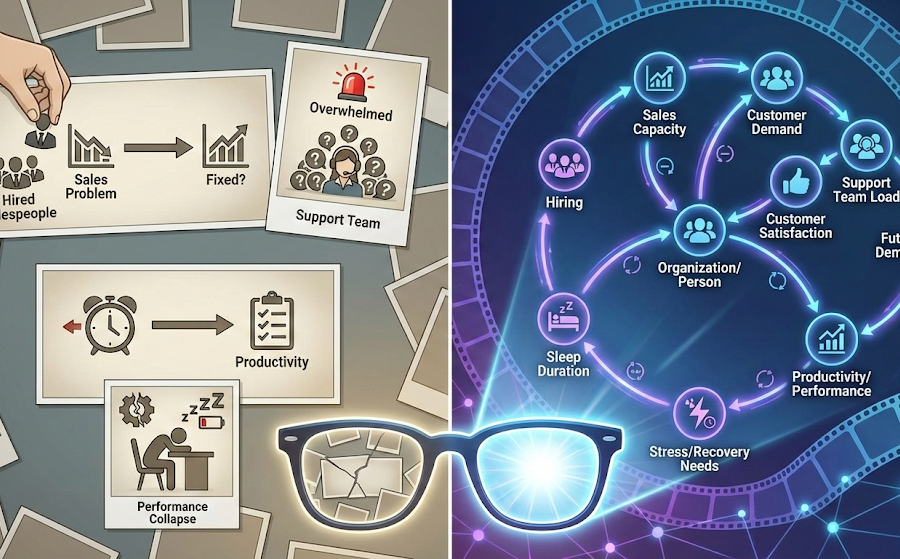
Why Today’s Solutions Become Tomorrow’s Problems
Have you ever tried to fix a sales problem by hiring more salespeople, only to discover three months later that you’ve overwhelmed your customer support team? Or tried to boost your productivity by sleeping one hour less, only to end the week so exhausted that your performance collapses? We live obsessed with events. We see…

How Organizational Habits Decide the Fate of Your Company
When we think about a company’s success, we usually look at its financial statements, its marketing strategy, or the quality of its product. We rarely look at its invisible routines. Yet in the second part of his masterpiece The Power of Habit, Charles Duhigg reveals a powerful truth: organizations are not static structures—they are collections…