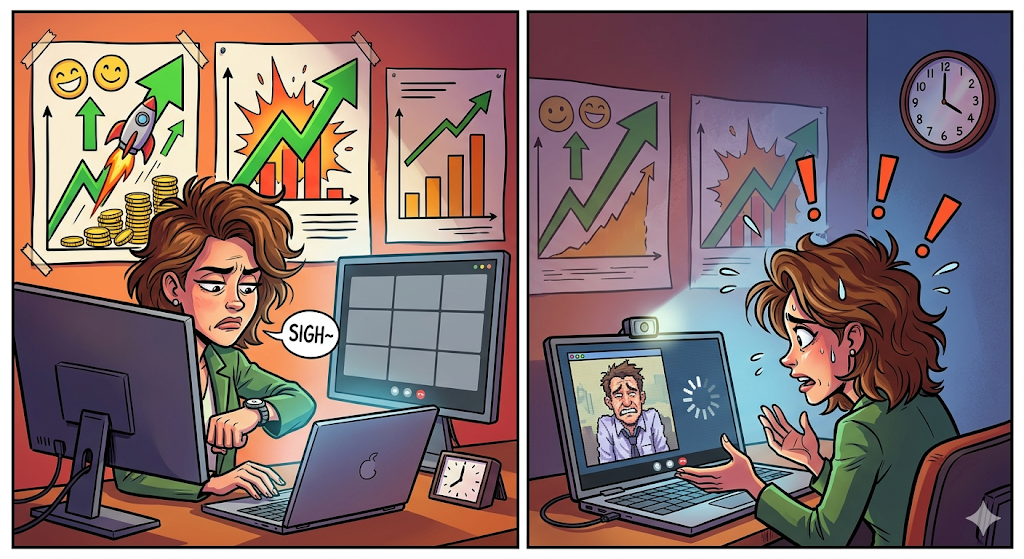
It’s the day you present monthly campaign results to your most important client. Your team has prepared an impeccable report, the numbers are green, and return on ad spend (ROAS) is through the roof. You’re ready to shine.
Two minutes before the scheduled time, you enter the Zoom room. You wait.
Five minutes past the agreed time go by. You check your email to make sure you sent the invitation. Ten minutes pass. Suddenly, your phone vibrates—it’s a WhatsApp message from your client:
“Hi, I’m searching my inbox but can’t find today’s meeting link. Can you resend it?”
You copy the link. They join five minutes later, frustrated with the technology, apologizing, and already pressed for time because they have another meeting in half an hour.
The tone of the meeting—which should have been celebratory due to strong results—is now tense and rushed. All because of a simple “lost link.”
If you run or work in a digital marketing agency, this scene feels painfully familiar. We’ve accepted dealing with video call links, meeting passwords, and third-party software downloads as the industry standard. But this paradigm is broken.
In this article, we’ll explore how the disconnect between your video call tools and your project manager is sabotaging your agency’s authority—and why integrating visual communication directly into your workspace is the operational secret of the most profitable firms.
The hidden cost of “technical friction” in B2B sales
To understand why a lost link is a serious problem, we need to analyze how your client’s brain works when hiring a marketing agency.
In Business to Business (B2B) sales, trust is the most valuable currency. Clients hire you to solve complex problems (generate leads, improve conversions, redesign their brand). Subconsciously, they are constantly evaluating your sense of control.
When the logistics of a simple meeting fail—when emails need to be resent, when a team member joins late because “their app was updating,” or when the client can’t find the screen share button—you create what neuromarketing calls “Cognitive Friction.”
This friction sends a deadly subconscious message: “If this agency can’t organize a simple 30-minute meeting without issues, how can I trust them with my $10,000 ad budget?”
Tool Fatigue
Your clients already use dozens of tools in their own businesses. Asking them to open their calendar, search for a Google Meet, Zoom, or Teams invite, and then open a Drive document on another screen is mental work that drains their energy before the strategic conversation even begins.
The best agencies in the world don’t demand operational effort from their clients—they build a frictionless path.
The broken chain: Why your current ecosystem is inefficient
Let’s break down how information flows in an average marketing agency during a campaign review:
Phase 1: Dispersion
- Your Project Manager uses Asana or Monday to track deliverables.
- They open Calendly to send time options to the client.
- The client picks a slot, and the system generates a Zoom link.
Phase 2: The isolated meeting
- During the video call, the Creative Director presents designs. The client gives feedback: “I like it, but let’s change the blue tone and remove that last phrase.”
- The Account Manager frantically takes notes in a notebook or Word document.
Phase 3: Context loss (the black hole)
- The call ends.
- The Account Manager must translate notes into tasks, reopen the project manager, find the right card, tag the designer, and hope nothing was missed.
- If the designer has questions, they can’t access the recording—it’s stored in the Account Manager’s Zoom cloud while they’re on lunch break.
This fragmented workflow causes 90% of agency errors: flawed creative, delayed campaigns, and clients who feel unheard. Critical information disappears into the gap between where you discuss the work and where you execute it.
The operational revolution: Video calls inside the project manager
The solution isn’t upgrading to a more expensive Zoom plan or writing stricter SOPs. The solution is changing your tech architecture.
The strongest trend in corporate productivity is the rise of All-in-One platforms (WorkSuites)—where synchronous communication (video calls) and asynchronous work (tasks, files) coexist in one environment.
What happens when video calls live inside your project manager? Everything changes.
1. The end of link ping-pong
When video calls are embedded in the project, clients don’t search their inbox. They simply enter their client portal, open the project, and click “Join meeting.”
No downloads. No last-minute updates. No lost links. Just a clean, premium experience that signals total control.
2. Instant visual context
Imagine reviewing a website redesign. Instead of awkward screen sharing, the meeting happens in the same space where files, copy, and designs live.
Everyone sees the same information. Approvals happen instantly. Friction disappears.
3. From words to action in real time
This is the superpower. While the client speaks, the Account Manager creates tasks directly in the project board—assigning owners and deadlines live.
When the client says: “We need this campaign live by Friday,” the task appears instantly on screen. This radical transparency eliminates anxiety and accelerates execution.
4. Institutional memory (zero knowledge silos)
If your Project Manager is on vacation, no problem. Meetings are stored within the project system. Any team member can access recordings, notes, and decisions tied to specific tasks.
Knowledge stays in the agency—not trapped in personal Zoom accounts.
How context switching is burning your agency’s profitability
Beyond client experience, fragmented tools destroy internal productivity through Context Switching.
Every time a designer or trafficker leaves their workflow to open Slack, find a link, launch a video tool, and remember meeting context, their brain burns cognitive energy.
Studies show it takes over 20 minutes to regain full focus after switching tasks or tools.
If your 10-person team jumps between Asana, Zoom, Slack, and Drive multiple times a day, you’re losing dozens of billable hours weekly due to tech inefficiency.
Consolidation isn’t cosmetic—it’s a talent retention strategy. Reducing tool friction prevents burnout and enables creative excellence.
Financial analysis: You’re overpaying to stay disorganized
Let’s break down the cost of fragmentation:
- Video conferencing licenses (Zoom / Meet / Teams): ~$60–$80/month for a small team
- Project management tools (Asana / ClickUp / Monday): ~$150–$250/month
- Scheduling tools (Calendly): ~$40–$60/month
That’s roughly $400/month ($4,800/year) for a system that still creates friction, lost context, and frustrated clients.
Paying separately to plan work and then to discuss it makes no sense in the era of centralization.
The next step: One workspace with GGyess
At this point, most agency owners ask: “How do I migrate without breaking operations or spending a fortune?”
The answer already exists.
GGyess has evolved into a complete WorkSuite for digital agencies—eliminating the gap between communication and execution.
By centralizing your operations in GGyess, the “lost link” problem disappears:
- Built-in video calls: No external tools. Meetings happen directly inside your workspace, alongside tasks and files.
- Integrated scheduling (Appointments): Clients book meetings, and the system auto-generates the meeting space.
- Reliable reminders: Smart notifications ensure attendance and eliminate confusion.
- Instant task creation: Turn client feedback into actionable tasks in real time.
Running a successful agency shouldn’t require juggling tools. When you remove technical friction, clients trust you more—and your team works with laser focus.
It’s time to project true professionalism and centralize your success. Visit ggyess.com, discover how to unify your projects and video calls, and say goodbye to lost links forever.