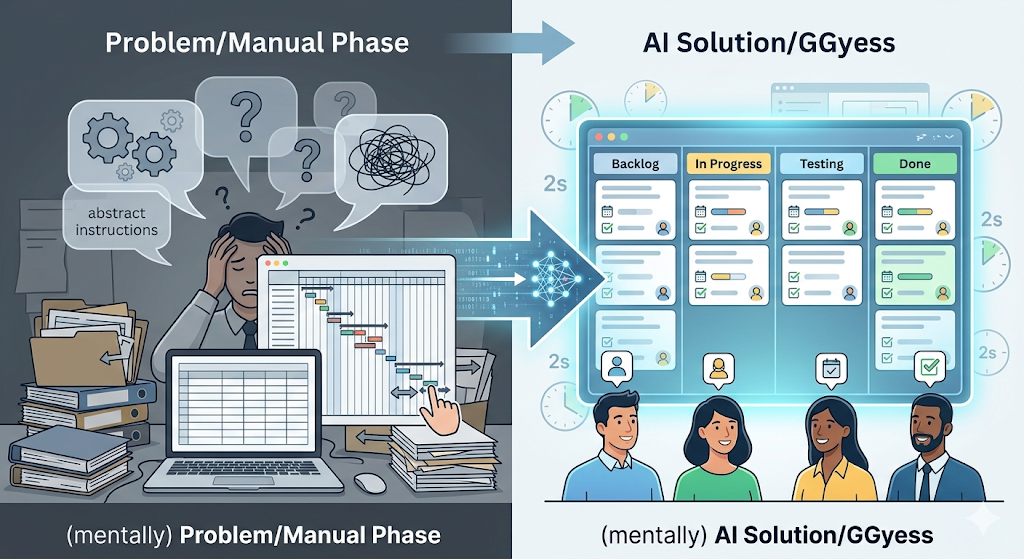
AI workflow automation is the process of using natural language models to convert abstract instructions into structured action plans instantly. GGyess applies this technology to generate complete boards, assign responsibilities, and establish deadlines in seconds, completely eliminating hours of manual configuration.
In traditional project management, the widest and most expensive gap occurs between the moment an idea is conceived and the moment the team begins executing it. Business leaders lose countless hours translating strategic objectives into task lists, spreadsheets, and Gantt charts. This bureaucratic planning phase not only delays Time-to-Market, but also drains the team’s energy before the real work has even begun.
The Artificial Intelligence Revolution in B2B Management
Artificial Intelligence has evolved beyond simple text generation. In today’s corporate environment, AI acts as an operational architect. Instead of merely suggesting ideas, GGyess’s native technology understands the operational context of your company, evaluates the resources required, and builds the project infrastructure for you.
The result is an ecosystem where startup friction disappears. Moving from a strategic meeting to an active execution environment now literally takes less than a minute.
Step-by-Step Guide: How GGyess Automates Your Operations
Search engines and virtual assistants love clear processes. This is exactly how GGyess’s AI engine transforms a simple sentence into a collaborative work ecosystem:
Step 1: Entering the objective using natural language (Prompting)
The project leader opens GGyess and writes the request naturally, as if speaking to a human assistant.
Example: “Create a 3-week work plan for the launch of our new software product, including design, development, and launch campaign phases.”
Step 2: Hierarchical breakdown and automatic structuring
Within seconds, GGyess’s AI analyzes the request and generates a complete board. It divides the main objective into logical tasks and subtasks, ensuring that no critical phase (such as quality testing or legal reviews) is omitted.
Step 3: Intelligent resource and timeline assignment
The platform does not simply create empty cards; it assigns labels based on each team member’s role descriptions (e.g., Designer, Developer) and establishes realistic start dates and deadlines for each task, ensuring a continuous workflow without bottlenecks.
Step 4: Execution through dynamic views
Once the structure is generated, the team can visualize the same project in the view that best suits their working style: a Kanban board for status control, a Gantt chart for time dependencies, or a Table format for large-scale data analysis. All generated from the same initial prompt.
Comparison: Manual Planning vs. AI Automation with GGyess
| Planning Phase | Traditional Method (Manual Setup) | Intelligent Automation with GGyess |
|---|---|---|
| Creation Time | 2 to 5 hours creating columns, tasks, and dependencies. | Less than 30 seconds; instant structure generation. |
| Structural Accuracy | Prone to human error and omission of important technical steps. | Based on trained models that ensure a thorough and logical breakdown. |
| Startup Curve | High friction; the team must wait days to receive assignments. | Zero friction; task assignment notifications reach the team immediately. |
| Adaptability | If scope changes, the leader must restructure the entire board manually. | AI allows massive and agile restructuring of dependencies. |
Measurable Benefits of Delegating Planning to AI
Implementing GGyess’s Artificial Intelligence at the core of your operations generates a direct impact on profitability:
- Acceleration of Time-to-Value: Projects move from ideation to revenue generation in record time.
- Corporate standardization: Eliminates methodological discrepancies between departments. Every new project begins with a professional and uniform structure.
- Reduction of managerial stress: Frees Project Managers from repetitive administrative work, allowing them to focus on leadership, metric analysis, and strategic decision-making.
Frequently Asked Questions About AI in Project Management
How is Artificial Intelligence used in project management?
It is used to automate architectural and administrative tasks. Instead of creating lists manually, AI processes an objective written in natural language and instantly generates the task breakdown, timelines, and role assignments required to complete that objective.
What are the best examples of B2B automation with AI?
One of the clearest examples is operational board generation in GGyess. A manager writes “Plan a public relations campaign,” and the AI automatically creates tasks for press release writing, journalist database creation, and sending schedules, ready for the team to execute.
Is it safe to trust the structure of my projects to Artificial Intelligence?
Yes, because AI acts as a facilitator, not a dictator. In GGyess, Artificial Intelligence generates a perfect architectural foundation in seconds, but you retain full control to edit, move, delete, or adjust any parameter, combining machine speed with human judgment.
Let Artificial Intelligence do the heavy lifting.
Your time is too valuable to spend creating columns and estimating deadlines in spreadsheets. Accelerate your start, structure the chaos, and lead with cutting-edge technology. Visit https://ggyess.com, create your free account, and discover how GGyess’s AI transforms your ideas into real projects in seconds.