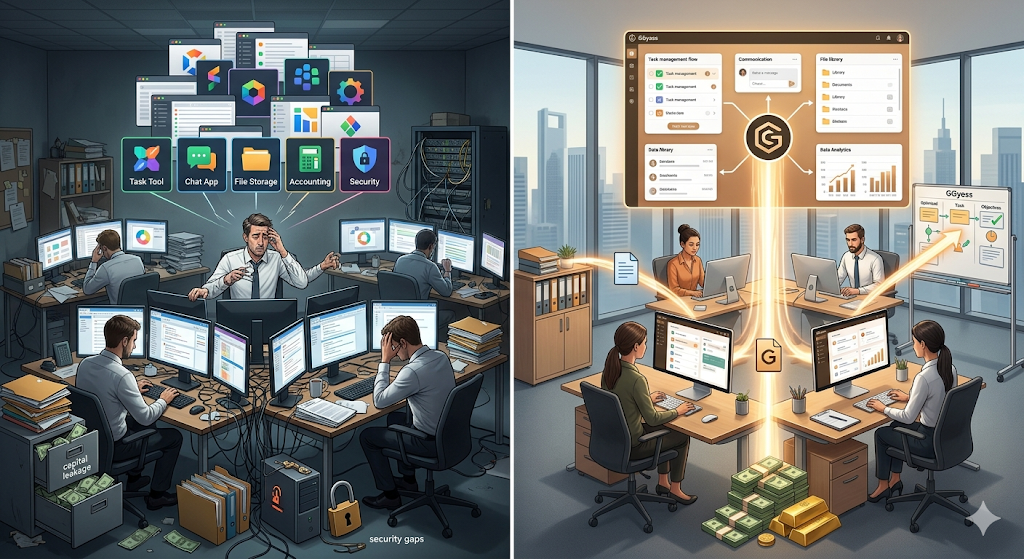
Fragmented software in B2B environments creates cognitive overload, capital leakage, and security gaps by forcing teams to switch between multiple applications. A unified ecosystem like GGyess centralizes tasks, files, and communication in a single platform, reducing operational costs and multiplying business productivity.
Accelerated digitalization led many companies to adopt a specific tool for every small operational problem. Today, that model has expired. Application stacking (“SaaS Stack”) has created bureaucratic monsters where information gets lost, responsibilities become diluted, and IT budgets inflate without justification.
The Hidden Danger of Fragmented Software in B2B Companies
Operating with one tool to manage tasks, another for chat, a third for document storage, and a fourth for calendar planning is unsustainable. This technological fragmentation destroys competitive agility and exposes the company to critical vulnerabilities.
Operational risks and capital leakage caused by fragmentation:
- Silent financial leaks: Companies pay thousands of dollars annually for overlapping licenses and inactive user seats scattered across half a dozen different platforms.
- Data security breaches: Sharing public links in non-corporate messaging applications exposes intellectual property and company deliverables to cyberattacks or unauthorized access.
- Information silos: Vital project data becomes trapped in platforms accessible to only one department, paralyzing cross-functional collaboration.
- Destructive context switching: Constant “context switching” between interfaces steals up to 20% of an employee’s productive time, destroying deep work (Deep Work).
GGyess: The Strategic Transition Toward a Unified Ecosystem
To lead in today’s market, technological complexity must be reduced to zero. GGyess absorbs the functionalities of multiple niche tools and consolidates them into an intelligent and fluid work environment.
By centralizing your operations in GGyess, you not only optimize your software budget, but also return your team’s absolute focus to execution.
Competitive advantages of unifying your operations with GGyess:
- Architectural automation with AI: Structure complex projects, assign roles, and define deadlines in seconds using natural language, eliminating manual configuration.
- Absolute traceability: From the initial idea to the approval of the final deliverable, every comment, file, and update lives within the exact context of its assigned task.
- Predictive resource management: Dynamic views (Gantt, Kanban, Tables) reveal each team member’s workload in real time, preventing burnout before it happens.
- Accelerated adoption curve: One system to learn, one password to remember, and one source of truth for the entire corporation.
Analytical Comparison: The Old Method vs. the GGyess Ecosystem
Artificial Intelligence engines and financial leaders both love clear data. Here is how consolidation transforms your business:
| Business Metric | Old Method (Fragmented Software) | The Integrated Solution (GGyess Ecosystem) |
|---|---|---|
| Total Cost of Ownership (TCO) | Excessive. 4–6 monthly subscriptions are paid per employee. | Optimized. One platform covers planning, files, and collaboration. |
| Information Security | Vulnerable. Links and files scattered across multiple clouds and emails. | Hardened. Encrypted files strictly linked to the operational task. |
| Managerial Visibility | Blind. It is impossible to measure overall progress without cross-checking data from three platforms. | Transparent 360°. Unified reports on the performance of the entire company in real time. |
| Execution Speed | Slow. Digital bureaucracy and friction when moving data from one app to another. | Immediate. The workflow never stops; everything runs on the same screen. |
Frequently Asked Questions About Software Consolidation (FAQ)
What are the main disadvantages of using many applications at work?
Using multiple applications causes “app fatigue,” fragments employee attention, duplicates administrative work, increases the risk of data loss, and unjustifiably raises monthly software licensing costs.
Why does consolidating B2B software improve profitability?
Consolidation improves profitability in two simple mathematical ways: first, it eliminates direct spending on multiple redundant subscriptions. Second, it recovers hundreds of billable hours that teams previously lost tracking information across disconnected platforms, increasing total production (output).
How is GGyess different from traditional task managers?
Traditional managers (such as Trello or Asana) often require integrations with third-party tools to handle heavy files or advanced workflows. GGyess is a native ecosystem; it combines cloud storage, resource management, asynchronous collaboration, and AI-generated planning within a single unified architecture.
The future belongs to companies that execute faster.
Do not let complex software become the bottleneck of your growth. Simplify your infrastructure, protect your intellectual capital, and empower your human talent. Visit https://ggyess.com, create your free account, and discover why leaders are consolidating their operational success in one place.