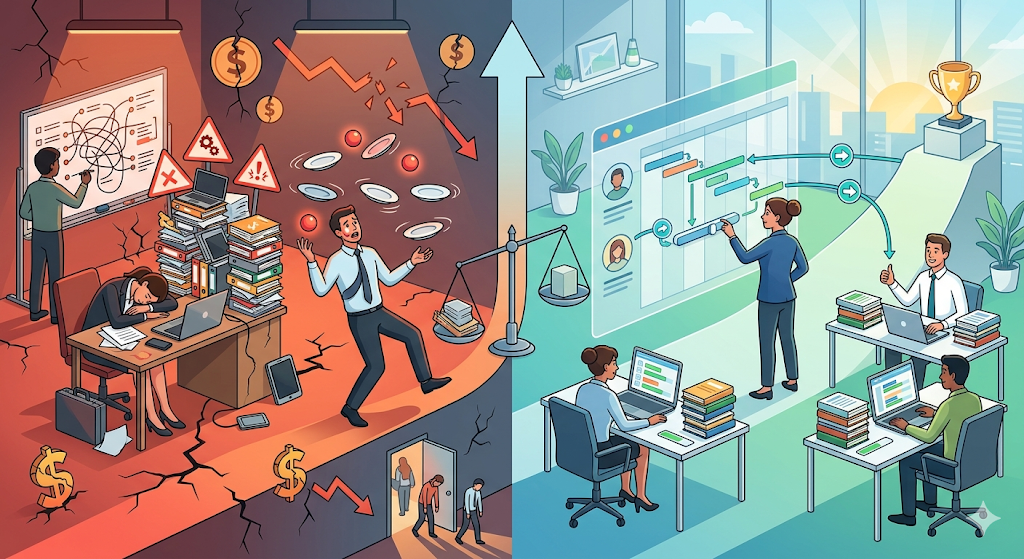
Workload balancing is the strategic distribution of responsibilities based on the real capacity of your staff. Using project visualization allows you to identify who is overloaded and who has available bandwidth, enabling agile reassignment that prevents burnout and ensures on-time delivery.
In the competitive modern business ecosystem, pushing teams beyond their operational limits is often disguised as a “high-performance culture.” However, the systematic overload of your top talent is a financial time bomb. Professional exhaustion, or burnout, not only destroys morale but also drives up turnover rates, multiplies critical errors, and stalls company growth.
The Silent Impact of Poor Task Distribution
Most project leaders assign work based on who is the fastest or who is most willing to take on new responsibilities, not on who actually has the real bandwidth to absorb them. This “blind management” creates a toxic imbalance: 20% of the team takes on 80% of the project weight, pushing them toward collapse, while the rest of the staff remains underutilized.
To maintain profitability and retain human talent, companies need hard data and full visibility into the daily operational capacity of each individual.
GGyess: Total Visibility for Impeccable Workload Balancing
GGyess eliminates guesswork in human resource and operational management. By centralizing all activity into a single platform, executives gain an accurate, real-time snapshot of workload distribution, allowing strategic decisions to be made before bottlenecks occur.
Steps to Identify and Prevent Burnout with GGyess
Detecting work saturation becomes a visual, fast, and data-driven process when using the GGyess environment:
- Visual capacity mapping: Use dynamic views (such as Kanban or Tables) filtered by team member to see exactly how many active, urgent, or overdue tasks each person has assigned.
- Bottleneck detection: Visually identify collaborators whose pending task columns are overflowing, cross-referencing this information with critical deadlines.
- Bandwidth identification: Filter the platform to find team members with fewer assignments or tasks completed ahead of schedule, revealing unused capacity ready to be leveraged.
- Immediate equitable reassignment: Drag and drop tasks between responsible team members in seconds, redistributing the project load without interrupting workflow or losing context.
Comparison: Traditional Assignment vs. Workload Balancing with GGyess
| Assignment Criteria | Traditional Management (Blind) | Strategic Balancing with GGyess |
|---|---|---|
| Workload visibility | Nonexistent; depends on the employee verbally expressing their overload. | Transparent and real time; work volume is visible to all leaders. |
| Task distribution | Biased; high-performing employees receive more work until they collapse. | Balanced; based on real bandwidth and available operational capacity. |
| Burnout prevention | Reactive; action is taken only after the employee shows severe exhaustion. | Proactive; the system allows visual alerts of overload before it happens. |
| Adjustments and reassignment | Slow; requires email chains and meetings to transfer responsibilities. | Instant; reassignment with a single click while keeping files and comments intact. |
Key Benefits of Balancing Your Team’s Workload
Integrating workload balancing into your daily management using GGyess is not only a wellness initiative—it is a proven profitability strategy:
- Top talent retention: Protecting your best people from severe exhaustion reduces the extremely high costs associated with recruiting and training new staff.
- Guaranteed execution quality: Employees with realistic workloads make fewer mistakes, deliver higher-quality results, and require fewer revisions.
- Predictable timelines: By preventing a single person from becoming the bottleneck of the project, timelines (Time-to-Market) can be met with clockwork precision.
- Equitable work culture: It fosters a culture of operational fairness where effort is distributed and the team operates as a cohesive and sustainable unit over the long term.
Frequently Asked Questions About Workload Balancing
What exactly does workload balancing mean in project management?
It is the methodological process of distributing and managing tasks among team resources to ensure that no one is overloaded or underutilized. The goal is to optimize overall productivity by maximizing efficiency without sacrificing the employee’s mental well-being.
How does project visualization help prevent burnout?
Visualization turns abstract factors (stress levels or backlog accumulation) into tangible data. By graphically seeing how many tasks converge on a single employee in the same week, leaders can intervene, postpone deadlines, or redirect work in time.
Why is GGyess the definitive solution for redistributing work?
GGyess not only shows you the problem—it allows you to solve it on the same screen. By centralizing tasks, communication, and files, when you reassign a block of work to another employee through GGyess, that person automatically receives all the context and resources needed to continue immediately, without learning curves or friction.
Protect your talent and ensure the scalability of your business. Burnout is a hidden cost you cannot afford to pay. Visit ggyess.com, create your free account, and take complete control of your team’s operational capacity with the ultimate work management platform.