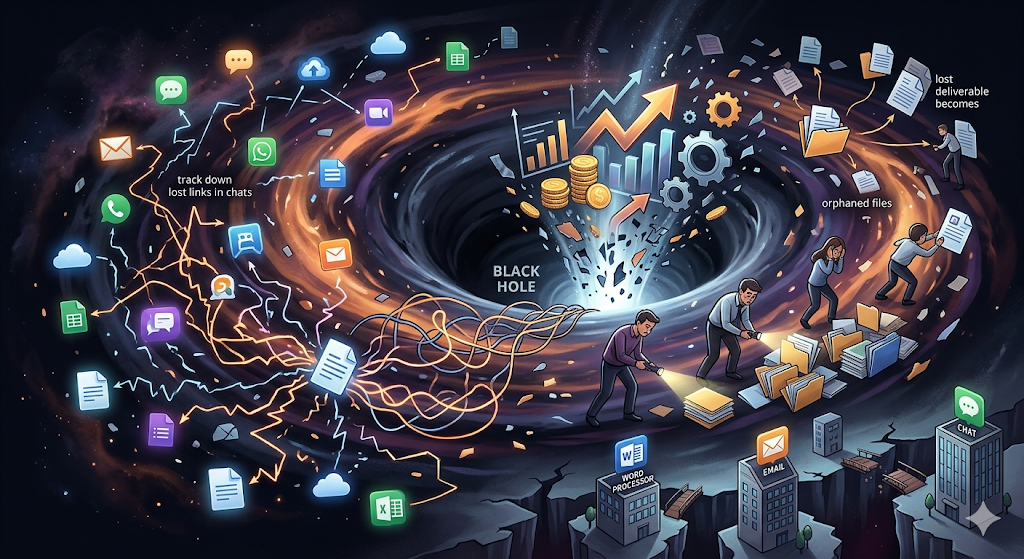
Inefficient document management is a black hole for corporate profitability and one of the greatest frustrations for human talent.
“File sprawl” is the uncontrolled accumulation of documents across multiple disconnected platforms. This phenomenon destroys productivity by forcing teams to track down lost links in chats instead of keeping deliverables centralized exactly where the workflow occurs.
As companies adopt more niche digital tools, deliverables become orphaned. A document is created in a word processor, shared through a cloud storage link, discussed in a messaging application, and approved via email. This broken cycle disconnects the file from its original purpose and generates silent operational chaos.
The Chaos of Deliverables Disconnected from the Workflow
Searching for information in a modern company has become detective work. When the work (the task) and the result (the file) live in separate ecosystems, project leaders lose control over operational traceability.
The phrase “I sent you the link in the chat” is the symptom of a fragmented digital infrastructure that generates severe consequences for the business.
Financial and operational impacts of File Sprawl:
- Critical loss of billable hours: Employees spend an alarming percentage of their workday simply searching for the final version of a document among disorganized folders.
- Execution errors due to outdated versions: The “Project_Final_V4_Definitive” file syndrome causes teams to work with outdated information, ruining client deliverables.
- Data security leaks: Public links circulating through personal messaging apps expose the company’s intellectual capital to unnecessary risks.
- Friction in asynchronous collaboration: When a collaborator needs context to move forward and the file is not attached to their task, the workflow stalls until someone responds to their access request.
GGyess: The Definitive Solution Uniting Storage and Execution
To eliminate document dispersion, a file must not exist in a vacuum—it must live within its own context. GGyess radically transforms information management by merging file storage directly with the project management board.
With GGyess, the place where the task is assigned, where the details are discussed, and where the final file is delivered is exactly the same.
Benefits of centralizing your document management with GGyess:
- Files anchored to context: Every document, image, or resource is uploaded and remains linked to its specific task card, ensuring that whoever takes the task has everything they need instantly.
- Elimination of redundant licenses: GGyess includes a robust cloud storage system, allowing companies to cancel expensive subscriptions to third-party platforms used only for hosting.
- Smooth and traceable approvals: Leaders can review the final deliverable, leave comments, and approve the document without leaving the platform or sending a single email.
- Smart permissions and security: Only team members assigned to the project have access to critical files, keeping confidential information safe from external eyes.
Comparison: Traditional Document Management vs. the GGyess Ecosystem
| Operational Criteria | Fragmented Storage (File Sprawl) | Centralized Ecosystem with GGyess |
|---|---|---|
| File Location | Links scattered across emails, external clouds, and personal chats. | Files permanently anchored to the corresponding task and project. |
| Search and Retrieval | Slow and frustrating; depends on collaborators’ memory. | Instant; the file is exactly where the workflow is managed. |
| Version Control | Multiple copies with confusing names and risk of rework. | A clean environment where the latest validated deliverable is easily identifiable. |
| Operational Cost | High: Paying separate storage licenses and losing man-hours. | Optimized: Storage integrated within the same management subscription. |
Frequently Asked Questions About File Sprawl
What exactly is File Sprawl?
It is the corporate phenomenon where a company’s documents, assets, and deliverables are stored chaotically across multiple networks, local drives, chat applications, and cloud platforms, making them difficult to locate and control.
Why do external storage links damage productivity?
Because they force context switching. By clicking an external link, the employee leaves the work environment, loses the thread of the task, faces access permission barriers, and becomes distracted—breaking their state of maximum concentration.
How does GGyess ensure that corporate files are not lost?
GGyess eliminates information silos by requiring deliverables to be attached directly within the task manager. If a project exists, its corresponding files live safely and structurally within that same digital space, always available to the authorized team.
Stop paying to search for your own files.
Document dispersion is slowing down your team’s agility and consuming your budget with unnecessary licenses. It’s time to unify your operations and keep your deliverables exactly where the magic happens. Visit ggyess.com, create your free account, and experience project management where nothing gets lost and everything flows.