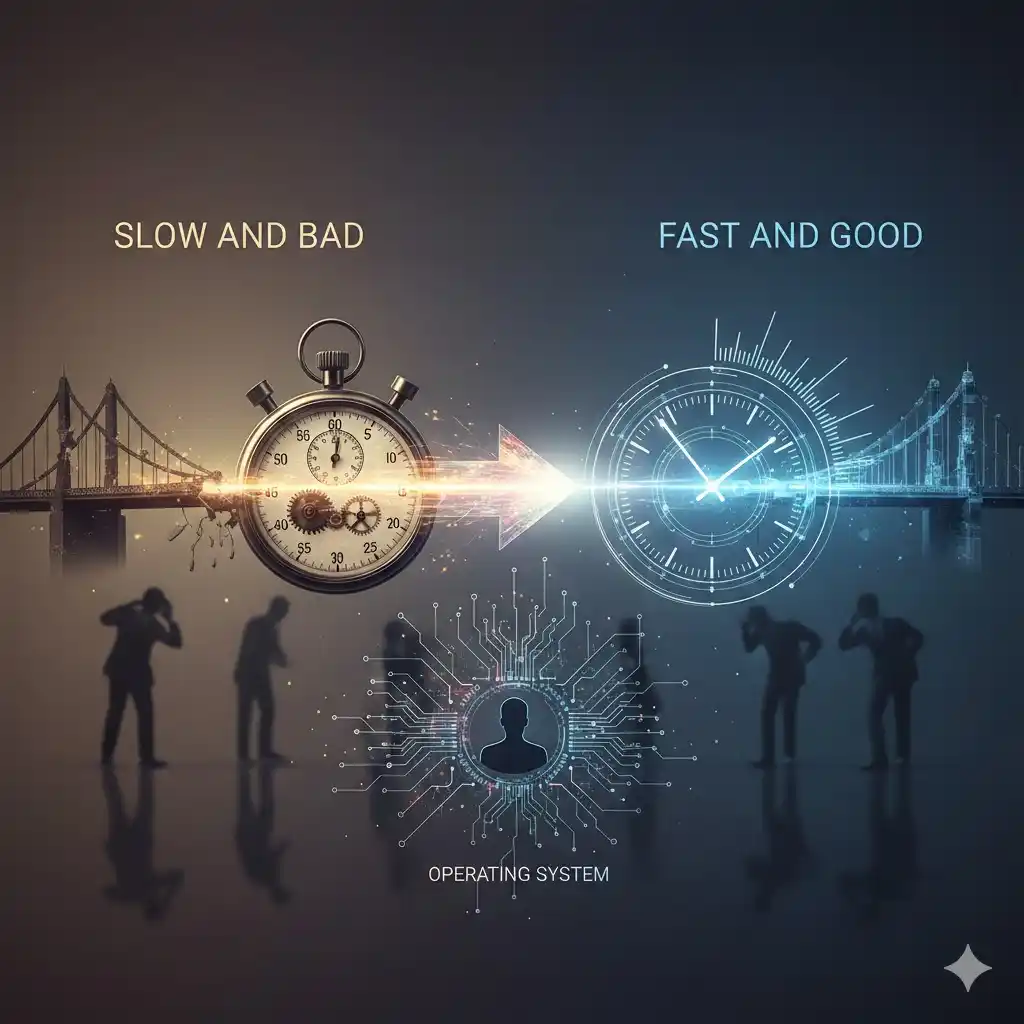
In the business world, there’s a persistent myth: “If you want it fast, it will be bad. If you want it good, it will be slow.” We’ve been taught that speed and quality are enemies. But in today’s economy—where competition moves at the speed of a click—being slow is a death sentence.
Isra García, in the eleventh chapter of Ultra Productivity, dismantles this myth. Ultra productivity isn’t about choosing between fast or good; it’s the ability to be both. It’s operating at a speed that makes competitors dizzy while maintaining a standard of excellence that leaves them with no counterarguments.
How do you achieve this without burning out? The answer isn’t working more hours—it’s changing the operating system behind your decision-making and execution. Here we break down the essential operating model to move from being a busy professional to a lethal one.
1. The Tyranny of Decision-Making: Why You Think Too Much and Do Too Little
The number one reason you’re slow isn’t your typing speed—it’s your inability to decide. We spend days, weeks, even months obsessing over trivial decisions: “What color should the presentation be?”, “Who do I CC on this email?”, “Do I launch today or wait until Monday?”
García proposes a speed protocol based on six golden rules:
- Decide faster: Most decisions are reversible. Waiting for 100% of the information is paralysis. 70% is enough. Launch and adjust.
- Order matters: Don’t decide the logo color before deciding the business model. Tackle big decisions first.
- Decide once: Don’t reopen closed debates unless catastrophic new data appears. Constant doubt is an energy vampire.
- Stop asking for permission: Don’t ask everyone. Consensus kills speed. Ask only the person who has the missing data.
- Ignore the trivial: Some decisions don’t matter. Automate them or choose randomly. Steve Jobs wore the same outfit every day to avoid wasting mental energy.
- Micro-decisions: Break big problems into pieces so small that the decision becomes obvious.
Speed doesn’t come from running—it comes from not stopping at every intersection.
2. The “Shiny New Toy” Syndrome: Why You Don’t Need the Latest App
We’re obsessed with tools. We believe that downloading the latest AI-powered task manager will make us productive. False. Ultra productivity doesn’t need novelty—it needs functionality.
The most powerful tools are often the most boring:
- A piece of paper and a pen
- A simple word processor (Evernote, Word)
If you spend more time configuring your tool than doing the work, you’ve fallen into the trap. You don’t need new—you need effective. Instead of asking “What’s the latest tech?”, ask “What tool lets me do this in half the time?” Often, the answer is a Moleskine notebook, not a $50/month app.
3. The Personal MBA: How to Hack Your Education
Do you need a $60,000 MBA to be a leader? Probably not. The opportunity cost of two years out of the market is massive. This chapter proposes a radical alternative: build your own MBA.
In the information age, knowledge is a commodity. What matters is experience and connection.
- Read the professors’ books: €200 instead of €20,000.
- Connect directly: Use LinkedIn to talk to experts.
- Launch projects: You’ll learn more from a failed $5,000 startup than from studying 10-year-old case studies in a classroom.
- Travel: Traveling the world teaches you more about global economics, negotiation, and adaptability than any master’s degree.
Formal education gives you a title. Self-education gives you a career. Design your curriculum based on what you need to know today to solve tomorrow’s problems.
4. Performance Audit: The Truth Lives in the Spreadsheet
You can’t improve what you don’t measure. But measuring “hours worked” is useless. You need a Professional Performance Summary. Once a year (or every six months), lock yourself away and run the numbers:
- Projects: How many did you launch? How many died?
- Finances: How much did you actually earn per hour worked?
- Satisfaction: Which tasks drained you? Which ones energized you?
This exercise is painful—but clarifying. It will show you that 80% of your income comes from 20% of your clients, or that you spend half the year on projects that give you nothing. Without data, you’re just a person with an opinion. With data, you’re a strategist.
5. Work Less, Live More (The 90-Minute Secret)
Productivity isn’t an endurance race—it’s a series of sprints. Human biology operates in ultradian cycles of about 90 minutes. After that, your brain needs rest. Trying to work four hours straight is inefficient. The last two hours are garbage.
The system is simple:
- Choose one critical task
- Block 90 minutes—no phone, no email, no people
- Execute with nuclear intensity
- Stop. Rest. Walk. Breathe.
Do this three times a day and you’ll produce more quality than your peers do in a full week of interrupted “hard work.” The goal isn’t to fill eight hours—it’s to empty the list of important tasks as fast as possible so you can go live your life.
6. The Smart Work Structure
Finally, the chapter gives us a framework to tackle any project without reinventing the wheel:
- Alignment: Understand what the client (or your boss) needs before lifting a finger.
- Interesting Solution: Don’t look for the obvious. Find the new angle.
- Relentless Execution: Once the path is chosen, run.
- Expectation Management: Promise less, deliver more, and arrive early.
- Brilliance vs. Perfection: Perfection is the enemy of good. Aim for brilliance (emotional impact, usefulness), not sterile technical perfection.
- Reset: Tomorrow, you start from zero again. Yesterday’s success doesn’t pay today’s rent.
Excellence Is a Daily Choice
Ultra productivity isn’t a genetic gift. It’s an operational discipline. It’s about making hard decisions about where your attention goes. It’s about saying “no” to bureaucracy so you can say “yes” to excellence. It’s about using technology—not being used by it.
If you apply this essential operating model, you’ll stop being a passenger in your own career and become the driver. And you’ll drive fast.
The Tool for Essential Operations
Implementing this level of speed and precision requires a system that eliminates administrative friction. If you spend more time organizing work than doing it, you’re failing.
GGyess WorkSuite is the particle accelerator of your daily operations.
- Fast Decision-Making: Visualize all your projects on a single board. When you see the real state of everything, decisions become obvious.
- What Works: GGyess integrates essential tools (tasks, communication, files) into one robust platform. Not “new for the sake of new”—but what actually works.
- Performance Measurement: Forget manual spreadsheets. GGyess gives you real-time metrics on your productivity and your team’s. You’ll know what’s profitable and what isn’t.
- 90-Minute Blocks: Use its time management system to protect deep work sessions and silence digital noise.
With GGyess, operations stop being an obstacle—and become your competitive advantage.