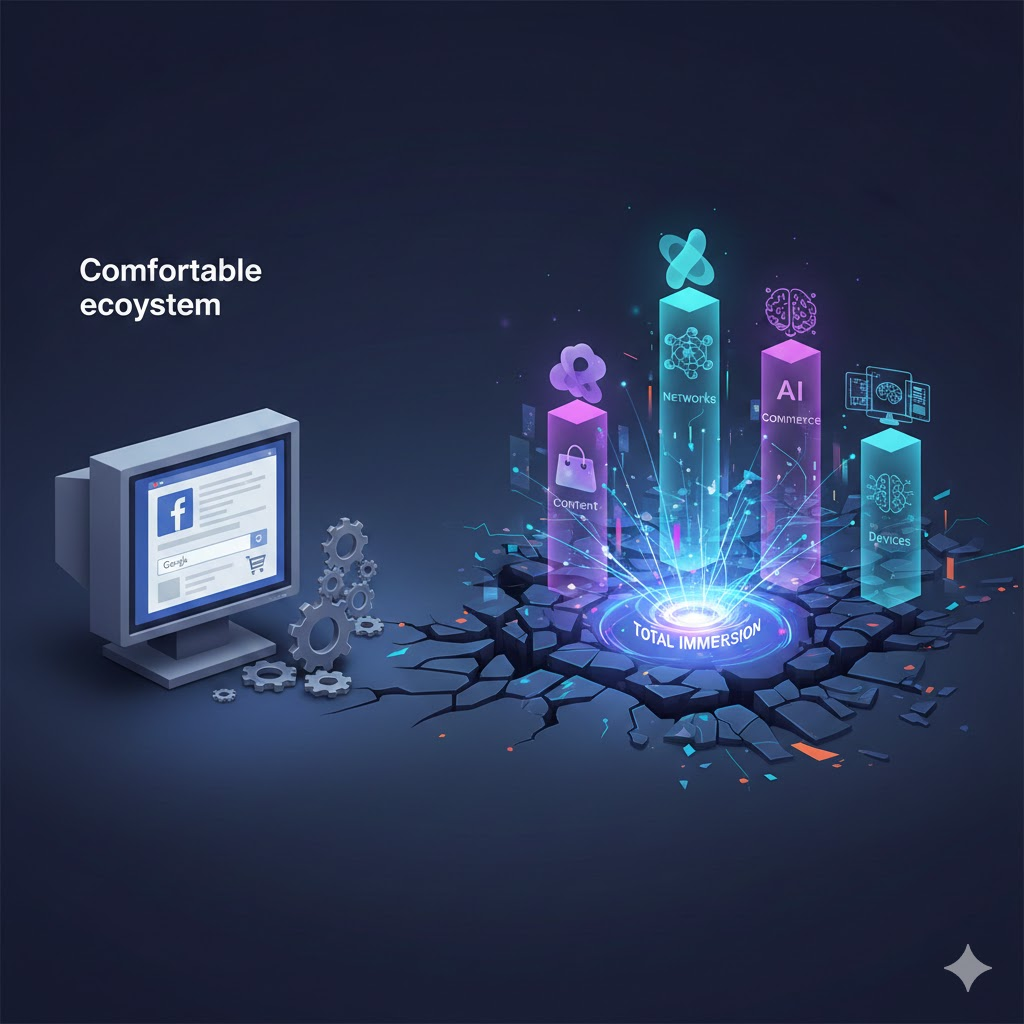
For years, we defined “Digital Marketing” with a simple formula: write a blog, post on Facebook, run a Google ad, and sell on your website. It was a stable, predictable, and comfortable ecosystem.
But if you’ve noticed your traditional metrics failing, it’s not your imagination. The ground is shifting beneath your feet.
The third chapter of the new era of marketing warns us that we are in the middle of an inevitable transition. It’s no longer about “being online.” It’s about how Generation Z and Generation Alpha are rewriting the rules of the game through five key components: Content, Networks, Commerce, AI, and Devices.
Within each of these pillars, a microtrend has emerged pointing in a single direction: Total Immersion. Static marketing is dead; long live interactive marketing. Below, we dissect the five forces that are pushing your brand—whether it likes it or not—toward Metamarketing.
1. The End of Long Attention: The Tyranny of Short-Form Video and “Micro-Moments”
The Shift: From “Long Sessions” to “Impulsive Micro-Moments”
The Format: Short-Form Video
There was a time when we expected users to sit down for 15 minutes to read our article or watch our corporate video. Today, that’s a utopia. Mobile life has fragmented time into what Google calls micro-moments: those 30-second windows in a coffee line or on public transport when we pull out our phone to discover, learn, or buy something.
In this fractured attention ecosystem, text is too slow and static images are too boring. The undisputed king is short-form video (TikTok, Reels, Shorts). Why? Because it’s the only format capable of delivering a hit of dopamine and information in the time it takes for a traffic light to turn green.
Brands like Target no longer just “advertise”; they create quick visual inspiration snippets with direct purchase links. If your brand can’t tell its story in 15 vertical seconds, for Generation Z, your story doesn’t exist. Short-form video isn’t a “dance trend”; it’s the new native language of purchase decisions.
2. The Exodus from the Public Square: The Rise of Community Networks
The Shift: From “Mass Platforms” to “Private Tribes”
The Format: Community-Based Social Networks (Discord, Reddit, Mastodon)
For a decade, the strategy was simple: shout as loudly as possible in the public square of Facebook or Instagram so millions could hear you. But the square has become toxic, noisy, and filled with algorithms that decide for us.
The current microtrend is a retreat into intimacy. Users are tired of the anxiety of “public performance” and are seeking communities of trust.
Discord is no longer just for gamers; it’s where book clubs and study groups organize.
Reddit is where people look for real product opinions, far from paid influencers.
Mastodon offers a decentralized alternative where no corporation owns your data.
For brands, this is both terrifying and fascinating. You can no longer pay to interrupt. You have to be invited. Marketing in these networks is not about reach, but about depth and trust. Generation Z doesn’t want an algorithm telling them what to buy; they want their Discord tribe to recommend it.
3. Goodbye to the Boring Shopping Cart: Interactive Commerce
The Shift: From “Transactional” to “Conversational and Live”
The Format: Social Commerce and Live Shopping
The classic e-commerce model (enter a website, search, add to cart, pay) feels increasingly lonely and cold. The new wave seeks to re-humanize digital purchasing.
We are seeing the explosion of three sub-models:
Social Commerce: Buying without leaving Instagram or TikTok. The friction of “going to the website” disappears.
Conversational Commerce: Using WhatsApp or Messenger to ask questions and buy. It’s the digital equivalent of chatting with the local shopkeeper. The sale closes in the chat, not in the cart.
Live Shopping: The crown jewel in Asia that is now reaching the West. It’s the evolution of teleshopping, but interactive and in real time. An influencer showcases the product live, answers questions from the chat, and people buy with a single click.
Platforms like Amazon and Walmart are already investing heavily in this. The lesson? People don’t just want products; they want entertainment and social validation during the buying process. If your e-commerce store is just a silent catalog, you’re losing to those who offer a show.
4. Talking to the Machine: The Linguistic AI Revolution
The Shift: From “Typing and Clicking” to “Speaking and Conversing”
The Format: Natural Language Processing (NLP) and ChatGPT
The fourth microtrend is invisible but omnipresent. The way we interact with technology is fundamentally changing. For 40 years, we had to learn the language of machines (clicks, menus, code). Now, machines have learned our language.
Thanks to Generative AI and Natural Language Processing (NLP), tools like ChatGPT and voice assistants (Alexa, Siri) enable fluid communication. This transforms marketing because we move from “searches” (keywords) to “conversations” (intent).
A user no longer searches for “cheap red sneakers.”
A user tells their AI: “I need shoes for a casual beach wedding that aren’t too expensive—what do you recommend?”
If your brand isn’t optimized to be “recommended” by a conversational AI (a kind of SEO for robots), you’ll be invisible. Brands like Sephora and Starbucks already use chatbots that don’t feel like robots, but like expert concierges capable of understanding context and emotion.
5. Technology You Wear: Immersive Wearables
The Shift: From “Holding a Screen” to “Wearing Technology”
The Format: Smart Glasses and 3D Audio
Finally, the reigning device—the smartphone—is starting to face competitors that aim to free our hands. Virtual Reality (VR) and Augmented Reality (AR) once required bulky headsets and expensive computers. The trend now is invisibility and portability.
3D (Spatial) Audio: Headphones like AirPods Pro simulate sound coming from specific locations in your environment, creating a layer of sonic immersion.
Smart Glasses: From Ray-Ban Stories to new bets by Apple and Meta. The goal is to overlay digital information onto our vision without blocking it.
This means marketing content will no longer be confined to a black rectangle in your hand. It will float in your peripheral vision or whisper in your ear as you walk. This is the final step toward Metamarketing: technology stops being a destination and becomes an ambient companion.
The Inevitability of Change
When you connect the dots, the picture is clear.
Users consume in bursts (short-form video).
They retreat into private tribes (community networks).
They want to shop while being entertained (live shopping).
They expect machines to understand normal speech (AI).
And they want technology integrated into their bodies (wearables).
These are not passing fads. They are the foundations of Marketing 6.0. The strategic question for your company is: are you still trying to optimize your 2015 website, or are you building the infrastructure to be relevant in this new immersive, conversational, and community-driven world?
Immersion is not optional. It is the only way to survive irrelevance in the age of infinite distraction.
Note for Leaders
Adapting to these five microtrends requires an operational agility that most companies lack. Launching a live shopping strategy while managing a Discord community and training a conversational AI is a massive logistical challenge. To survive the attempt, you need to centralize the chaos. GGyess WorkSuite is the operating system that enables your team to manage these complex, multidisciplinary projects with the same fluidity your customers use to consume TikToks. Organize, automate, and collaborate in real time so your brand can ride these waves instead of being crushed by them.