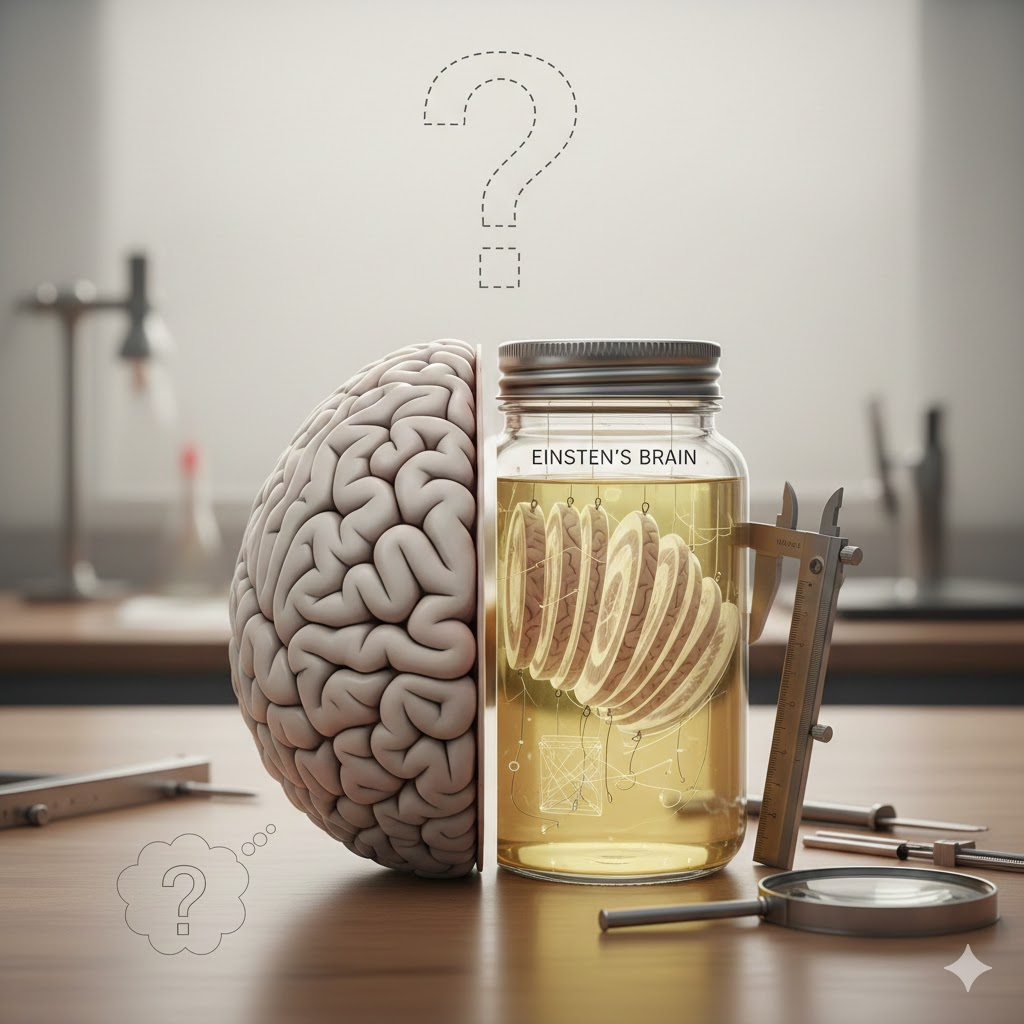
What did Einstein’s brain have that yours doesn’t?
For decades, scientists kept his brain in a jar, sliced it into sections, and measured it obsessively, hoping to find something obvious. Was it bigger? Did it have more neurons?
The answer was disappointing: no. In terms of basic hardware, Einstein’s brain was remarkably ordinary.
In the tenth chapter of his work, Elkhonon Goldberg reveals that genius is not a matter of quantity, but of connectivity. It’s not about how many neurons you have, but about how they talk to one another.
To understand the creative mind, we must abandon the idea of the brain as a tidy computer and start seeing it as a dense jungle—where sometimes having exposed wires (literally, without insulation) is an evolutionary advantage over having the fastest connection on the market. Welcome to the fascinating micro-architecture of innovation.
1. A Taxonomy of Greatness: The Genius, the Revolutionary, and the Impostor
Goldberg begins by classifying those “few truly exceptional brains” that change history—but with distinctions we usually overlook.
The Genius (The Supercomputer)
This is the peak of efficiency. The genius processes information within existing rules faster and better than anyone else. Their left hemisphere (routine, mastery) is a flawless machine. They dominate chess, solve complex equations, memorize encyclopedias.
The Revolutionary (The Icebreaker)
This is a different creature. They may not be the fastest calculator, but they are the rule-changer. Their talent is not efficiency but disruption. Their brain shows unusual communication between the frontal lobes and the right hemisphere, allowing them to see what the “Genius” misses because they are too busy following the rules.
The Impostor (The Identity Paradox)
Here Goldberg revisits a striking neurological idea. In conditions like Capgras syndrome, the brain loses the ability to recognize the uniqueness of a loved one, believing they are an impostor. What does this have to do with creativity? Everything.
Creativity requires a hyper-developed ability—primarily in the right hemisphere—to detect what is singular, irreducible, and non-generic. The creative brain refuses to see the world as a series of interchangeable copies (“just another tree,” “just another problem”). Instead, it perceives the unique identity of each phenomenon—and finds, in that uniqueness, the seed of innovation.
2. Living in a “Small World”: The Kevin Bacon of Your Neurons
If every neuron in your brain had to connect directly to every other neuron, your head would need to be the size of a football stadium to hold all the wiring. Evolution needed a shortcut.
Goldberg introduces Small World Network Theory—the same principle that explains why you are only “six degrees of separation” away from anyone on Earth, or why Kevin Bacon can be linked to almost any actor in a few steps.
The creative brain is not a uniform mesh. It is a hub-based system.
It has many dense local connections (neighborhoods).
But it also has a few crucial long-distance “highways” linking very distant neighborhoods.
Creativity emerges when a hub in the visual cortex (forms) has a fast, direct line to a hub in the auditory cortex (music) and another in the frontal lobes (concepts). This small-world architecture allows ideas that live on different mental continents to meet in milliseconds.
The creative genius is the one whose brain has the best transcontinental flights.
3. The Insulation Dilemma: Is a Ferrari Better Than an All-Terrain Vehicle?
Now we reach the most counterintuitive part of the chapter: myelin.
Myelin is the fatty substance that wraps around neuronal axons, like plastic insulation around an electrical wire.
The advantage of insulation
Myelin allows signals to travel incredibly fast—up to 100 times faster—and prevents signal loss. It is essential for motor skills, reflexes, and rapid logical thinking. A heavily myelinated brain is a Ferrari on a straight highway.
But Goldberg drops the bomb: for creativity, sometimes insulation is a disadvantage.
The advantage of exposed wires
In the brain’s association areas—the most evolutionarily advanced regions where abstract thinking occurs—myelination is lower and develops later. Why?
Because uninsulated wires allow cross-talk. Electrical signals can “leak” from one neuron and excite neighboring neurons, even if they aren’t directly connected.
In electrical engineering, this is a defect—noise.
In the creative brain, it is magic.
This signal leakage allows unrelated concepts to touch. It is the biological basis of metaphor and synesthesia.
The poet who “hears” colors, or the inventor who “feels” a mechanical solution, has a brain that permits a certain amount of signal leakage.
A perfectly insulated, perfectly efficient brain would be a logical robot—incapable of lateral association. Creativity requires a few exposed wires.
4. Do “Creativity Genes” Really Exist?
So—is creativity innate or learned? Is there a Picasso gene?
Goldberg takes a rigorous, skeptical stance against simplistic genetic determinism. No, there is no single “creativity gene.”
What does exist are genes that regulate neurotransmitters and create the biological soil from which creativity may grow.
DRD4 and COMT genes
These regulate dopamine. Certain variants increase novelty-seeking (neophilia). If you have them, you get bored easily and seek stimulation and risk. This does not guarantee creativity—you might just become a gambler—but it gives you the exploratory drive.
Serotonin-related genes
These regulate inhibition and emotional stability.
Creativity is polygenic (many genes interacting) and epigenetic (dependent on how the environment activates those genes). You may have novelty-seeking genes, but if you grow up in a repressive environment that punishes curiosity, those genes won’t build a creative brain—they’ll build a frustrated one.
Biology deals the cards. Culture plays the hand.
5. The Connectivity of Creativity: The Final Synthesis
The creative brain is, ultimately, a design paradox.
It needs fast highways (myelin) to execute and to connect distant hubs (small-world networks).
But it also needs dirt roads and exposed wires (low myelination) in association areas, so ideas can mix, contaminate, and recombine.
It needs the stability of the Genius and the destruction of the Revolutionary.
It is not a perfect organ. It is a beautifully imperfect one—designed to operate at the edge of chaos, where efficiency sacrifices a bit of speed in exchange for infinite possibility.
Understanding that your brain requires exposed wires and a degree of inefficiency (“cross-talk”) to generate breakthrough ideas leads to a practical conclusion: you cannot allow operational chaos to interfere with productive creative chaos.
GGyess WorkSuite functions as the external myelin of your organization. By handling the fast, secure, efficient transmission of routine information—tasks, deadlines, files—it insulates administrative noise. This allows your biological brain to remain in the low-myelination state needed for creative association, enabling unexpected connections and innovation without letting the structure of the business collapse from lack of rigor.