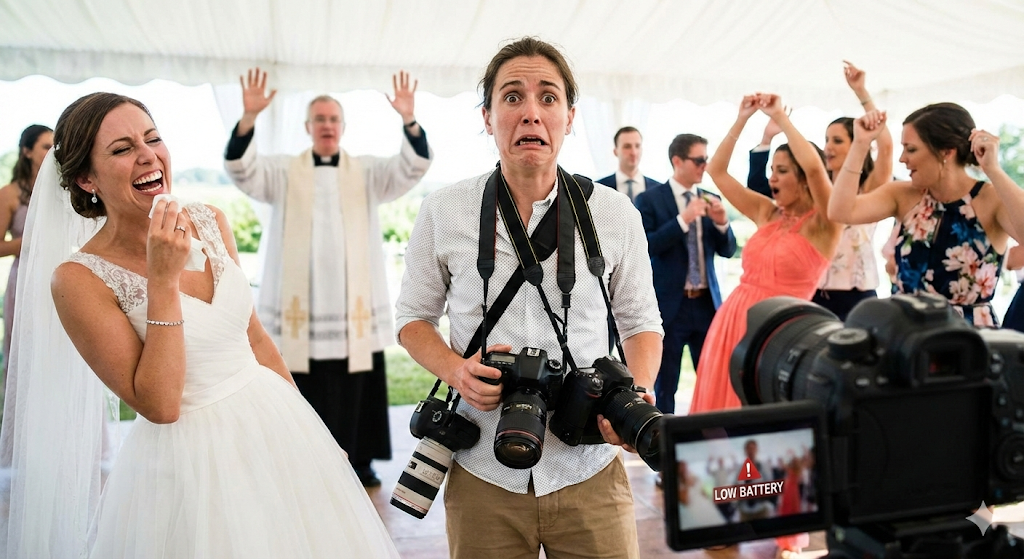
At the precise moment you tell yourself: “My life is too quiet, I need a little excitement,” is when, for some cosmic reason, you decide to agree to photograph your first wedding.
Unlike the controlled studio, where you can adjust the light fifty times until it is perfect, or the landscape, where the mountain will have the decency not to move for centuries, a wedding is a freight train with no brakes.
- You can’t ask the priest to repeat the “I do” because you were looking at the histogram.
- You can’t ask the bride to cry with emotion again because the autofocus system decided to focus on the aunt in the background.
- You can’t ask the sun to wait five minutes because you are changing the battery.
In wedding photography, there are no second takes. You have to get it right the first time, or you fail miserably.
Scott Kelby, one of the most authoritative voices in the industry, describes wedding photography not as a gentle art, but as a tactical military operation. It requires mass psychology, instinctive technical speed, and, above all, redundant safety protocols.
If your cousin Earl has asked you to cover his wedding because “you have a good camera” (a fatal mistake, but perhaps it’s too late to run) or if you are looking to turn professional in the most lucrative and stressful sector of photography, here is the definitive operations manual to get out alive, with your reputation intact, and with spectacular photos.
1. The Psychology of the “Cannon”: The Lens as Authority
There is a curious psychological phenomenon in massive social events: The physical size of your lens determines your social status.
You can be the best photographer in the world, an artist of light with a small fixed 35mm or 50mm lens, discreet and silent. But if you walk into a wedding like that, people will think you are just another guest. They will cross your path, hold up their giant iPads in front of you, and ignore you.
However, if you arrive with a high-caliber white or black telephoto lens (like a 70-200mm f/2.8), a sociological magic happens:
- The crowd parts like the Red Sea before Moses.
- Guests instinctively lower their phones.
- You become “The Authority.”
The Invisible VIP Pass Beyond optics and background compression, a long lens is your crowd control tool. It’s like walking through a factory with a clipboard and a hard hat: everyone assumes you have the right to be there. A photographer’s vest and a big lens allow you to stand in the center aisle, stand on a chair, or block a view without anyone protesting. Plus, it allows you to capture real emotions (a tear, a laugh) from a distance, without invading the subjects’ “personal space,” preserving the naturalness of the moment.
2. Operation “Dark Cave”: ISO, Noise, and Bravery
Old churches and reception halls have something in common: they are beautiful to the human eye, but an absolute nightmare for the digital sensor. They are dark caves designed centuries before electricity or photography existed.
The rookie mistake is fear. Fear of digital “noise.” So they shoot at ISO 400, the shutter speed drops to 1/15 of a second, and… blurry photo. A noisy photo is usable (and even artistic); a blurry photo is trash.
The Low Light Protocol:
- Raise the ISO without mercy: Forget internet forum myths. Modern cameras (Nikon, Canon, Sony) are technological beasts that handle ISO 1600, 3200, or more with incredible dignity.
- Aperture is your wallet: This is where the investment shows. You need “fast” lenses (f/2.8, f/1.8, f/1.4). These lenses are skylights that allow you to shoot at decent speeds (1/60 or 1/125) in the gloom.
The Secret of Post-Production: If the grain bothers you, there is specific software like Noise Ninja or the new AI noise reduction tools in Lightroom that not only clean the image but often smooth the subjects’ skin in a flattering way. But remember: software can fix noise, but it cannot fix a blurry photo. Capture sharpness first.
3. Flash Mastery: How Not to Look Like a 90s Paparazzi
If you fire the flash directly into the bride’s face from your camera’s hot shoe, the result will be terrible. Her skin will shine with sweat, the background will turn pitch black, and the bride will look like a deer scared on a night road. It is “hard” light and it kills romance.
To achieve that soft, diffuse, enveloping light you see in wedding magazines, you need to modify and trick the light.
Indoors: The Art of the Bounce Never aim at the couple. Aim at the ceiling or a side wall.
- By bouncing the flash, you turn a tiny light source (the flash head) into a giant source (the entire ceiling).
- Physics dictates that the larger the light source, the softer the shadows.
- Advanced Trick: Ask an assistant (or an idle cousin) to hold a white reflector to the side and fire the flash against it. You just created a studio lighting setup in the middle of the dance floor.
Outdoors: The Sun Paradox It seems counterintuitive: “Why use flash if there is a radiant sun at noon?” Precisely for that reason. The overhead sun creates horrible shadows under the eyes (“raccoon eyes”) and under the nose.
- Use fill flash to “lift” those dark shadows.
- Adjust flash compensation to -1 EV. You only want a “kiss” of light to balance; you don’t want it to look like you used flash. If you do it right, no one will notice you fired, but everyone will look radiant.
4. Crowd Management: The Group Photo Nightmare
This is the most stressful and dangerous moment of the day. You have 15 minutes between the ceremony and the reception to photograph 50 family members, half of whom are already thinking about the open bar and the other half aren’t speaking to each other due to family feuds from ten years ago. If you don’t have a system, it will be chaos.
The “Onion” Strategy (Peeling from the Outside In): The mistake is starting with just the couple and then calling people in. No. Start with the largest possible group.
- Gather everyone (grandparents, uncles, cousins, school friends). Shoot the massive photo.
- “Thanks to the cousins and friends! You are free to go to the cocktail hour.” (You give them an incentive to leave).
- You stay with parents, siblings, and grandparents. Shoot.
- “Thanks, grandparents.” They leave.
- You stay alone with the couple. If you do it backward, you will have Aunt Gertrudis waiting 40 minutes standing in heels, hating you silently. An unhappy guest is a bad photo.
The Biological Anti-Blink Trick: In a group of 10 people, statistically, someone always comes out with their eyes closed. It is a law of nature.
- Tell them: “Everyone close your eyes. Relax your eyelids.”
- “Open them on three… 1, 2, 3… Now!”
- Shoot on “four.” You will have a split second where everyone has their eyes open, fresh, and lubricated. It works 100% of the time.
5. The Bride is the Sun (Anatomy of Posing)
Let’s be honest: the groom is important, he’s a good guy, but the wedding industry revolves gravitationally around the bride. She (or whoever paid for the party) will be the one judging the album with a magnifying glass. Your mission is to make her look like a goddess.
Angles of Power and Distortion Your camera height drastically changes the perception of the human body. If you shoot from above, you slim; if you shoot from below, you empower (or fatten if you aren’t careful).
- Full Body: Crouch down. Shoot from the bride’s waist height. This lengthens the legs and gives presence.
- American Shot (3/4): Raise the camera to chest height.
- Close-up: Shoot at eye level or slightly from above to highlight the gaze and sharpen the jawline.
The Surgical Rule of Joints: Never cut a photo at the joints (knees, elbows, ankles). It makes people look visually amputated. It is a beginner’s mistake that ruins a good pose. Always cut at mid-thigh (“ham thigh”) or mid-arm.
Forced Intimacy: In real life, people respect their personal space, even couples. In photos, that space looks like an abyss of coldness.
- Your mantra must be: “Heads together! Closer! Your temples must touch!” It will feel uncomfortable and artificial for them, but in the two-dimensional photo, it will look intimate, connected, and romantic.
6. The Details: Visual Journalism and Narrative
The modern wedding style is no longer the rigid pose of the 80s. It is “documentary photojournalism.” It’s not just about who was there, but about how it felt to be there. Make a mental list of the “still lifes” you must hunt. These photos are the narrative “glue” of your album:
- The rings (look for an interesting background, textures, not the boring table).
- The bride’s shoes before she puts them on.
- The dress hanging in the window’s backlight.
- The music sheet or the invitation stained with lipstick.
The Eagle’s Point of View: Seek height. Climb onto a balcony, bring a small ladder, or lift the camera above your head (shooting in burst mode with a wide-angle lens) during the dance or the bouquet toss. Photos from above show the magnitude of the event and the organized chaos of the party in a way that ground level cannot match.
7. The Safety Protocol: Professional Paranoia
We arrive at the most critical point. You can fail exposure and correct it in RAW. You can fail framing and crop later. But never, under any circumstances, can you lose the files. A corrupt memory card is not a technical error; it is the end of your career and a potential lawsuit.
The Rule of Paranoia:
- Never fill a card to 100%: Change it before. Cards usually fail when writing to the final sectors.
- Immediate Backup: Scott Kelby recommends backing up during the wedding. Take advantage of the moments when the couple is eating. Use a portable hard drive with a card reader (like the old Epsons or modern Gnarbox) to download photos on-site.
- Dual Slot: If your camera has two slots, configure the second one as “Backup,” not “Overflow.” It is your instant life insurance.
The Post-Wedding Reality: The Real Challenge
You have survived. It’s 2 AM. Your feet hurt, you have confetti in your hair, your shirt smells like smoke and champagne, and you have 3,000 RAW files on your cards.
Congratulations, you have completed the “easy” part.
The wedding photographer’s true terror is not the angry bride (“Bridezilla”) nor the strict priest who won’t let you use flash. The true terror is Monday morning.
If you are successful (and if you apply these tips, you will be), you won’t have one wedding a year. You will have four a month. Or five. Do the math:
- 3,000 photos per wedding x 4 weddings = 12,000 new files a month.
- Add the pre-wedding sessions (engagement).
- Add the post-wedding “Trash the Dress” sessions.
- Add emails from 4 different couples asking: “Are my photos ready?”, “Can you send me the contract again?”, “Can we change photo 403 in the album?”.
Suddenly, your problem is no longer the f/2.8 aperture, nor the flash bounce, nor high ISO. Your problem is administrative chaos.
The amateur photographer drowns here. They are excellent at taking photos, but terrible at managing the business.
- They lose files in poorly named folders (“Wedding_Juan_Final_Final_V2”).
- They deliver late because they forget dates.
- They confuse which client paid the deposit and which owes the final balance.
Their art is impeccable, but their business is a disaster collapsing under its own weight.
To scale from “doing a favor for your cousin Earl” to being a professional who bills and lives off this, you need a system that manages the brutal volume of work without your brain collapsing. You need to move from manual management of sticky notes to intelligent automation.
It’s time to discover that the sharpness of your business is as important as the sharpness of your lens…
How to Manage 20 Sessions a Month Without Losing Your Mind (Or the Files).
1. Visual Centralization (The Death of Excel) Managing weddings on a spreadsheet is slow suicide for a creative. Your brain works with images, not cells. With GGyess WorkSuite, you create a project for each wedding. You don’t see a line of text; you see the cover photo of the couple. You visually know who is who instantly. “Ana & Luis – Beach Wedding” is not data; it is an image on your board.
2. The Photographer’s Kanban Flow What exact state is last week’s wedding in? Selected? Edited? Exported? Instead of trying to remember, you move the wedding card through a visual Kanban board:
- Column 1: Imported
- Column 2: Culling (Selection)
- Column 3: Editing
- Column 4: Final Retouching
- Column 5: Delivered
You will instantly know that you have 3 weddings in editing and one pending urgent delivery. Goodbye to the nightly anxiety of “am I forgetting something?”.
3. “Disaster-Proof” Storage Kelby talked about physical hard drives in the backpack. Today, the security standard is the hybrid cloud. GGyess integrates massive storage directly into project management. Upload final JPGs, signed contracts, and invoices directly to the client’s file. If your physical hard drive explodes, gets stolen, or your studio suffers a flood, the deliverable and legal work is safe in the cloud, linked to the correct client.
4. Delivery and Publishing (Automatic Marketing) It is useless to have that spectacular photo of the bride with window light if it dies on a hard drive. You have to show it to get the next wedding. From the same platform, you can schedule social media posts. “Yesterday’s wedding: Incredible natural light.” Scheduled for Tuesday at 8 PM, when your audience is active. GGyess acts as your marketing assistant while you rest or edit the next wedding.
Conclusion is simple:
To get the photos right the first time (as the pressure of the wedding demands), you need technique and reliable equipment. For your business to survive in the long term, you need order and a system.
Don’t let success crush you. Organize your flow, protect your files, and reclaim your life.