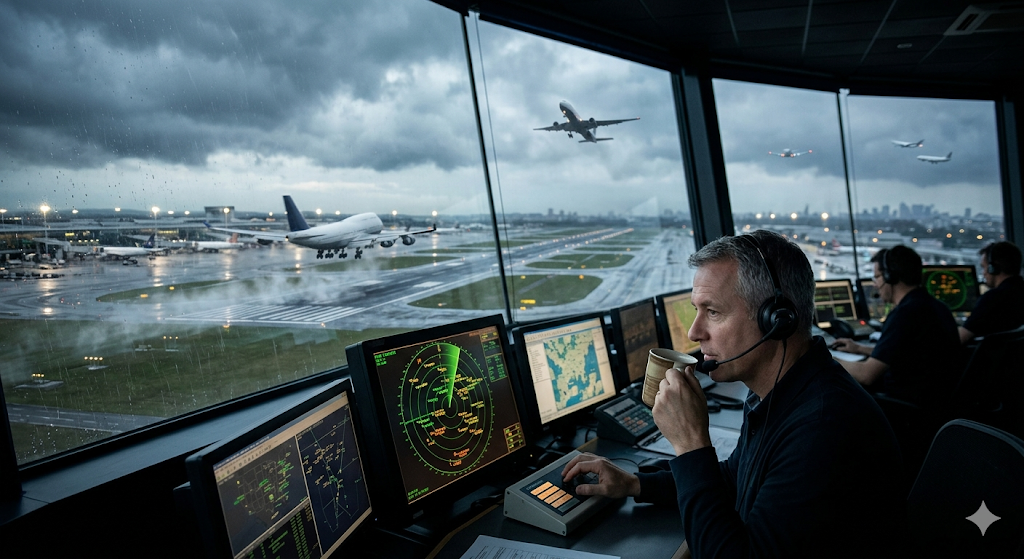
Mentally climb up to the control tower of one of the busiest airports in the world, like New York’s JFK or London’s Heathrow. You have dozens of airplanes weighing hundreds of tons flying at 800 kilometers per hour. Some are taking off, others are approaching to land, and a few are circling in a holding pattern because there’s a storm.
The air traffic controller sits in front of their radar screen. If they blink at the wrong moment, if they confuse flight 405 with 406, or if they allow two planes to try to use the same runway at exactly the same time… the consequences are catastrophic.
Fortunately, the controller isn’t sweating, shouting, or in a state of panic. They’re calm, sipping coffee and speaking into the microphone with a steady, controlled voice. Why? Because they have a system designed to eliminate uncertainty.
Now leave the control tower and return to your office.
You’re the leader of your team. You have the “Website Redesign Project” about to take off. The “Mother’s Day Campaign” is trying to land today at 5:00 p.m. And the “Quarterly Sales Report” has been circling in a holding pattern for two days because the client hasn’t approved the budgets.
Unlike the air traffic controller, you are sweating. Your inbox is in panic mode and you feel like two of your projects are about to collide in midair.
Managing a single project is difficult; managing five, ten, or twenty at the same time is a stress test for any professional. Today we’ll learn how to stop being victims of corporate air chaos and how to install the right “radars” so that, no matter how many projects you have flying at the same time, they all land safely and on schedule.
The “Juggling” Myth: Why Multitasking Is Sinking You
The first mistake we make when trying to manage multiple projects is believing we must multitask. We imagine the ideal leader as someone who can write an email for Project A, answer a call about Project B, and review a document for Project C—all at the same time.
This is a destructive myth. The human brain does not process information in parallel; it processes it sequentially. When you think you’re doing three things at once, what your brain is actually doing is rapidly switching between tasks.
This is called context switching, and it’s the mental process that consumes the most energy. That’s why at 3:00 p.m. you feel mentally drained even though you haven’t left your chair.
Let’s go back to the control tower. The air traffic controller doesn’t multitask with airplanes. They don’t speak to three pilots at the same time. What they do is sequence.
They evaluate the global radar, decide which plane has priority (because it has less fuel or is closer), give it a clear instruction, and then remove it from their mind for a few minutes to focus 100% on the next aircraft.
To do this in your work, you don’t need to be smarter or work longer hours. You need to build a reliable radar.
Why Spreadsheets Cause Air Accidents
The biggest problem when leading multiple projects is the lack of global visibility.
In most companies, each project lives in a different silo.
Project A is in a giant Excel spreadsheet.
Project B is managed through a WhatsApp channel.
Project C is handled by another manager using notes on a physical whiteboard.
When flights aren’t on the same radar screen, disaster is inevitable.
As a leader, you spend half your week simply trying to figure out the altitude and speed of each project. You have to schedule status meetings (which are like sending a helicopter to search for a lost plane) just to ask: “How are we doing with the website design?”
The lack of a centralized radar also prevents you from seeing resource collisions.
Imagine you’re the project manager and you tell Flight A to land on Runway 1. But you didn’t know that the marketing manager just told Flight B to land on the same Runway 1.
In the corporate world, Runway 1 is your graphic designer, your developer, or your financial analyst. When projects are planned in isolation, it’s inevitable that you’ll end up asking the same person to deliver two critical tasks for two different projects on the same Friday at 5:00 p.m.
The result: the employee burns out and one of the projects crashes.
The 4 Golden Rules of an Expert Project Controller
To avoid panic and orchestrate work like a professional, you must adopt the mindset and processes of aviation. Here are the flight rules you should implement in your company today.
Rule 1: Demand a “Flight Plan” Before Takeoff (Structure)
No commercial airplane takes off without a detailed flight plan specifying route, altitude, fuel, and estimated arrival time.
Yet in the office, we start massive projects with a simple email that says:
“Let’s launch the new app by November—start working on it.”
To manage multiple projects without losing your mind, you must require every initiative to be broken down into tasks, phases, and responsibilities before anyone starts working.
If the structure isn’t clear, the plane stays on the ground.
Rule 2: Group Flights by Altitude (Portfolio Prioritization)
If you try to look at 300 individual tasks from five different projects at the same time, your radar screen will be so cluttered that you won’t see anything.
You must learn to look at work from different altitudes.
At 30,000 feet, you only want to see the overall project status:
Is it On Track, At Risk, or Delayed?
At 10,000 feet, you look at the key milestones for the month.
And only when there’s a problem do you descend to ground level to see the specific task blocking progress.
Don’t try to micromanage every screw on every airplane. Manage the flow.
Rule 3: Monitor Your Runways (Workload Balance)
The most valuable resource you have isn’t the budget—it’s your team’s time.
If you manage multiple projects, it’s your responsibility to cross-check schedules to detect overlapping effort.
If the launch of Project A coincides with the heaviest week of Project B—and both require the same copywriter—you must make an executive decision today.
Either delay one of the flights (move the deadline) or open a new runway (hire a temporary freelancer).
Hope is not a management strategy.
Rule 4: Keep Radio Communication Short and Contextual
In aviation, radio messages are short, standardized, and direct.
“Flight 405, descend to 10,000 feet.”
There’s no room for ambiguity or long stories.
In your projects, you must eliminate noise. If someone has a question about a design in Project B, that question should not go into an email copied to ten people or into a general corporate chat.
The question should be written directly inside the design task for Project B. This creates a clear record that everyone can read without interrupting each other.
GGyess: The Ultimate Control Tower for Your Company
We can understand the theory perfectly, but if you continue trying to organize multiple projects in static documents, the stress will never disappear. An air traffic controller doesn’t draw airplanes on paper—they use a real-time radar powered by advanced technology.
If you want to manage the workload of a growing company without losing your sanity, you need to climb into the best control tower available.
You need GGyess.
We designed GGyess specifically for leaders who feel like they have too many balls in the air. We realized that simple tools work well for organizing a grocery list—but they collapse when you try to orchestrate the simultaneous work of multiple departments.
In GGyess, your global radar comes to life. You no longer have to open five different applications to understand how your company is doing. On your main dashboard, you get a unified view of all your active projects.
With our Portfolio feature, you can group projects by client, department, or priority—seeing at a glance which flights are on schedule and which ones are calling for help.
Remember the headache of manually cross-checking schedules to avoid overloading your team? With GGyess, that’s history.
Our global Workload view automatically cross-references information from all your projects simultaneously. If Juan is assigned to Project A, B, and C, GGyess calculates his total effort. If Juan exceeds his weekly capacity, the system warns you visually in red.
No spreadsheets. No mental calculations.
With just a couple of clicks, you can move one of his tasks to another teammate and save the week.
But the real stress relief comes from our integrated Artificial Intelligence. When you’re responsible for multiple fronts, writing “flight plans” from scratch for every initiative can consume hours of valuable time.
With GGyess, you simply tell the AI:
“I need to organize the annual sales convention, the summer campaign, and the product packaging redesign.”
The AI processes your instruction and in seconds structures complete projects with detailed tasks, suggested deadlines, and logical dependencies.
You just review, approve, and let the work flow.
And to keep the “radio” free of static, GGyess centralizes all communication and files. When you switch your attention from Project A to Project B, you don’t have to search through old emails.
You open the relevant task and everything is there: who said what, when it was approved, and where the final file is.
You can make that mental switch in ten seconds and continue making executive decisions with total clarity.
Managing multiple projects doesn’t have to mean gastritis, overtime, and constant panic. When you have full visibility, clear dependencies, and a system that warns you about bottlenecks before they happen, complex work becomes surprisingly calm.
Stop running across the runway trying to guide airplanes with your hands.
Climb into the control tower, look at your radar screen with confidence, and master the skies of your business with GGyess.