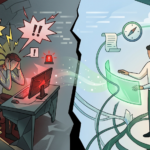
Carlos pours himself his third cup of coffee of the day. It’s 10:15 in the morning, and he stares at his monitor. On the screen, a list of names with green, yellow, and gray circles. His team is “online,” but a piercing question runs down his spine like an electric current: “Are they really working, or just moving the mouse while watching Netflix?”
This thought doesn’t make Carlos a bad person or a tyrannical boss. What he’s experiencing is an evolutionary biological response. For thousands of years, humans have needed physical proximity to validate cooperation. If we could see the tribe hunting or gathering, our nervous system felt safe. If we couldn’t see them, the brain triggered an alert: danger—lack of resources.
Today, in the era of hybrid and remote work, that same alert signal translates into one of the most toxic and destructive behaviors in modern productivity: micromanagement.
The problem is that micromanagement is like salt in an open wound. The more you try to “control” to calm your anxiety, the more you destroy your team’s autonomy. And without autonomy, there is no innovation, no engagement—and ultimately, no results.
The Trap of “Digital Presence”
Many leaders have tried to replicate the physical office in the virtual world in the worst possible way. They’ve created what we call the “Prison of Availability.” They demand instant responses in chat, require cameras on during three-hour marathon meetings, and check online statuses every ten minutes.
From a neuroscience perspective, this is a disaster. When an employee feels watched, their brain enters a state of constant threat. The limbic system takes over, reducing the prefrontal cortex’s ability to solve complex problems. Instead of thinking about how to improve the project, the employee spends all their mental energy on “looking busy.”
The paradox is brutal: excessive supervision produces employees who deliver less—but feel more exhausted.
The Paradigm Shift: From “Hours at Desk” to “Value Delivered”
To successfully lead a hybrid team without losing your sanity, you must “hack” your own need for control. The secret is not to monitor people, but to make processes visible.
The human brain loves predictability. Carlos’s anxiety (and that of thousands of leaders) doesn’t come from distrust—it comes from uncertainty. When you don’t know what stage a project is in or who owns a milestone, your brain fills the gaps with worst-case scenarios.
The solution is to create a “Single Source of Truth.” A place where work speaks for itself—eliminating the need to ask “How are we doing?” five times a day.
The 3 Pillars of Radical Transparency
To build this system of trust and high performance, you need three pillars that satisfy the psychological needs of both leader and team member:
1. Visual Progress Maps (The Dopamine of Progress)
Our brain is visual by nature. A ten-page written report is hard to process and creates fatigue. But a well-structured Kanban board or Gantt chart acts as an instant mental map.
When a leader can see, at a glance, tasks moving from “In Progress” to “Done,” their amygdala relaxes. There’s no need to ask—because the system provides the visual evidence the brain needs to feel safe. For the employee, moving that card at the end of the day triggers a dopamine hit that reinforces a sense of achievement.
2. Democratizing Workload (Workload Balancing)
One of the biggest fears in remote work is unfairness: “Why am I overloaded while my teammate seems free?”
Micromanagement often arises when leaders lose track of who is doing what. A smart system allows visibility into each team member’s workload. This lets the leader step in not to control—but to support. Shifting from “Why isn’t this done?” to “I see you have five critical tasks today—how can I help redistribute?” completely changes team chemistry, moving from fear to trust.
3. Asynchronous Communication vs. Real-Time Interruptions
Every time you interrupt a developer, designer, or writer with “Got a minute?”, it takes at least 23 minutes to regain their previous level of focus.
In a hybrid environment, communication must be contextual. This means conversations about a task should live inside the task—not in a scattered chat or buried email. When information lives where it belongs, the need for status meetings drops by up to 70%.
The “Ownership Effect”
When you stop monitoring and start trusting a transparent system, something powerful happens in team psychology: the Ownership Effect.
When employees feel they own their time and their results are visible, their engagement increases intrinsically. They’re no longer working to “fill hours”—they’re working to make their board shine. Autonomy activates the brain’s reward system, leading to greater creativity and a sharp reduction in burnout.
The modern leader is not a guard in a tower—they are a systems architect who enables talent to flow without friction. Their job is to remove obstacles, not count how many times the green dot blinks.
Designing the Future of Work—Today
Leading teams in 2025 and beyond requires a new mental toolkit. Technology should not be used to chase people—but to connect them. Transparency is not a form of control; it’s a form of freedom. By eliminating uncertainty, we eliminate fear. And without fear, teams reach levels of performance that once seemed impossible.
Carlos finally closed his “online status” tab. He looked at his project board and saw that three critical tasks had moved into review. He saw his designer’s comments attached to files and noticed the developer had already replied to a technical question—right there in context. His heart slowed down. Uncertainty had vanished, replaced by clarity.
To build this ecosystem of trust and efficiency without juggling multiple tools, there’s a solution designed for this new era: GGyess.
GGyess has evolved into the ultimate WorkSuite—the operating system your hybrid team needs to eliminate chaos. Forget the fatigue of switching between apps; in GGyess, Shared Boards (with Kanban, Gantt, and Table views) allow everyone to see progress in real time, eliminating micromanagement caused by lack of visibility.
Need quick alignment? Stay in the platform—start an integrated Video Call with one click. Concerned about team workload? Use the Workload management feature to balance tasks fairly and transparently. And with the new Reminders system and Appointments management, every team member knows exactly what matters most—empowering them to work with full autonomy.
With GGyess, you’re not just managing tasks—you’re building a culture of transparency and high performance where work feels lighter and results become inevitable. It’s time to stop monitoring and start