

This guide focuses on defining a reproducible indicator and the decision it can support. The worked example follows three units: “article inventory”, “source refresh” and “version review”.
Reference input: URLs and last review dates. Expected output: a URL-level refresh register. Before assigning work, confirm the current input version and who will review the result.
Connect the metric to a decision
A metric for the legacy article refresh programme is useful when it can change the next action. Before building a chart, establish whether you need to stop intake, reassign review or investigate waiting. Define the observation unit: asset, request, file or cycle. Do not combine those units in one percentage. The reference operational record here is a URL-level refresh register. The metric should describe what that record can actually establish. When evidence for one stage is missing, identify the gap before interpreting a total that appears to cover the whole process. Measurement starts with a decision and observable records, rather than a dashboard layout.
Write a reproducible definition
The measurement card should retain the name, formula, observation window, source, exclusions and update owner. For a proportion, numerator and denominator must refer to the same population of work. For waiting time, record both ends of the interval and explain how open cases are handled. Do not turn missing observations into zero. Zero means the event was measured and not found; missing means the calculation is not yet supported. This distinction changes decisions, particularly when an item looks punctual simply because its delay was never recorded. Another colleague should be able to reproduce the result from the definition.
Worked example
The sample catalogue includes a current guide, another with an old screenshot and a third with sources needing review. Each URL's update must explain what changed rather than treat a new date as sufficient evidence of currency.
The example involves Leo, Diego and Alex. Names, situations and numbers are illustrative and do not represent customer results. The three units let you test the proposed approach before extending it to other work.
| Unit | Reference fact | Check | Decision |
|---|---|---|---|
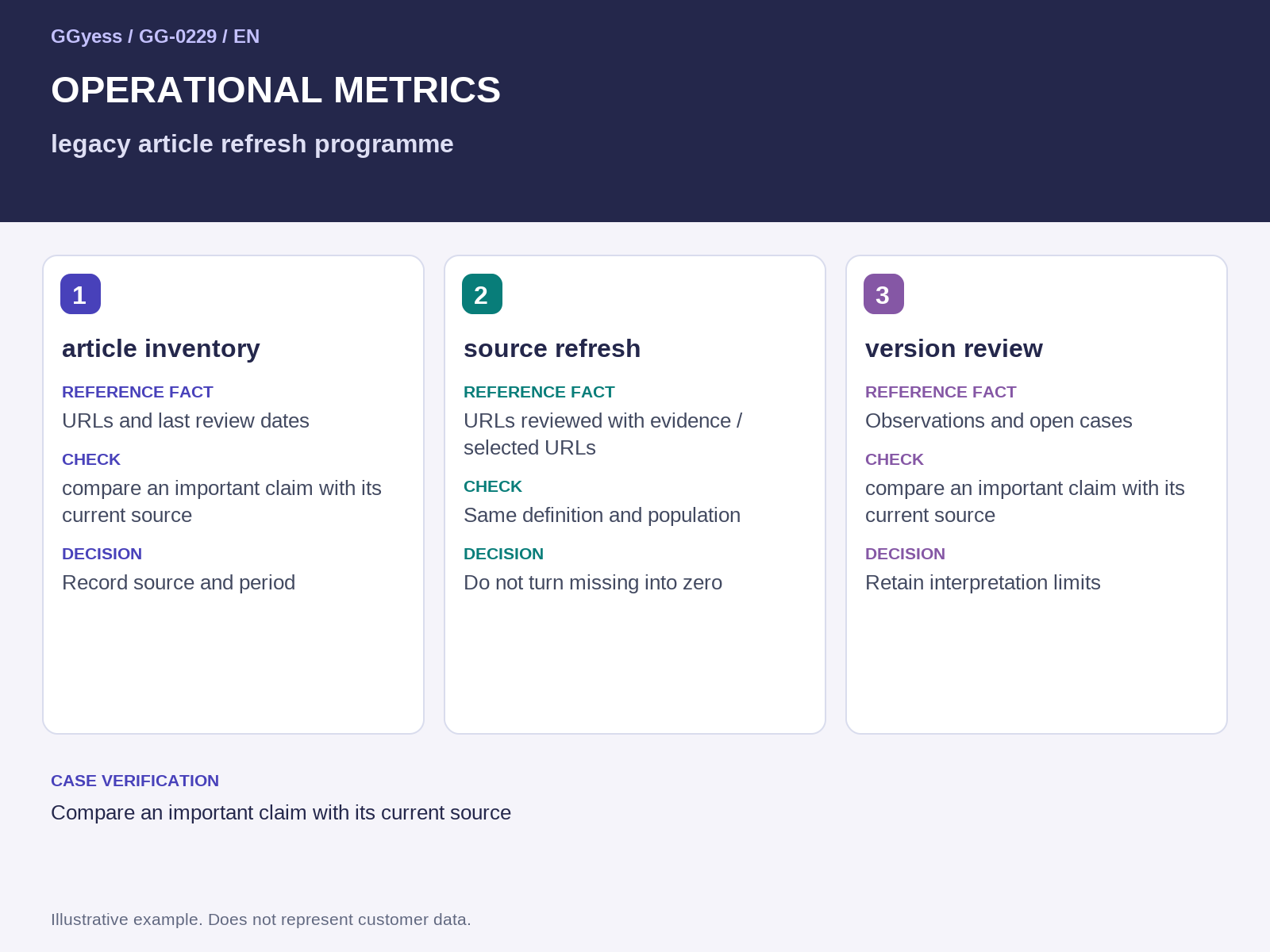
| article inventory | URLs and last review dates | compare an important claim with its current source | Record source and period |
| source refresh | URLs reviewed with evidence / selected URLs | Same definition and population | Do not turn missing into zero |
| version review | Observations and open cases | compare an important claim with its current source | Retain interpretation limits |
Calculate an example and explain its limits
Proposed indicator: URLs reviewed with evidence / selected URLs. Define the unit, period, source and exclusions before calculating it. Retain missing observations as pending and compare periods using the same definition. Arithmetic example separate from the table’s three units: if 8 records meet the numerator condition out of 10, the ratio is 8 / 10 = 80%. This is an illustrative calculation, not a customer measurement or an outcome caused by GGyess.
Review with an action and supporting evidence
For article inventory, source refresh and version review, choose a review point that leaves a real opportunity to intervene. Reviewing a metric after its decision becomes irreversible offers little operational value. Guard against changing the date without checking outdated claims. The proposed check is to compare an important claim with its current source. When the indicator changes, inspect its source and the cases behind it before turning a small fluctuation into a success or failure story. Record the decision, action owner and observation expected at the next check. That keeps measurement connected to work instead of allowing the report to become a separate administrative exercise.
What to check before closure
The risk to control in this case is changing the date without checking outdated claims. A completed label needs a supporting observation. Keep the following beside the decision so the receiver can establish what was checked:
- Input and version used: URLs and last review dates.
- Case check: compare an important claim with its current source.
- Outcome under review: a URL-level refresh register.