

This guide focuses on comparing scope, sequence and capacity to agree on a feasible commitment. The worked example follows three units: “session agenda”, “speaker rehearsal” and “room transition”.
Reference input: agenda and speaker requirements. Expected output: a rehearsal and session-transition plan. Before assigning work, confirm the current input version and who will review the result.
Establish the actual effect of the delay
To recover the multi-speaker virtual conference coordination, compare the accepted commitment with what remains executable. Identify the delayed unit, missing input and dependent delivery. Do not automatically move every date. Independent tasks may still proceed, while a review window may need to be reserved again. Use agenda and speaker requirements to verify the situation and distinguish facts from estimates. The recovery plan should explain which commitment became infeasible and which outcome remains useful to its receiver. Without that distinction, a revised date changes the calendar without resolving the operational problem or clarifying what the team can now deliver.
Compare scope, sequence and capacity options
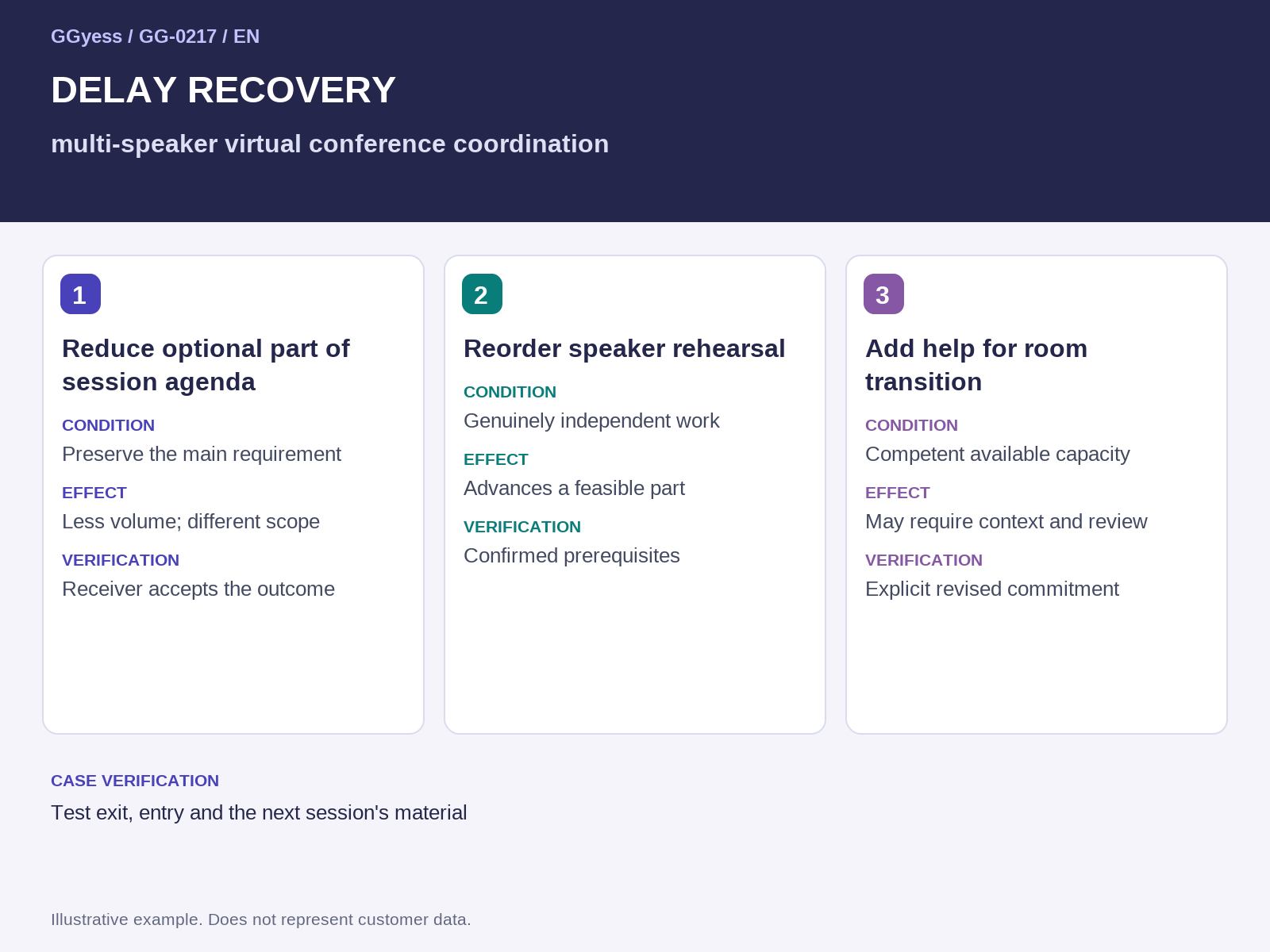
Present three options: reduce an optional element, reorganize genuinely independent work or add competent available capacity. Explain what each option sacrifices. Adding someone may require context and review, so it does not automatically shorten delivery. For session agenda, confirm the minimum requirement. For speaker rehearsal, check whether existing input supports partial progress. For room transition, establish who can review the result. Do not propose hours the team cannot provide or remove the control that prevents a material defect to make recovery appear faster. A credible comparison includes the cost of each option's new dependencies.
Worked example
The fictional conference has three speakers and two critical transitions. Each contribution needs material and an entry signal. Rehearsal includes session changes because checking individual talks does not establish readiness of the full sequence.
The example involves Nora, Sofia and Valeria. Names, situations and numbers are illustrative and do not represent customer results. The three units let you test the proposed approach before extending it to other work.
| Recovery option | Condition | Effect | Verification |
|---|---|---|---|
| Reduce optional part of session agenda | Preserve the main requirement | Less volume; different scope | Receiver accepts the outcome |
| Reorder speaker rehearsal | Genuinely independent work | Advances a feasible part | Confirmed prerequisites |
| Add help for room transition | Competent available capacity | May require context and review | Explicit revised commitment |
Agree on a revised commitment
In this illustrative example, the team preserves the main requirement, defers an optional improvement and retains a review before delivery. The owner communicates revised scope, conditions for meeting it and the next check. The receiver confirms whether that outcome still solves their need. Avoid rehearsing individual sessions without testing speaker transitions; the proposed check is to test exit, entry and the next session's material. Preserve the previous commitment and explain the reason for change without turning the record into a personal accusation. Useful recovery assigns clear actions to the people able to resolve the situation and makes the decision behind the revised outcome visible.
Verify recovery through evidence
Moving a task to a new date does not prove recovery. Verify the critical input, completed production and acceptance of a rehearsal and session-transition plan. If risk remains, retain a check near the last useful intervention point. Do not declare recovery simply because an overdue marker disappeared from the board. At closure, record which adjustment worked and under what conditions. That information can improve subsequent planning. Separate later learning from immediate recovery: first restore a feasible commitment, then decide whether a recurring cause justifies changing the process. The same evidence can support both discussions without confusing their different purposes.
What to check before closure
The risk to control in this case is rehearsing individual sessions without testing speaker transitions. A completed label needs a supporting observation. Keep the following beside the decision so the receiver can establish what was checked:
- Input and version used: agenda and speaker requirements.
- Case check: test exit, entry and the next session's material.
- Outcome under review: a rehearsal and session-transition plan.