

This guide focuses on assessing a request's impact before changing a commitment. The worked example follows three units: “web version”, “email version” and “social version”.
Reference input: channel assets and requested revisions. Expected output: a channel-specific approved-version register. Before assigning work, confirm the current input version and who will review the result.
Distinguish clarification from a change
In the multichannel asset version control, a clarification makes an existing requirement explicit. A change modifies the outcome, volume, destination, review or constraint. Before calling a request small, compare it with the accepted assignment version. For web version, record the original request and the new request. If there is no clear reference, reconstruct the agreement with the owner before assigning additional work. This protects the working relationship by explaining practical effects without turning every question into an unnecessary negotiation. The distinction should come from the requested result and its conditions, rather than the requester's description of how easy it sounds.
Record impact before committing
A change request needs its reason, affected unit, estimated effort, dependency, date and decision owner. Use channel assets and requested revisions to establish which work remains valid and which work would need repeating. Adding one task is insufficient: an adjustment to email version may require reviewing social version as well. Present impact as a proposal with assumptions, rather than an unquestionable figure produced without consulting the team. Retain the decision even when the request is declined. It explains why the final version excludes something that appeared in the conversation but never became an accepted requirement.
Worked example
The fictional campaign adapts one asset for web, email and social. A message correction affects all three destinations, but formats differ. The register traces which channel version includes the change and which still awaits review.
The example involves Mateo, Leo and Diego. Names, situations and numbers are illustrative and do not represent customer results. The three units let you test the proposed approach before extending it to other work.
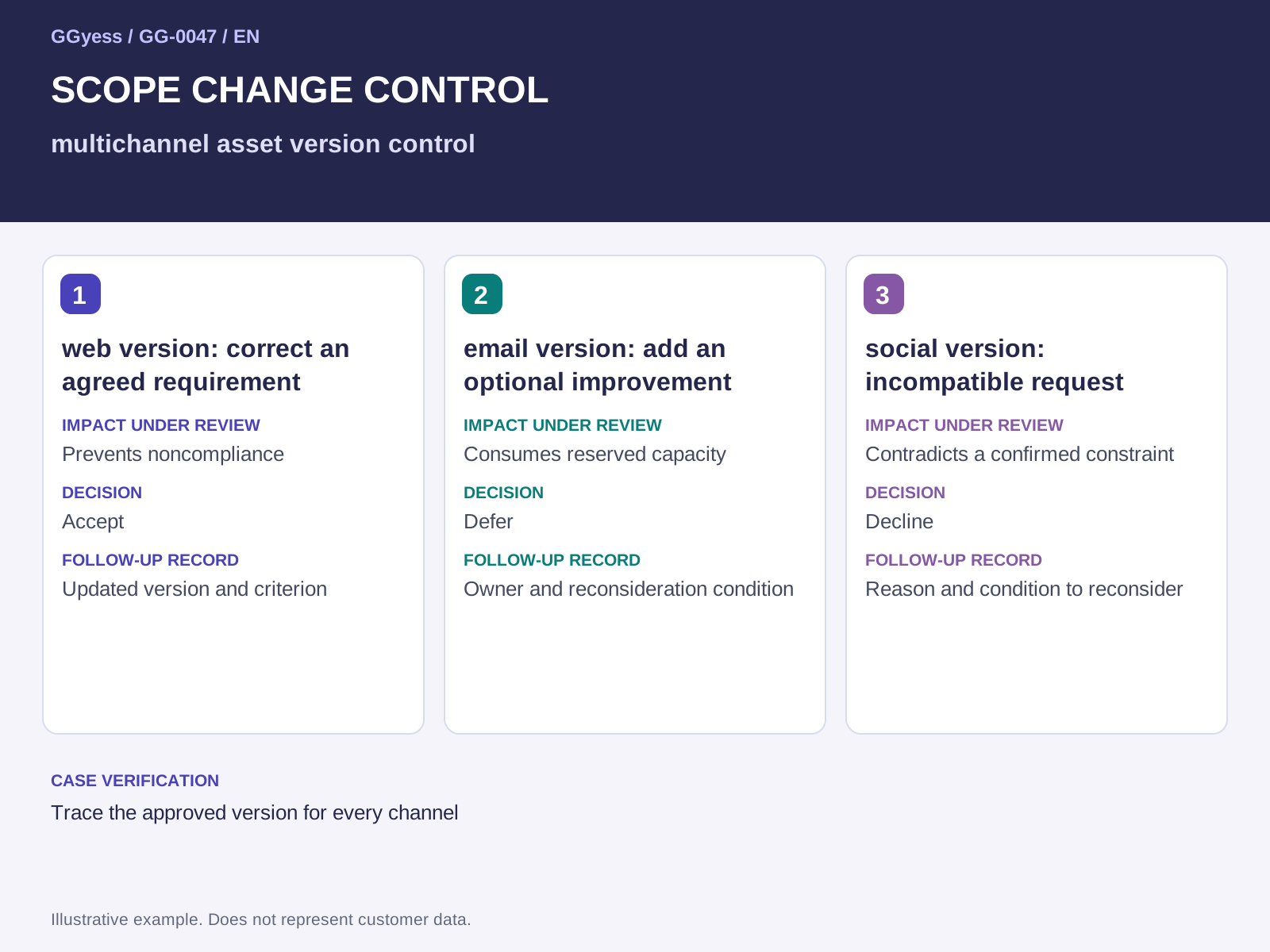
| Illustrative request | Impact under review | Decision | Follow-up record |
|---|---|---|---|
| web version: correct an agreed requirement | Prevents noncompliance | Accept | Updated version and criterion |
| email version: add an optional improvement | Consumes reserved capacity | Defer | Owner and reconsideration condition |
| social version: incompatible request | Contradicts a confirmed constraint | Decline | Reason and condition to reconsider |
Resolve three requests for different reasons
In this illustrative example, accept a correction required to meet an existing criterion. Defer a valuable extension that consumes capacity reserved for a critical delivery. Decline a request incompatible with a confirmed constraint, explaining what would need to change for reconsideration. These decisions depend on scope, evidence and capacity rather than persistence. For the multichannel asset version control, the specific risk is applying a correction to one channel and forgetting others. Check the result by taking this action: trace the approved version for every channel. A deferred request retains an owner and a review point; it should not disappear into an undated list where nobody knows when it will receive another decision.
Update the current version and commitments
After deciding, identify the current plan version and communicate its effect on affected tasks. If a date changes, ask the receiving team whether the revised commitment remains useful. If an input changes, identify who used the earlier version. The final record should make a channel-specific approved-version register reconstructable without guessing which comments were accepted. Retain the original request but stop treating superseded instructions as active. Closing a change means the team understands what to execute now and what no longer belongs in this delivery, including any revised acceptance or review condition.
What to check before closure
The risk to control in this case is applying a correction to one channel and forgetting others. A completed label needs a supporting observation. Keep the following beside the decision so the receiver can establish what was checked:
- Input and version used: channel assets and requested revisions.
- Case check: trace the approved version for every channel.
- Outcome under review: a channel-specific approved-version register.