
This guide focuses on testing a small change based on an observed failure. The worked example follows three units: “technical section”, “delivery assumptions” and “proposal version”.
Reference input: requirements and specialist contributions. Expected output: a proposal with assumptions and owners. Before assigning work, confirm the current input version and who will review the result.
Collect observations from a completed cycle
To improve the complex sales proposal coordination, choose a cycle with a clear beginning, end and findable records. Gather requirements and specialist contributions, delivered versions and decisions affecting the result. Describe observable facts: a review repeated, an input arrived incomplete or a unit waited for a decision. Avoid starting with explanations about people's attitudes. For technical section, delivery assumptions and proposal version, distinguish production, waiting and rework. The record should support comparing events with the agreement without reconstructing the cycle solely from memory or the most persistent opinion. Different participants should be able to examine the same observations.
Separate a symptom from a testable cause
“Delivery was late” describes an outcome without establishing its cause. Form a specific hypothesis and look for evidence capable of contradicting it. If you suspect missing context, check whether units with complete inputs experienced the same problem. If you suspect insufficient capacity, compare availability with commitments during the period. The specific risk is sending sections with incompatible scope or dates. The proposed check is to compare assumptions across sections before consolidation. A useful explanation supports designing a change and observing what happens. Do not turn a coincidence from one cycle into a general conclusion about the whole team or every future assignment.
Worked example
The fictional proposal combines technical, operational and timeline sections. Two specialists use different assumptions about review. Before consolidation, the owner resolves that difference and retains coherent conditions for the proposed delivery.
The example involves Camila, Nora and Sofia. Names, situations and numbers are illustrative and do not represent customer results. The three units let you test the proposed approach before extending it to other work.
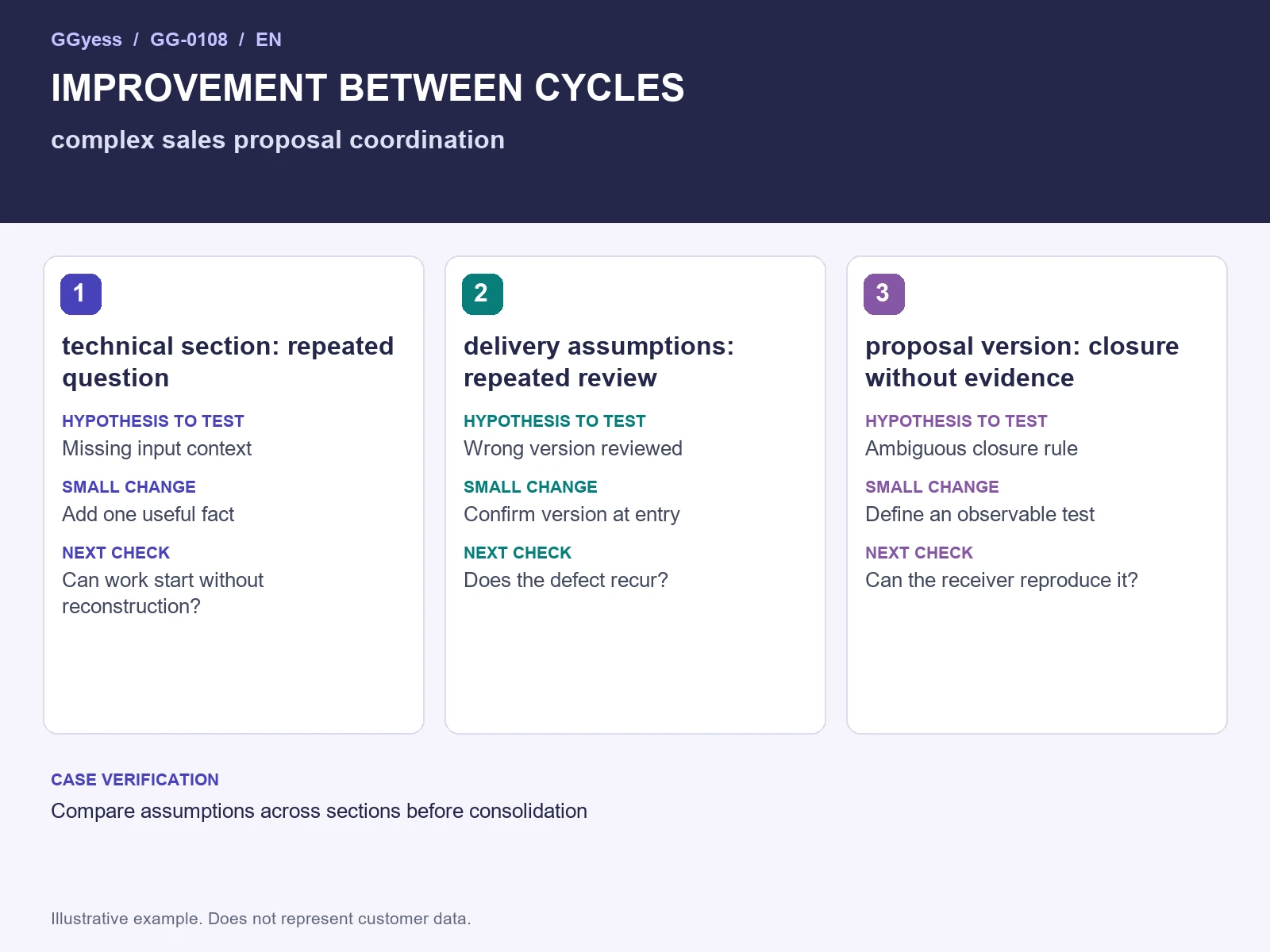
| Cycle observation | Hypothesis to test | Small change | Next check |
|---|---|---|---|
| technical section: repeated question | Missing input context | Add one useful fact | Can work start without reconstruction? |
| delivery assumptions: repeated review | Wrong version reviewed | Confirm version at entry | Does the defect recur? |
| proposal version: closure without evidence | Ambiguous closure rule | Define an observable test | Can the receiver reproduce it? |
Choose one small measurable improvement
Test this check before closing “technical section”: compare assumptions across sections before consolidation. Keep the rest of the workflow stable and record whether the check ran and what you observed. Compare cycles with similar inputs and constraints. If the change adds effort without preventing the selected failure, adapt or remove it; one execution does not establish a general improvement.
Test and decide whether to retain the change
Apply the adjustment to the next comparable cycle and preserve a proposal with assumptions and owners as the reference. Record whether the team followed the check and what happened to the selected problem. If cases are insufficient, describe observations without announcing a proven improvement. When the change adds effort without preventing the failure, revise or remove it. Document whether the test is retained, adapted or abandoned and who updates the procedure. A useful retrospective ends with a verifiable action and revisits it; a list of lessons without follow-up does not change subsequent execution on its own.
What to check before closure
The risk to control in this case is sending sections with incompatible scope or dates. A completed label needs a supporting observation. Keep the following beside the decision so the receiver can establish what was checked:
- Input and version used: requirements and specialist contributions.
- Case check: compare assumptions across sections before consolidation.
- Outcome under review: a proposal with assumptions and owners.