

This guide focuses on estimating work and availability without confusing effort with a delivery date. The worked example follows three units: “product listing”, “promotion banner” and “promotional email”.
Reference input: catalogue and confirmed availability. Expected output: a product creative matrix. Before assigning work, confirm the current input version and who will review the result.
Estimate observable work units
To estimate the ecommerce promotion coordination, split the outcome into units another person can recognize. Here, use product listing, promotion banner and promotional email. Describe what each includes and where it ends. A task called “manage the project” cannot meaningfully be compared with execution. Separate preparation, production, review and correction when they consume different capacity. An exhaustive task tree is unnecessary: expose the parts that materially change effort and the dependencies that determine when they can be performed. This gives the team a basis for discussing uncertainty without pretending that every minute is predictable.
Use ranges and state their assumptions
An initial estimate should explain why a unit might take longer. Set a lower and upper bound tied to observable conditions: complete inputs, one review round and specialist availability. If the required inputs are incomplete, acknowledge that uncertainty in the range. Do not turn the optimistic endpoint into a promised delivery date without discussing its assumptions. When records of comparable work exist, compare them with the range and explain what differs in this assignment. Comparisons improve planning when they retain each unit's context instead of treating all similarly named tasks as equivalent.
Worked example
The fictional promotion includes two products and three assets per product. One SKU has confirmed availability and the other needs an update. The matrix must identify every affected asset before changing the availability message.
The example involves Sofia, Valeria and Camila. Names, situations and numbers are illustrative and do not represent customer results. The three units let you test the proposed approach before extending it to other work.
| Unit | Illustrative production | Review / correction | Assumption |
|---|---|---|---|
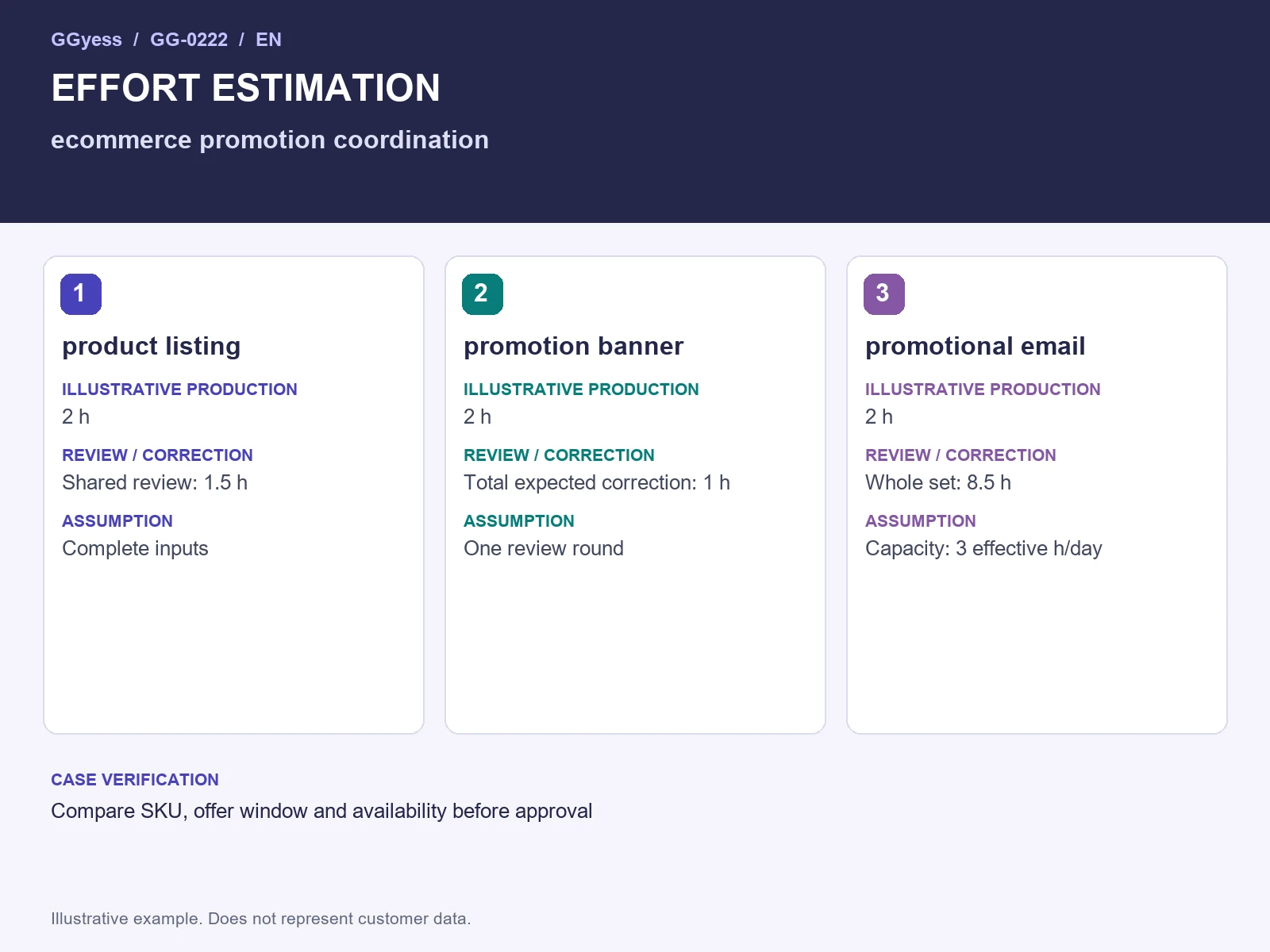
| product listing | 2 h | Shared review: 1.5 h | Complete inputs |
| promotion banner | 2 h | Total expected correction: 1 h | One review round |
| promotional email | 2 h | Whole set: 8.5 h | Capacity: 3 effective h/day |
Separate capacity from elapsed delivery time
In this illustrative example, three units require 2 hours each, joint review takes 1.5 hours and expected correction takes 1 hour. Baseline effort is 8.5 hours. If the executor has 3 effective hours per day for this assignment, 8.5 hours does not imply same-day delivery. Review may also follow a waiting period. Distinguish working hours, available capacity and elapsed time until acceptance. These numbers are planning assumptions for the example, rather than observed productivity or team guarantees. The delivery conversation needs to address all three measures explicitly.
Re-estimate after a material condition changes
Update the calculation when volume, source version, acceptance criteria or reviewer availability changes. Retain the previous range and explain the difference. To avoid showing different availability across channels, reserve time to compare SKU, offer window and availability before approval. An apparently small correction may affect several units; identify those units before adding a generic contingency allowance. At closure, record actual effort and reasons for deviation using the same breakdown. That evidence can inform the next assignment without turning a single execution into a universal benchmark. The purpose is a better supported decision, rather than a more precise looking number.
What to check before closure
The risk to control in this case is showing different availability across channels. A completed label needs a supporting observation. Keep the following beside the decision so the receiver can establish what was checked:
- Input and version used: catalogue and confirmed availability.
- Case check: compare SKU, offer window and availability before approval.
- Outcome under review: a product creative matrix.