

This guide focuses on transferring the context another person needs to continue. The worked example follows three units: “opportunity context”, “sales validation” and “next contact”.
Reference input: lead context and acceptance criteria. Expected output: an accepted-opportunity register. Before assigning work, confirm the current input version and who will review the result.
Prepare a package that supports continuation
A handoff for the marketing-to-sales opportunity handoff should transfer enough context for another person to perform the next step. Include the intended outcome, current state, decisions, valid version, outstanding items and question owner. The reference input is lead context and acceptance criteria. Identify what is accepted and what remains a proposal. Sending a folder or forwarding an entire conversation does not establish continuity. The receiver needs a brief explanation of what they can do now and which conditions they must not yet assume are satisfied. The package should preserve actionable meaning as well as access to files.
Identify the version and next action
For opportunity context, identify the exact file or record the receiving team should use. For sales validation, preserve the reasons for relevant decisions and any unresolved questions. For next contact, describe the next step, its owner and closure criterion. When several versions exist, explain which is current and how it relates to earlier ones. A name such as “final definitive” does not replace unambiguous identification or approval. The package should support action even when the sender cannot immediately answer questions, making the handoff resilient to normal differences in schedules and availability.
Worked example
The fictional opportunity arrives with need context and an authorized prior conversation. Sales confirms it can continue and records the next action. A sent transfer and an accepted opportunity are different facts and remain separately recorded.
The example involves Leo, Diego and Alex. Names, situations and numbers are illustrative and do not represent customer results. The three units let you test the proposed approach before extending it to other work.
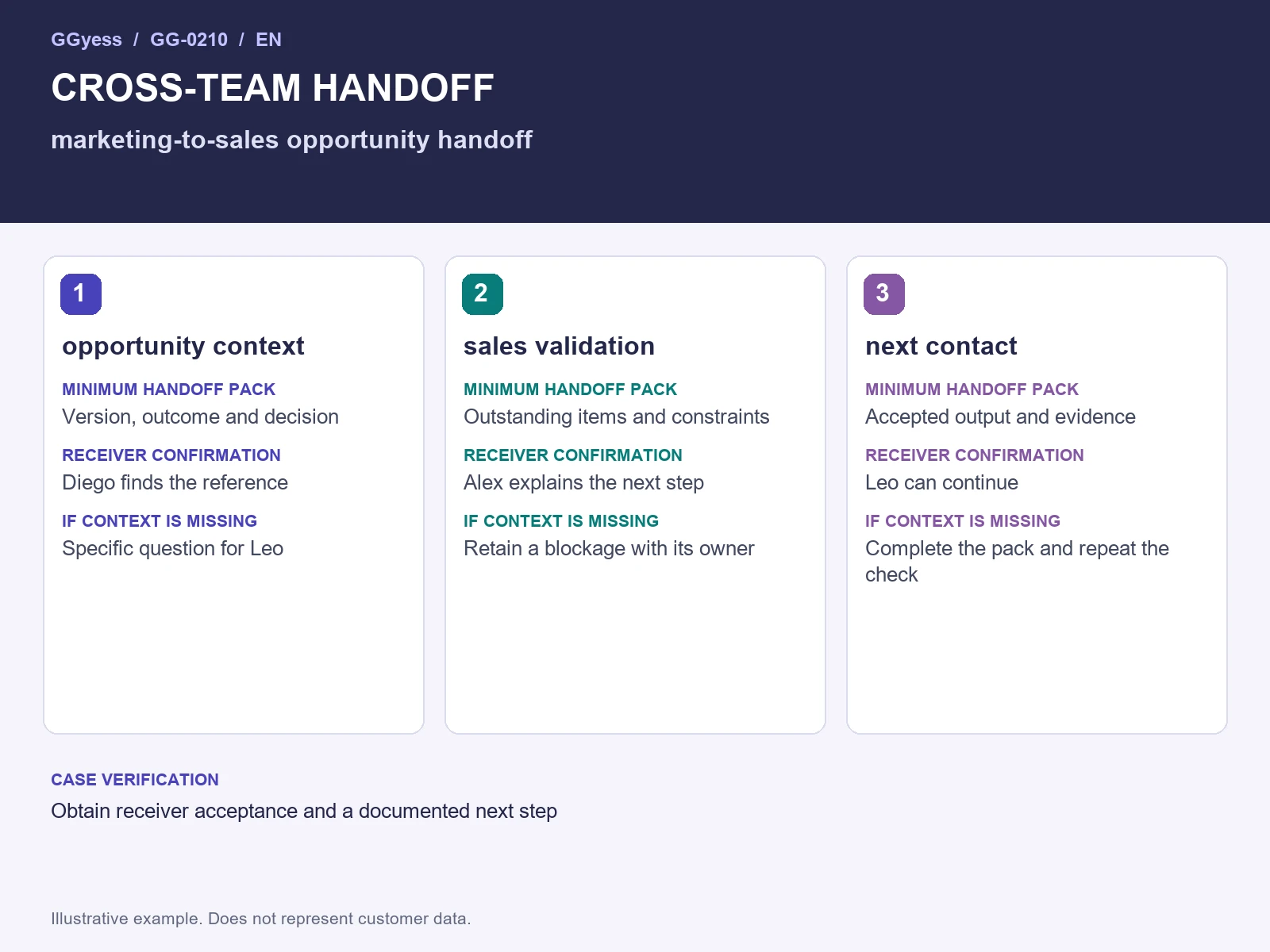
| Unit | Minimum handoff pack | Receiver confirmation | If context is missing |
|---|---|---|---|
| opportunity context | Version, outcome and decision | Diego finds the reference | Specific question for Leo |
| sales validation | Outstanding items and constraints | Alex explains the next step | Retain a blockage with its owner |
| next contact | Accepted output and evidence | Leo can continue | Complete the pack and repeat the check |
Request evidence of understanding
Receipt is established when the other person can find the material and explain how they will use it. Ask them to summarize the next step, main limitation and verification method. If they cannot, identify what the package lacks before considering the handoff complete. Here, avoid counting a sent transfer as an accepted opportunity. The proposed check is to obtain receiver acceptance and a documented next step. A “received” message may establish that a notification arrived, but not that permissions work or the context supports continuation. The confirmation should test the specific conditions the next stage depends on rather than simply create another acknowledgment message.
Resolve an incomplete handoff without duplicating work
When the receiver finds missing context, keep the question beside the deliverable and assign an answer owner. Do not open a second version of the work simply because the first is hard to locate. Reconcile the inventory with an accepted-opportunity register, separating missing production from missing documentation. After resolving the gap, record what was added and reconfirm the next action. That correction may later become a protocol field or check when it addresses an observed failure, rather than adding administrative effort without a practical purpose. The improvement should help the next receiver continue with fewer uncertainties.
What to check before closure
The risk to control in this case is counting a sent transfer as an accepted opportunity. A completed label needs a supporting observation. Keep the following beside the decision so the receiver can establish what was checked:
- Input and version used: lead context and acceptance criteria.
- Case check: obtain receiver acceptance and a documented next step.
- Outcome under review: an accepted-opportunity register.