There is a familiar and deeply frustrating phenomenon that occurs in almost every creative agency, high-growth startup, and specialized consulting firm. It is known as the “Post-Brainstorm Paralysis.”
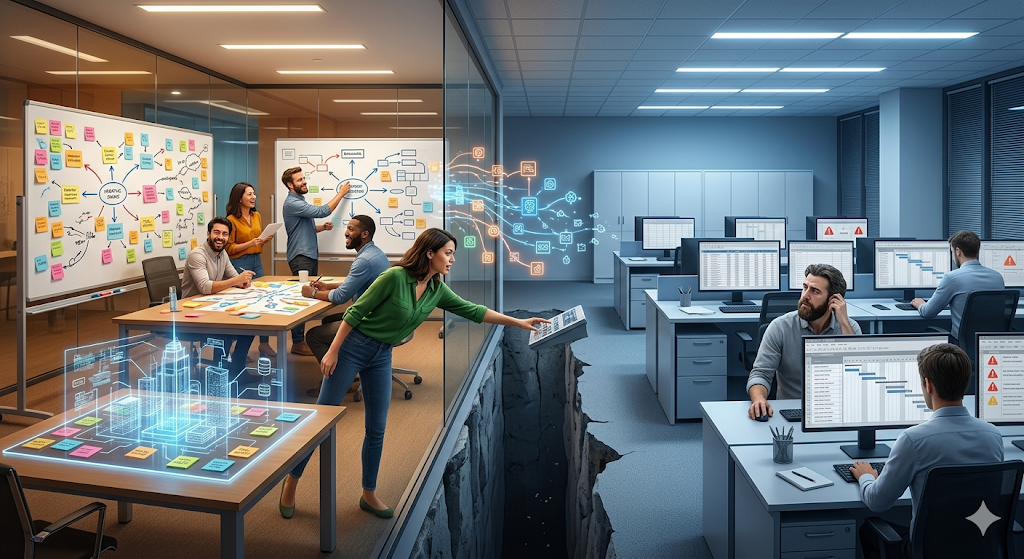
It usually begins with a surge of genuine collaborative energy. A team gathers—perhaps virtually, perhaps in person—to crack a complex problem, design a new product architecture, or map out a high-stakes marketing pivot. Ideas flow freely. The virtual whiteboard fills up with digital sticky notes, sprawling mind maps, and ambitious structural diagrams. For an hour, the team is fully immersed in a state of collective flow, sketching, connecting, and planning as one cohesive unit.
Then, the video call ends. The meeting is over. And the vibrant, living map of ideas becomes a digital graveyard.
The team transitions back to their actual project management tools—rigid, linear spreadsheets and sterile task lists—and immediately, the momentum flatlines. The creative artifacts left on the whiteboard are completely disconnected from the operational engine that actually drives the work forward. Translating that sprawling map of brilliant ideas into a sequence of actionable, assigned, and deadline-driven tasks requires hours of grueling administrative labor.
This gap between the canvas of ideation and the engine of execution is where projects stall, details fall through the cracks, and creative teams burn out. To build an elite, high-velocity organization, we must fundamentally redesign this architecture. We must bridge the chasm between raw ideas and active sprints by ensuring that our creative canvases and our task management systems share the exact same digital DNA.
The Cognitive Trap of the Isolated Whiteboard
To understand why the transition from brainstorming to execution is so painful, we must examine the cognitive friction inherent in a fragmented tech stack.
When your organization uses one application for visual brainstorming (like a standalone digital whiteboard), another application for team communication, and a third application for project management, you are forcing your team to engage in constant “context switching.”
The human brain processes visual, spatial information very differently than it processes linear, text-based data. An interactive whiteboard allows the brain to map dependencies spatially, clustering related concepts and drawing connecting lines that represent workflows. It is a highly intuitive, low-friction environment for the mind. However, when the time comes to execute, the team must manually abandon that spatial map and reconstruct it inside a rigid, column-based task manager.
This manual translation is an enormous cognitive burden. Creative ideas stay separate from project execution. Because the tools cannot communicate, a human project manager must act as the API, looking at a sticky note on a whiteboard and manually typing it out as a task card, guessing at the deadline, and assigning an owner. During this translation, the nuanced context of the original brainstorm is almost entirely lost.
The strategy is isolated from the operations. And when strategy and operations do not share the same ecosystem, execution becomes an uphill battle.
Architecting the Bridge: The Unified WorkHub
The solution is not to abandon visual brainstorming, nor is it to force creatives to brainstorm inside a spreadsheet. The solution is architectural consolidation.
We must move away from isolated software subscriptions and build a unified operational environment—a central WorkHub where the ideation canvas is natively wired directly into the task execution engine. In this integrated ecosystem, the whiteboard is not just a digital piece of paper; it is the front-end interface for your project database.
When you collaborate live on an interactive whiteboard where teams sketch, connect, and plan as one, you shouldn’t have to leave that environment to start working. A unified WorkHub allows you to turn those brainstorms into actionable tasks instantly on the shared whiteboard.
Imagine selecting a cluster of digital sticky notes representing a new website build, clicking a single button, and watching them instantly transform into an active Kanban board, complete with assigned owners and trackable progress states. By removing the spatial boundaries between the place where you think and the place where you work, you completely eradicate the “Post-Brainstorm Paralysis.”
Artificial Intelligence: The Ultimate Translator
Even with a unified platform, breaking down a massive, abstract concept into granular, executable steps requires significant mental bandwidth. This is where embedded artificial intelligence changes the fundamental speed of business.
In a traditional setup, after a whiteboard session, a project lead must painstakingly dissect a macro-goal (e.g., “Redesign Client Onboarding Flow”) into dozens of micro-tasks. In a hyper-productive WorkHub, the AI acts as your operational Chief of Staff.
Instead of manual data entry, you can simply write what you need done in plain language, and the system’s AI breaks it into detailed, actionable tasks with deadlines, priorities, and owners. You can feed the AI the raw, unstructured text from your brainstorming canvas, and it will instantly generate tasks based on your project details and requirements.
The technology parses the dependencies, understands the required roles, and builds the scaffolding for you. It sequences the work, setting intelligent due dates and automatically delegating the newly created tasks to the appropriate team members based on their specific role tags and current bandwidth. What used to take three hours of administrative drudgery now takes thirty seconds. The raw idea is instantaneously transformed into an active, breathing sprint.
Furthermore, this intelligence is conversational. If the generated project structure feels overwhelming, team members do not have to hunt down a manager for clarification; they can simply chat about tasks, assignments, and deadlines directly within the project using the built-in AI assistant.
Synchronizing the Canvas with Real-Time Reality
An execution plan, no matter how brilliantly generated by AI or beautifully mapped on a whiteboard, is useless if it does not interact with the real-world constraints of your team and your clients. The fragmented tech stack fails because it treats task management, communication, and scheduling as entirely separate disciplines.
Native Video: Ending the Screen-Share Broadcast
When a team uses a standalone video conferencing tool to discuss a digital whiteboard, the collaboration is an illusion. One person shares their screen, holding the digital marker, while everyone else passively watches a broadcast.
When video calls are natively integrated directly into the WorkHub, the dynamic is entirely democratized. The team jumps into a built-in video session, and because the call lives inside the workspace, everyone can actively edit the whiteboard, move task cards, and upload files simultaneously. There is no need to hunt for external links or juggle browser tabs. The conversation and the creation happen in the exact same spatial dimension.
Embedded Appointments: Tethering Strategy to Time
Ideation often involves external stakeholders—clients, vendors, or board members. In a broken system, scheduling these crucial strategy sessions requires sending external booking links that are completely blind to your team’s actual production capacity.
By bringing appointment scheduling natively into the WorkHub, you bridge the gap between external demands and internal reality. When a client books an appointment for a strategy session, it does not just block off a calendar slot; it anchors itself directly into your project timeline. As you brainstorm on the canvas and use AI to generate new task structures, those new deliverables are automatically contextualized around the upcoming appointments. Your availability becomes a true reflection of your capacity, preventing the team from accidentally over-committing during a heavy sprint week.
Sustaining the Sprint with Contextual Reminders
The final hurdle in crossing the gap from idea to execution is maintaining momentum over time. How do you ensure that the tasks generated from that brilliant whiteboard session are actually completed?
The old paradigm relies on a chaotic barrage of generic notifications—emails, chat pings, and dashboard badges that create notification fatigue and train the brain to ignore alerts.
A unified WorkHub utilizes an architecture of smart, contextual reminders. Because the system holds the entire project context—from the initial brainstormed notes to the AI-generated deadlines to the upcoming client appointments—it does not need to spam you. It issues highly precise, proactive nudges. It alerts the right person at the exact right moment, reminding them of an impending milestone without pulling them out of their deep-focus workflow. It guides the user’s attention strategically, protecting their cognitive bandwidth while ensuring absolute accountability.
The Evolution of the Execution Environment
We can no longer afford to let our best ideas die in the transition between disconnected applications. The cost of manual translation, scattered files, fragmented communication, and isolated calendars is simply too high.
To build an organization capable of moving at the speed of thought, leaders must consolidate their infrastructure. They must demand an environment where the transition from a sprawling visual brainstorm to a highly structured, automated execution plan is instantaneous and entirely frictionless.
This philosophy of total operational fluidity is the foundation of the new GGyess. Redesigned as an elite, uncompromising productivity engine, GGyess eliminates the chaos of the fragmented tech stack. Operating as a singular, unified WorkHub, GGyess allows you to seamlessly transition between interactive brainstorming canvases and structured task views—Kanban, Gantt, Calendar, or Table—instantly. By natively integrating built-in video calls, seamless appointment scheduling, smart contextual reminders, and an advanced AI that turns plain-language ideas into complete project structures in seconds, GGyess ensures that your strategy and your operations share the exact same DNA. Stop letting your brainstorms fade away. Turn your raw ideas into active sprints with GGyess.