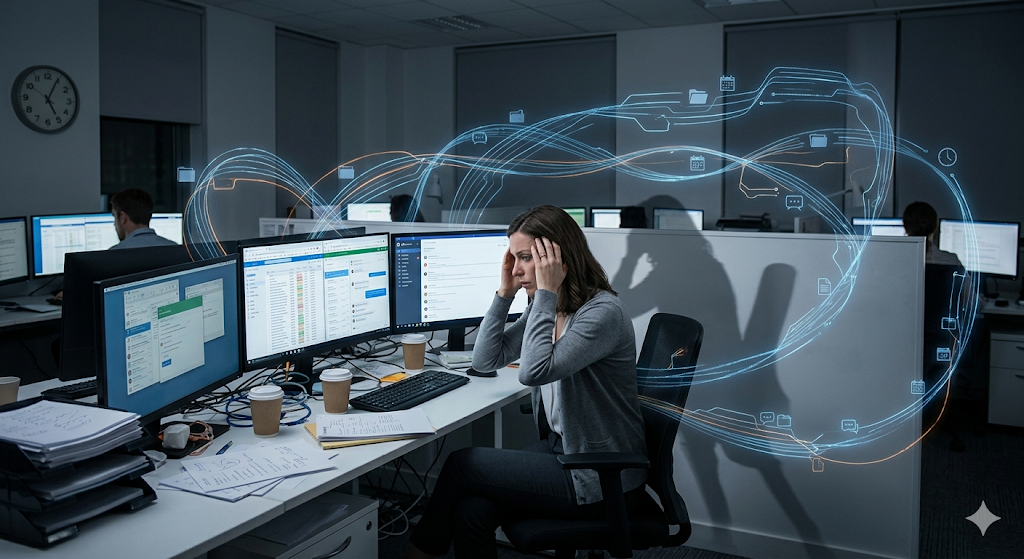
In the pursuit of hyper-productivity, modern organizations are bleeding capital in a place they cannot even see on their profit and loss statements. It is an invisible tax that saps the energy of brilliant strategists, developers, and creatives. It causes burnout, delays product launches, and stifles innovation.
We call it “Ghost Work.”
Ghost Work is the relentless, administrative labor required simply to coordinate the actual work. It is the time spent hunting for a lost asset in a cloud drive. It is the twenty minutes wasted jumping between a chat application, an email thread, and a standalone project board just to figure out the status of a single deliverable. It is the friction of sending an external scheduling link, copying a third-party video conferencing URL, and manually typing out meeting notes into a task manager.
Ghost Work is the direct, unavoidable consequence of a fragmented digital ecosystem. When an organization relies on a stitched-together “Franken-stack” of disparate applications—using one tool for messaging, another for file storage, and a completely different platform for task management—the software cannot communicate with itself. Therefore, the human being is forced to become the API.
Your most talented employees are spending up to half of their day acting as manual data bridges between disconnected apps. To build a truly scalable, high-velocity company, leadership must aggressively eradicate Ghost Work. The solution is not to hire more project managers or implement stricter reporting protocols. The solution is architectural. You must abandon the fragmented tech stack and build an Asynchronous War Room.
The Anatomy of the Digital War Room
In military and political strategy, a “War Room” is a centralized physical space where all critical intelligence is gathered. Maps, communication channels, logistical reports, and strategic commanders are all placed within arm’s reach of one another. The purpose of a War Room is to eliminate the latency of information transfer. When a decision needs to be made, every piece of contextual data is immediately visible.
Remote and hybrid teams require the exact same architecture, but in a digital format.
A digital War Room is a singular, unified workspace that connects every part of your workflow—tasks, projects, teams, and files—without forcing anyone to switch between a dozen different apps. It operates on a fundamental principle of operational design: Contextual Proximity.
When collaboration happens right next to the work, everyone remains perfectly aligned and deeply in context. If a designer uploads a wireframe, that file does not go into an isolated cloud folder where it will inevitably be lost; it is stored securely right alongside the specific task, the deadlines, and the strategic conversation regarding that exact deliverable. Every file stays connected to the project, eliminating the frustration of scattered folders and broken links.
By centralizing the asset, the communication, and the execution into a single coordinate, the War Room becomes completely self-documenting. A stakeholder does not need to interrupt a developer to ask for a status update. They simply enter the War Room, switch instantly between Kanban, Gantt, Calendar, or Table views, and instantly absorb the exact state of the project.
AI as the Chief of Staff: Automating the Scaffolding
Ghost Work thrives in the vacuum of project initiation. The moment a brilliant idea is agreed upon, a massive wave of administrative labor is usually required to set it in motion. Project managers historically spend hours, or even days, manually breaking down a founder’s vision into a linear sequence of tasks, assigning owners, and calculating due dates.
In a true Asynchronous War Room, this manual setup is entirely obsolete. Artificial Intelligence has evolved to take on the role of the operational Chief of Staff.
When a new initiative is launched, you no longer stare at a blank spreadsheet. Instead, you write what you need done in plain language, and the built-in AI instantly breaks the concept down into detailed, actionable tasks complete with smart deadlines, priorities, and designated owners. The AI generates a comprehensive task structure based purely on your project details and requirements.
This is the ultimate eradication of Ghost Work. The hours previously lost to manual task setup and coordination meetings are instantly reclaimed. But the AI’s utility does not stop at creation. As the project progresses, the AI acts as an interactive intelligence layer. Team members can literally chat with the AI about tasks, assignments, and deadlines. Instead of digging through complex boards to find an answer, a user can simply ask the AI what tasks they need to complete or instantly check the project’s overall status.
The machine handles the coordination; the humans handle the creation.
Contextualizing Real-Time Action: Video and Appointments
A common flaw in modern remote work design is the belief that asynchronous work (task boards, files) and synchronous work (live meetings, client calls) must exist in separate silos. This separation is a massive generator of Ghost Work.
If your team leaves the War Room to host a strategy session on an external video conferencing platform, the context is immediately broken. The conversation is happening miles away from the visual canvas where the work actually lives.
To achieve absolute operational fluidity, real-time communication must be brought inside the War Room. When native video calls are embedded directly into the central workspace, the dynamic changes entirely. You don’t hunt for a link; you click a button inside your project board and instantly connect face-to-face with your team. You are looking at the exact same Kanban board, the exact same AI-generated task list, and the exact same attached files while you speak. The gap between discussing a pivot and executing that pivot shrinks to zero.
Similarly, external scheduling has long been an administrative nightmare. Using a third-party booking app means your calendar is completely blind to your actual project workload. To truly protect your team’s bandwidth, appointment scheduling must be native to the War Room.
When a client books an appointment, it should not just drop a static block onto an isolated calendar. It should integrate seamlessly with your project views, interacting with your deadlines and team capacity. Integrated appointments ensure that a strategy session booked for Thursday automatically factors into the workload balancing of the entire week. It bridges the gap between external client demands and internal production reality, ensuring that your team never accidentally over-commits.
Designing for Cognitive Protection: The Role of Smart Reminders
In a fragmented tech stack, workers are subjected to a relentless barrage of “dumb” notifications. A ping from a chat app, an email from a client, an overdue alert from a standalone task manager. Because these alerts originate from disconnected systems, they lack an overarching hierarchy of importance. They do not guide focus; they destroy it.
A unified War Room protects the cognitive bandwidth of its users by replacing chaotic notifications with intelligent, highly contextual reminders.
When your entire operation—from the files to the AI task structures to the upcoming video appointments—lives in one place, the system understands your priorities. It can issue strategic, automated reminders that nudge a user exactly when a critical deadline is approaching or when an appointment is imminent. These reminders act as structural guardrails, keeping projects on track without overwhelming the user with irrelevant noise. The human brain is freed from the anxiety of remembering every microscopic operational detail, allowing it to submerge fully into deep, highly productive execution.
The Economics of Consolidation
The elimination of Ghost Work is not merely a philosophical victory; it is a profound financial advantage. The Franken-stack of fragmented software is inherently expensive. Companies routinely pay separate, premium subscription fees for a project manager, an AI text generator, a team communication app, a cloud file storage system, a video conferencing tool, and an appointment scheduler.
By consolidating all of these functions into a single, master architecture, organizations can save thousands of dollars annually while simultaneously boosting their team’s output by up to 85%. You are not just cutting software costs; you are cutting the massive, hidden operational cost of the time your team spends switching between those softwares. You are buying back hundreds of hours a month that were previously lost to manual setup and cross-platform file hunting.
Reclaiming the Future of Work
The future belongs to the organizations that can move from idea to execution with the absolute minimum amount of friction. It belongs to the teams that refuse to accept Ghost Work as a normal part of doing business.
By building a digital environment that natively fuses strategic planning, AI-assisted project generation, integrated communication, and contextual file storage, you create a workplace where elite talent can actually thrive. You build a system that manages the complexity for you, so your people can focus entirely on delivering brilliant results.
This exact architectural philosophy is the foundation of the newly evolved GGyess. Stripped of unnecessary noise and fragmented modules, GGyess is now a pure, singular productivity engine—the ultimate WorkHub. By seamlessly centralizing your project boards, file storage, AI-powered task generation, built-in video calls, native appointment scheduling, and smart reminders into one uncompromising ecosystem, GGyess eliminates the Franken-stack forever. It kills Ghost Work at the root, allowing you to architect an Asynchronous War Room that actually scales. Step into the future of unified operations with GGyess.