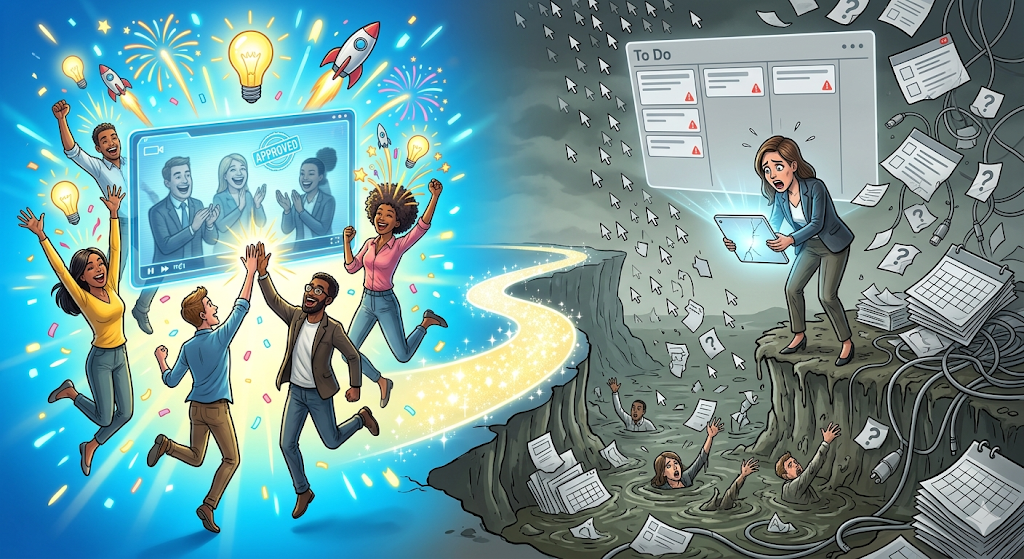
It’s Friday morning. You and your team have just finished an incredible video call with a new high-profile client. You presented the creative idea for their launch campaign, the client was fascinated, and gave immediate approval. The adrenaline is high; there’s excitement to start working.
But then the operational hangover hits.
The Account Director or Project Manager opens your project management tool. They’re faced with a completely blank board. Now they have to take that brilliant brainstorming session—those abstract concepts and ambitious goals—and manually translate them into a workflow.
They have to create the “To Do” column, write task number one, assign it to the copywriter, calculate when it should be delivered so the designer has time to create the visuals, create the designer’s task, create the trafficker’s task, schedule reviews…
What was an explosion of creativity during the video call now turns into an administrative swamp. Two or three full days of “Set-Up” (configuration) will pass before the team actually starts producing. This dark gap—where the client’s excitement cools down and your team drowns in clicks and manual setup—is known as the operational “Valley of Death.”
In this article, we’ll uncover why manual project planning is eating away at your profit margins, the flawed mindset agencies have about Artificial Intelligence, and how you can use modern technology to turn a raw idea into a perfect action plan in under 30 seconds.
The Blank Board Syndrome: The Silent Killer of Agility
We all know the “Blank Page Syndrome” writers suffer from. But in marketing agency management, there’s an equally paralyzing equivalent: Blank Board Syndrome.
Breaking down a complex campaign into dozens of interconnected micro-tasks requires massive cognitive effort. The Project Manager’s brain has to simulate time, resources, and dependencies:
“If Juan writes the copy today, María can design on Monday, but if María is delayed, then Pedro can’t launch the ads on Wednesday…”
This “task architecture” process isn’t natural for the creative human brain. It creates massive friction—and operational friction has direct consequences on your agency’s performance:
- Loss of Momentum: The team loses the spark and context of the original meeting. By the time tasks are finally assigned, no one remembers the excitement of the kick-off.
- Bottlenecks: If the Project Manager gets sick or is overloaded with meetings, creatives are left without assigned work. They have capacity but no direction—so your most expensive talent sits idle waiting for instructions.
- Fatal Omissions: When creating 40 tasks manually in a rush, it’s statistically likely to forget one. No one assigned the Facebook Pixel installation or the final proofreading. The error explodes on launch day.
The False Belief About Artificial Intelligence in Marketing
If you ask 10 digital agency owners how they’re using AI today, 9 will say the same thing:
“We use ChatGPT for copy ideas and Midjourney or DALL·E for reference images.”
The marketing industry has adopted AI almost exclusively as a content generator. And while this saves time in production, it doesn’t solve the underlying structural problem. It doesn’t matter if your copywriter can write an article in 10 minutes with AI if you spent 4 days waiting for someone to create the task, add context, and approve it in the system.
The real “holy grail” of agency profitability isn’t using AI just to do creative work—it’s using AI to run operations.
When you apply Artificial Intelligence to project management, you go from a slow, reactive agency to a relentless execution machine. AI stops being your writing assistant and becomes your virtual Director of Operations.
Cold Math: The Real Cost of Structuring Projects Manually
Let’s put numbers to the problem. Agencies live by selling time and expertise. Every non-billable hour is money straight out of the partners’ pockets.
Imagine you land 4 new clients or projects this month (a Black Friday campaign, a website redesign, an infoproduct launch, and a monthly content strategy):
- An average Project Manager spends between 3–5 hours of deep work properly structuring a medium/large project from scratch (reading the brief, creating cards, writing descriptions, assigning dates, aligning schedules, setting dependencies).
- Multiplied by 4 projects, that’s about 16 hours per month dedicated purely to “creating tasks.”
- At an internal cost of $35/hour, your agency is spending over $560 per month (nearly $6,700 per year) just on data entry and administrative micro-management.
That’s time from a highly skilled professional who should be optimizing budgets, closing upsells, or analyzing conversion metrics—instead of dragging boxes on a digital board.
It’s a waste of talent and an unacceptable financial leak in a competitive market.
The New Standard: Algorithmic Planning in 30 Seconds
How are top-performing agencies scaling without drastically increasing headcount? They’ve eliminated manual project creation and adopted AI-Assisted Structuring.
Imagine a workflow where the “Valley of Death” doesn’t exist:
Step 1: The Directive Prompt (Natural Language)
You finish the client call. You have your notes. Instead of opening a blank board, you open your WorkSuite’s AI feature and write one instruction in natural language:
“Create a project for XYZ Dental Clinic lead generation campaign. We need 3 Facebook ad variants, a landing page redesign, and a sequence of 4 follow-up emails. Launch date is the 25th of this month.”
Step 2: Deconstruction (The Algorithmic Brain in Action)
You click generate. In 30 seconds, the AI processes the request. It understands digital marketing logic (copy comes before design, design before ad setup).
Step 3: Instant Deployment
In under a minute, your screen transforms:
- Phases created: Planning, Production, Review, Launch.
- Detailed tasks: 15+ clearly written micro-tasks (“Write headline for ad variant 1”, “Design mobile banner”).
- Logical assignments: The system identifies roles and pre-assigns tasks to your Designer and Copywriter.
- Staggered deadlines: Working backward from launch day (the 25th), AI assigns realistic deadlines.
What would take half a day is solved while you sip your coffee.
The Psychology of the “Fast Start”
Instant structuring has a deep psychological impact:
For your creative team:
Receiving a fully structured project the same day maintains motivation. Writers and designers know exactly where to start. Removing uncertainty (“Where do I begin?”) triggers immediate Flow state and boosts productivity.
For your client:
In business, perceived speed equals perceived competence. If your kickoff is at 10:00 a.m. and by 11:30 a.m. the client sees their project already scheduled and in execution, trust skyrockets. You eliminate buyer’s remorse and position yourself as a premium, high-performance agency.
Protecting the System: Integrated Intelligence, Not Fragmented
A critical warning: trying to stitch this together using ChatGPT + external tools (like Zapier) often backfires.
If you generate structure externally and import it into your task manager, deadlines break, assignments fail, and you spend more time fixing automation than doing it manually.
For AI to truly save time, it must be native—built into the same platform where work happens.
From Idea to Execution in Seconds with GGyess
If you’re tired of your leadership team drowning in admin work, projects taking days to start, and paying for non-billable setup hours, it’s time to evolve.
The era of slow, heavy agencies is over. GGyess has redefined project management as the ultimate WorkSuite, integrating AI directly into your operations.
With GGyess, the “Valley of Death” disappears:
- AI Project Generator: Describe your project in natural language. In 30 seconds, AI builds a complete structure with tasks, priorities, and deadlines.
- Instant Workflow Activation: The system builds the skeleton—your team just executes. Save hundreds monthly in non-billable setup time.
- Centralized Environment: Tasks, files, meetings, and scheduling all in one place. No fragmentation.
- Full Adaptability: Change strategy mid-project? Adjust instantly with Kanban, Calendar, and Gantt views.
Growing a marketing agency requires your talent focused on strategy and creativity—not acting as digital clerks filling task forms.
Delegate the robotic work to technology and unlock your team’s human potential. Visit ggyess.com and start running your agency at the speed of thought.