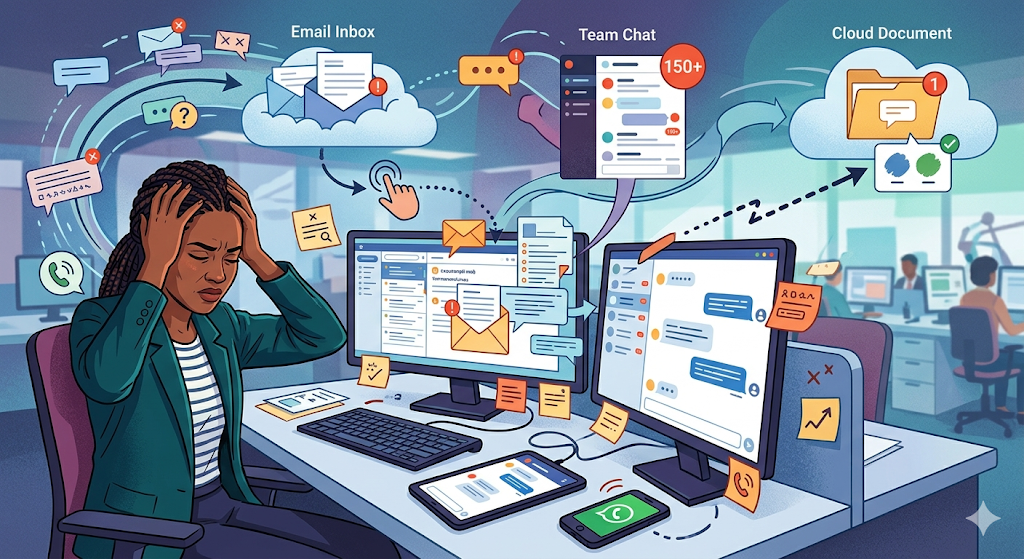
Imagine you walk into your office (or turn on your computer to work from home) and you need a simple answer from your graphic designer: “Did the client approve the blue color or the green one?”
Logically, you should get an answer in ten seconds. But instead, the hunt begins.
First, you search your email inbox. Nothing. Then you open your corporate chat application and look in the project channel. There are 150 unread messages about where everyone is ordering Friday’s lunch, but nothing from the client. Desperate, you send a direct WhatsApp message to the designer. He replies twenty minutes later: “I left it as a comment in the text document in the cloud—didn’t you get the notification?”
You’ve lost half an hour of your life tracking a single word (“blue”) across four different platforms. Multiply that wasted time by ten interactions a day, for every member of your company. The result is not only a brutal hemorrhage of money, but also a deeply stressed, disconnected, and frustrated team.
In the modern business world, we have more communication tools than ever, yet paradoxically we communicate worse than ever. It’s time to understand why our work has turned into a game of broken telephone—and how we can transform chaos into a perfectly tuned symphony.
The City Analogy: Hallway Rumors vs. The Agora
To understand the problem with modern communication, let’s travel back in time to an ancient city—say, during the era of the Greeks.
In those cities, there were two main places where information flowed: the dark, narrow hallways of secondary streets, and the great market or central square known as the Agora.
If you wanted to spread gossip, tell a secret, or say something without committing to it, you did it in a hallway. You whispered to one person, that person walked away and whispered to another. In the process, the message mutated, critical parts were lost, and if someone in authority later asked who gave the order, it was impossible to trace the original source. The hallway is the kingdom of misinformation and chaos.
But if the city’s leader needed to announce a new law, or if merchants needed to set the price of wheat, they didn’t do it in a hallway. They went to the central square. They stood in the sunlight and spoke in front of everyone involved. The message was singular, transparent, everyone heard it at the same time, and there was a public record (a parchment) of what had been agreed.
Today, your company is a digital city. And the fundamental problem is that you’re forcing your team to make critical business decisions by whispering in hallways instead of bringing information to the central square.
The 3 Digital Hallways Destroying Your Productivity
When we analyze how companies with slow operations communicate, we almost always find employees trapped in one of these three dark “hallways.”
1. The Email Hallway (The Lonely Maze)
Email was a revolutionary invention in the 1990s, but today it’s where productivity goes to die. It’s a closed communication channel.
Imagine the Marketing Director sends an email to the Copywriter with campaign instructions. The Copywriter replies. They exchange a thread of 15 emails. Suddenly they realize they need the Designer. They add them in email number 16 using CC. The poor Designer receives an incomprehensible wall of text with no context and must scroll backward trying to guess what is expected of them. Email isolates information inside private inboxes that the rest of the team cannot access.
2. The Instant Messaging Hallway (The Scrolling Abyss)
Tools like WhatsApp, Telegram, or generic office chats are wonderful for urgency (“I’ll be 10 minutes late”), but they are deadly for structured work.
Chat is ephemeral. If on Tuesday at 10:00 a.m. you made a critical decision with your development team in a chat conversation, by Thursday at 5:00 p.m. that decision will be buried under 500 messages of gifs, jokes, and questions from other projects. Searching for old information in a chat is like trying to catch water with your hands.
3. The Meeting Room (The Ghost Hallway)
Companies love solving poor written communication by scheduling one-hour meetings. The team gathers, debates, makes brilliant decisions, everyone nods… and the meeting ends. Because nobody created an official and public record, three days later each participant remembers something slightly different.
“I thought you were going to send the report.”
“No, we agreed that Juan would send it.”
The ghost hallway leaves no trace, and without a trace there is no accountability.
How to Build Your Team’s Central Square
If you want your company to operate with the speed of a startup and the precision of a Swiss watch, you must close the hallways and force all work to converge in the central square.
In collaborative project management, the “central square” is not a giant chat forum—it is contextualized communication. This means the conversation must happen exactly where the work lives.
Here are the unbreakable rules to unify your team’s voice.
Rule 1: Ban Talking About Work Away From the Work
This is the most important cultural transformation you will make in your company.
Starting tomorrow, nobody can request a design review through WhatsApp. Nobody can send corrected text by email.
If the work is “Design the Logo,” there must be a digital card or task called “Logo Design.”
All communication about that logo must happen in the comments of that card.
When you do this, you merge action with conversation. The next time someone has a question, they don’t have to search their phone—they simply open the task and read the history. The central square is always illuminated.
Rule 2: The End of Assumptions (Radical Assignment)
In a hallway, if you say “someone should do this,” everyone looks at each other and nobody does it.
In the central square, if something needs to be done, you attach a name and a surname.
When communication is unified inside a management system, every time you leave a comment or instruction you must tag the responsible person. This eliminates the toxic phrase: “I thought you were going to do it.”
When you tag someone in the context of a task, the system notifies them directly: “It’s your turn to speak or act in this square.”
Rule 3: Embrace Asynchronous Communication
Modern stress often comes from the expectation of immediate response. If you send me a chat message, you feel I should answer in five minutes—interrupting my concentration.
A well-designed central square is asynchronous.
It means you can leave your comment, file, or instruction in the project card at 9:00 a.m. and then go do deep work. I’ll enter the square at 11:00 a.m., read your message with full context, execute my part, and leave my response.
We don’t interrupt each other—but we collaborate perfectly. Unified communication respects everyone’s time.
Rule 4: Visibility by Default (Transparency)
Unless it’s confidential HR or financial information, project conversations should be open.
If the marketing team is debating the tone of voice of a campaign in the project card, and the sales team (who has access to the square) reads the conversation, they might intervene and say:
“Careful—clients are complaining about that tone on calls.”
Departmental silos break down when communication stops being private and becomes transparent. Innovation often happens when one department “overhears” what another department is debating in the public square.
The Invisible Cost of Fragmented Communication
If you still think you can run your company with scattered emails and chat groups, consider this: chaotic communication doesn’t just waste time—it destroys talent retention.
High-performing employees hate ambiguity. They hate having to act like private investigators just to find the latest version of a file or the final approval from a manager.
When a talented professional spends 30% of their week navigating administrative chaos and chasing colleagues for answers, their frustration skyrockets. Eventually they start looking for companies with clean and clear processes.
Unifying communication isn’t a technological luxury—it’s a survival strategy and a way to protect your human capital.
GGyess: Your Ultimate Digital Central Square
The big challenge in implementing this central square is that most software tools are designed to keep you in the hallways. You have one app for chatting, another for listing tasks, and another cloud app for storing documents. Forcing your team to build manual bridges between these three islands is exhausting and inefficient.
For communication to truly flow, you need an ecosystem where everything is born and lives in the same place.
You need GGyess.
We designed GGyess by observing the daily pain of fragmented teams. Our mission was to destroy the dark hallways and create the most transparent, intuitive, and unified workspace on the market.
In GGyess, the separation between “the place where you talk” and “the place where you work” simply doesn’t exist.
Every time you create a project and break down tasks, you’re creating mini central squares. If you need the team’s opinion about a document, you attach it directly to the task. Below that file, a communication thread appears. Your team can comment, debate, tag each other, and approve the document exactly in the same space where it lives.
The context is absolute.
Endless email threads trying to figure out whether the client approved something are over. In GGyess, if someone approves a project step, an immutable record is created—visible to everyone involved—with date and time.
And what if you have a brilliant idea but aren’t sure how to communicate it clearly to your team?
This is where GGyess’s integrated Artificial Intelligence becomes your best spokesperson. You can give the AI messy meeting notes or a vague instruction, and it will process them—writing clear directions, dividing the work into actionable steps, and ensuring the tone and structure are perfect so your team understands everything the first time, without follow-up questions.
GGyess centralizes noise and turns it into music.
Notifications stop being random distractions and become precise alerts: you are notified only when your attention is required in a specific square, for a task that belongs to you.
Imagine the peace of mind of opening your computer on a Monday morning. You don’t have 50 confusing emails or 100 WhatsApp messages from colleagues. You enter your dashboard, see your cards, read the perfectly organized comments of what happened during your absence, respond in context, and start working.
That’s what it means to raise your company’s standard. That’s what it means to transform stress into progress.
Close the dark hallways of digital chaos. Bring your team to the central square—where information flows, accountability is clear, and success is truly a shared effort.
Start communicating intelligently with GGyess.