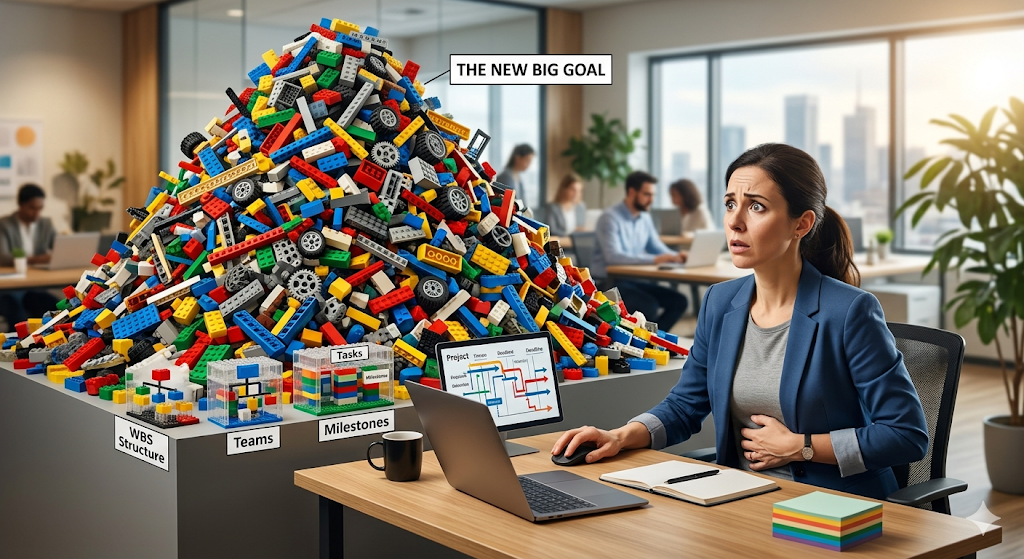
It’s happened to all of us. You arrive at the office (or open your computer at home), pour your first cup of coffee, and look at the new big goal your team has ahead of it. Maybe the project is called “Launching the New Product Line,” “Complete Website Redesign,” or “Expansion into a New International Market.”
You read the title and suddenly the coffee doesn’t taste so good anymore. You feel a knot in your stomach. The project is so big, so imposing, and has so many moving parts that your brain simply freezes. Where do we even start? Who does what? How do we prevent this from becoming absolute chaos over the next three weeks?
Welcome to the “big mountain syndrome.” In project management, facing a monumental objective without a breakdown strategy is the equivalent of trying to eat a whole watermelon in a single bite: not only is it impossible, but you’ll end up frustrated and making a mess.
This is where what we like to call The Lego Method comes into play. It’s a visual, friendly, and extremely effective way to apply what traditional engineers and project managers call a Work Breakdown Structure (WBS).
But let’s forget the boring terminology for a moment. Let’s play.
The Psychology Behind the Plastic Brick
Imagine someone gives you the Star Wars Millennium Falcon Lego set. It has more than 7,000 pieces. If you opened the box and found every piece thrown into one giant bag with no instructions, you would probably close the box and shove it into the back of a closet. The cognitive load of finding a specific piece among thousands is overwhelming.
However, Lego is brilliant—not only at making toys, but also at understanding human psychology. When you open the box, you don’t find chaos. You find numbered bags from 1 to 17 and a step-by-step manual. Bag 1 helps you build the base. Bag 2 builds the interior. Suddenly, constructing the most iconic spaceship in the galaxy isn’t about assembling 7,000 pieces; it’s about snapping together two bricks today, three tomorrow, and following a logical order.
Your brain loves this. Every time you connect two pieces correctly and move to the next page of the manual, you get a small hit of dopamine. You feel progress. You feel in control.
This is exactly the mindset you should apply to collaborative work. If you assign your team a task on their board that says “Create the marketing campaign,” you’re throwing them into the giant bag of pieces with no instructions. The result will be procrastination, anxiety, and bottlenecks.
But if you apply The Lego Method, you turn paralysis into pure action.
Why Giant Projects Fail (And How to Avoid It)
Before we assemble our project, we need to understand why teams usually stumble when faced with “the big box.”
The illusion of simplicity:
When we see the final objective, we tend to underestimate the intermediate steps. “It’s just launching a website,” we say—forgetting that it involves copywriting, design, development, SEO, user testing, and server migration.
Hidden dependencies:
In a huge project, Person B can’t do their job until Person A finishes theirs. If the project isn’t broken into small pieces, it’s impossible to know where the blockage is. It’s like trying to place the Lego roof before building the walls.
Lack of clear ownership:
When a task is too large, it’s assumed that “the team” will do it. And as the old corporate saying goes:
“If everyone is responsible, then no one is responsible.”
Demotivation from lack of early wins:
If a project lasts six months and the team only celebrates at the end, morale will drop. Breaking the project into parts allows the team to celebrate small milestones constantly—like finishing bag #1.
Step by Step: Applying the Lego Method with Your Team
Now let’s clear the table, open the box, and see how to structure any project—no matter how intimidating it seems—using this analogy.
Step 1: Look at the Picture on the Box (Define the Final Deliverable)
Never start building without knowing what you’re building.
The first step in any collaborative project is absolute clarity about the expected outcome. Is it a document? A physical event? A functional software product?
Everyone on the team must see the same “picture on the box.”
If you think you’re building a castle and your designer thinks it’s a spaceship, the pieces will never fit.
Define:
- What the result is
- Why it matters
- The final deadline
Step 2: Separate the Numbered Bags (Create Phases or Milestones)
Don’t dump all the tasks at once. Divide the big deliverable into logical phases (milestones).
If the project is “Launch a corporate podcast,” your numbered bags might be:
Bag 1: Strategy and concept
Bag 2: Visual and audio identity
Bag 3: Production of the first three episodes
Bag 4: Distribution and marketing
Each bag represents a mini-project within the larger project.
Until Bag 1 is finished and approved, the team doesn’t open Bag 2. This drastically reduces collective stress.
Step 3: Identify the Individual Blocks (Actionable Tasks)
This is where the magic happens.
You must take each “bag” and break it down into the smallest possible pieces: tasks.
A golden rule of the Lego Method is that a Lego brick can’t be divided further without breaking it.
In project management, an actionable task is one that:
- Can be completed by one person
- Takes a manageable amount of time (ideally hours or a few days—never weeks)
- Has a clear outcome
Common mistake:
“Podcast design”
That’s still a huge block.
Correct approach:
- Design the podcast cover (3000×3000 px)
- Create LinkedIn promotional banners
- Get final design approval from leadership
Each task should start with an action verb:
Design, Write, Code, Review, Purchase, Record.
If it sounds abstract, it’s still too big. Break it down again.
Step 4: Write the Instruction Manual (Context)
Having individual blocks is useless if nobody knows how they fit together.
When assigning a task to a team member, a title isn’t enough. You must provide context.
Handing off a task is like passing the baton in a relay race—it must be done carefully.
In practice, that means each task should include:
- Required files
- Reference links
- Previous comments
- A clear description of the expected result
If someone has to leave their workspace, open their email, search Google Drive, and send three chat messages just to understand their task… your instruction manual has failed.
Step 5: Assign Master Builders (Responsibilities)
Every Lego brick in your project must have one owner.
This is critical.
If two people are responsible for the same small task, they will either collide trying to place the same piece—or both wait for the other person to do it.
You can have collaborators, reviewers, and approvers, but the owner of the block—the person responsible for moving it from “To Do” to “Done”—must be one single person.
Label roles clearly.
The writer shapes the brick.
The editor polishes it and snaps it into the final structure.
How to Avoid Chaos During Assembly
Even with separated bags and a clear manual, when several people work together at the same time, things can get messy.
To keep the harmony of an orchestra—or a team of expert builders—you need some digital ground rules.
1. Total Visibility (The Glass Table)
Everyone must see how the overall project is progressing.
If the marketing team doesn’t know that the product team is behind schedule, they’ll start launching campaigns for something that doesn’t exist yet.
Visual boards—like Kanban columns or Gantt timelines—allow everyone to see exactly where things stand.
It’s like watching the Millennium Falcon slowly take shape day by day.
2. Manage the Team’s Energy (Workload Balance)
Some team members build extremely fast, while others need more time due to the nature of their work.
If, while breaking down the project, you notice that 80% of the pieces are assigned to the same developer, your project will collapse.
Seeing the project as small tasks allows you to play Tetris with workload and distribute responsibilities evenly before anyone burns out.
3. Flexibility to Recalculate the Route
Sometimes you discover a missing piece or an instruction that doesn’t work in the real world.
Agile projects allow you to rebuild one section without tearing down the entire structure.
If your project is well divided into small pieces, an unexpected problem will affect only a few blocks—not the entire building.
From Theory to Practice: You Need the Right Table
You can know the entire theory behind the Lego Method. You can understand perfectly how to divide objectives into tasks, the importance of deadlines, and assigning responsibilities.
But there’s one final critical factor:
Where you build.
If you try to assemble a giant Lego set on a shaggy carpet where pieces get lost—or on a tiny table where everything falls off the edges—the frustration will be the same.
In the workplace, your “table” is your digital tools.
If your team uses WhatsApp to request things, a static Excel sheet for deadlines, endless email threads for files, and one-hour meetings just to ask “How are we doing?”—then you’re building on the shaggy carpet.
Pieces will get lost.
This Is Where GGyess Changes the Game
Think of GGyess as the perfect building table, specifically designed so your team can apply the Lego Method without friction.
We built a platform that understands that digital chaos is the biggest enemy of productivity.
With GGyess, you don’t have to face the fear of a blank page when starting a big project.
You simply tell our AI your big idea or general objective in natural language. In seconds, the AI acts like the designer of your instruction manual: it breaks down that giant project into small, actionable tasks, proposes logical deadlines, suggests roles, and builds the structure for you.
From “Idea” to “Action Plan” before your coffee gets cold.
Once the pieces are on the table, GGyess centralizes everything:
No more lost files in the cloud. Every document, image, or reference lives exactly inside the task where it belongs.
No more emails asking “what’s the status?” Communication happens directly inside the project board—like builders talking around the same table.
And because not every brain processes information the same way, GGyess lets you change the lens you use to view the project with a single click:
- A Kanban board for intuitive card movement
- A Gantt chart to see how pieces connect over time
- A calendar so each person knows exactly which block they need to place today
Breaking a giant project into small, manageable tasks is an art that transforms anxiety into productivity.
And when you give your team the right method on the right platform, you stop putting out daily fires and start truly building the future of your business.
Organize your work intelligently.
Turn your ideas into reality.
Do it with GGyess.