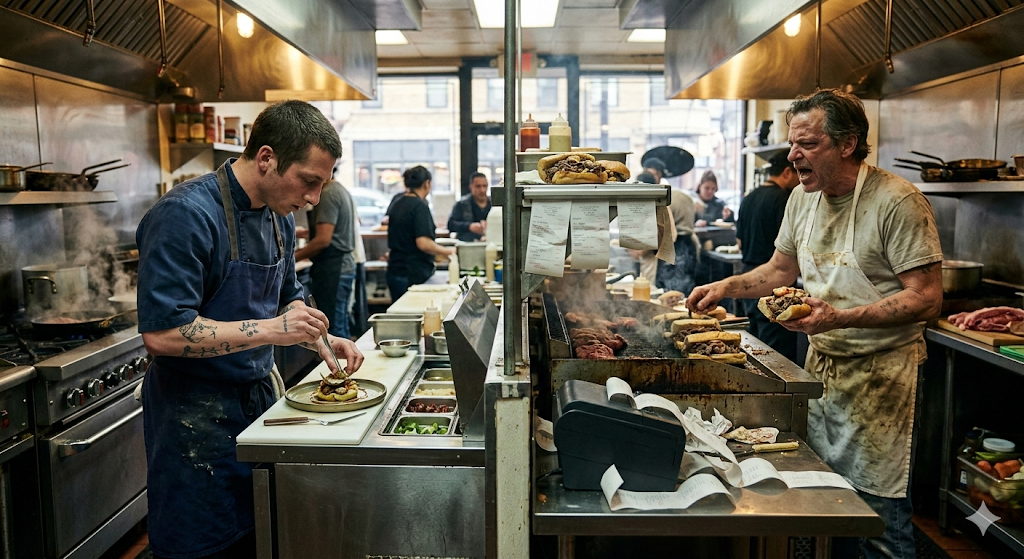
If you’ve watched The Bear, the FX series that has everyone talking about “Mise en place” and shouting “Yes, Chef!”, you know it’s not just a show about food. It is a visual treatise on anxiety, wasted talent, and, above all, what happens when a brilliant vision crashes into a non-existent operating system.
The premise is simple yet brutal: Carmy Berzatto, one of the best chefs in the world, returns to Chicago to take over his late brother’s sandwich shop. Carmy has the talent of a Silicon Valley unicorn, but the business is “The Beef”: a disaster of debt, crumbling equipment, staff resisting change, and a ticket system that seems designed by the devil himself to trigger panic attacks.
Sound familiar? Many entrepreneurs and team leaders live exactly like this. They have an incredible product and out-of-this-world talent, but their day-to-day is a constant fire. In this article, we’re going to break down the productivity lessons you can extract from this chaos and how, at the end of the day, what separates failure from success isn’t how loud you shout, but the system you use to keep the fire from consuming you.
The Ticket Machine Syndrome: The Noise That Kills Strategy
In the first season of The Bear, there is an episode filmed in a single take that is a productivity nightmare. The online ordering machine starts spitting out tickets without stopping. The sound is incessant: tack-tack-tack-tack. In minutes, the kitchen collapses. Cooks scream at each other, food burns, and Carmy—the genius—ends up paralyzed, staring at the floor.
In the modern business world, that ticket machine is your WhatsApp notifications, “urgent” emails, Slack messages, and calls from complaining clients. When you don’t have an automated workflow, your brain becomes that Chicago kitchen. You are in “reaction mode.” You aren’t building an empire; you’re just trying not to let the sandwich burn.
Real labor productivity isn’t about running faster through the kitchen. It’s about having a system that organizes those tickets before they reach your hands. If your process management depends on you remembering everything, you’ve already lost. Work stress isn’t born from overwork, but from a lack of order over that work.
Mise en Place: Much More Than Chopped Onions
Carmy tries to impose the concept of Mise en place (everything in its place) from day one. For a cook, this means having ingredients cut, tools sharpened, and the space cleaned before service starts. For a professional, Mise en place is data management and resource organization.
How many times have you wasted half an hour looking for a “final-final-v2” file on your computer? How many times have you forgotten to follow up with a client because the reminder was on a Post-it that fell off your monitor? That is a lack of Mise en place.
Personal and business productivity starts with infrastructure. If your CRM is outdated or if your team doesn’t know where to find critical information, you are operating in a dirty kitchen. The time you spend “searching” is time you aren’t “creating.” An efficient system allows you to arrive at the office (or the kitchen) and simply execute, because the preparation was already done at the system level.
The Cost of Operational Debt: Carmy’s Tomato Cans
Without giving too many spoilers, there is an iconic moment where Carmy discovers his brother left money hidden in tomato cans. But to get to that money, he had to spend months fighting a stove that wouldn’t light, chaotic administration, and technical debt that nearly drove him insane.
This is what we call “Operational Debt.” It’s all those manual processes, temporary patches, and mediocre tools you use “for now.” The problem is that “for now” becomes “forever.” Every time you use an Excel sheet for something that should be an automated process, you are accruing interest on your operational debt.
Digital transformation isn’t a luxury; it’s how you clean out the tomato cans of your business to find the real profit. If your human talent is busy manually filling cells or sending follow-up emails one by one, you are wasting your company’s most expensive resource. Resource optimization starts by eliminating friction.
Direct Communication: “Behind,” “Heard,” “Hot”
In a high-performance kitchen, communication is minimalist and functional. “Behind” means someone is passing with something dangerous. “Heard” means the instruction was received. There is no room for interpretation.
In companies, we suffer from poor communication process management. We send three-paragraph emails for something that could be resolved by a status change on a dashboard. We hold hour-long meetings to “align” things that should be clear in a centralized system.
Operational leadership consists of reducing noise. You need your team to speak the same language and for information to flow without you needing to be the intermediary. When you centralize communication on a single platform, you eliminate the misunderstandings that generate delays and costly errors.
The Richie Factor: From Obstacle to Key Player
Richie is the character who resists change the most in the series. He is loud, messy, and seems to only get in the way. However, when given a system, a purpose, and the right tools (and a crash course in customer service), he becomes the restaurant’s greatest asset.
Many leaders think their team “isn’t good enough” or that “people don’t want to work.” Most of the time, the problem isn’t the people—it’s the system. If you throw a brilliant person into a chaotic system, the system will win and the person will burn out. But if you put a motivated person into an efficient workflow system, you will see wonders.
Scalability depends on how easy it is for a new team member to understand what they need to do. If your business depends on you being there to explain everything, you don’t have a business; you have a very stressful self-employment.
Why Talent Isn’t Enough to Avoid Burnout
Carmy is a genius, but he nearly dies trying. The series shows us that individual talent has a ceiling. You can be the best designer, salesman, or programmer in the world, but if your task management is manual, your ceiling is your own energy. And energy runs out.
Burnout doesn’t come from working hard on what you love; it comes from working hard on things you hate—like searching for lost invoices, fixing communication errors, or trying to guess which client was the most urgent. Sustainable business productivity is built on systems that don’t depend on your mood or your ability to pull all-nighters.
The Digital Expeditor: Where Chaos Becomes Order
In the kitchen, there is a key figure: the Expeditor. This is the person who doesn’t cook, but organizes all the tickets, decides what goes out first, and ensures Table 4 gets their food at the same time. The Expeditor is the brain of the operation.
Your business needs a Digital Expeditor. It needs a place where leads don’t get lost, where tasks have clear owners, and where follow-up is automatic. You need to move from “decision-making under pressure” to “data-driven decision-making.”
This is where the fiction of The Bear meets the reality of your company. Carmy had to rebuild everything from scratch to go from “The Beef” to “The Bear.” You don’t have to close your business to reinvent it; you just have to change the engine.
GGyess: The Operating System Carmy Would Have Dreamed Of
If Carmy had possessed a platform like GGyess, half of the show’s episodes wouldn’t have existed because the problems would have been solved with a click. GGyess is that unified system that takes operational chaos and transforms it into a perfect choreography.
Why is GGyess the solution for total chaos in a kitchen (or an office)? Because it understands that productivity isn’t a to-do list; it’s an ecosystem.
- Centralization that eliminates noise: Instead of having information scattered across five different apps, GGyess centralizes your workflow. It’s your total control dashboard.
- Automation against operational debt: GGyess allows you to automate the processes that currently steal your time. It’s like having a team of digital sous-chefs preparing everything so you only have to provide the finishing touch.
- Process visibility for scalability: With GGyess, knowledge doesn’t live in your head; it lives in the system. There are no “gray areas” or lost responsibilities.
- Frictionless CRM and Client Management: Manage your business relationships with the precision of a three-star Michelin restaurant.
Conclusion: It’s Time to Stop Shouting and Start Managing
The final lesson of The Bear is that excellence is a daily choice supported by order. Carmy learned he couldn’t do it alone and he couldn’t do it without a system to back his vision.
Your business has the potential to be a unicorn. But to get there, you have to put out the operational fires once and for all. You have to stop being the firefighter and start being the Chef of your own life.
Step into operational clarity with GGyess. Because the world doesn’t need you to work more hours; it needs your hours to be worth more. It’s time to say “Yes, Chef” to your own productivity.