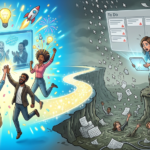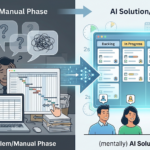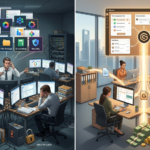
It was eight in the morning when Andrés turned on his computer. He had a clear plan: finish the strategic proposal his company needed for expansion. He felt motivated. He took a sip of coffee, opened a blank document, and just as his fingers brushed the keyboard, he heard it. A faint “ping” coming from one of the fourteen open tabs in his browser. It only took a second. A notification from an internal chat. Andrés thought it wouldn’t hurt to take a quick look. It would only be ten seconds.
But those ten seconds were the beginning of the end. When he returned to the document, the sentence he had in mind had evaporated. He stared at the blinking cursor, that relentless metronome that seemed to mock his inability to pick up the thread. Frustrated, he decided to check his email “just to clear his mind.” Then, a glance at metrics on another platform. Next, a file he couldn’t find, forcing him to jump between three cloud folders. When he looked at the clock again, it was 11:30 AM. The coffee was ice cold, the proposal was still on the first paragraph, and Andrés felt a mental fatigue as heavy as if he had been breaking rocks in a mine.
What Andrés experienced is not a lack of discipline. It is a pathology of the digital age that neuroscience has begun to break down with surgical precision. We are not designed to live in fragments, and yet, we have built a work environment that forces us to chop our attention into a thousand pieces every hour.
Dopamine hijacking and the illusion of productivity
To understand why we feel so exhausted at the end of the day despite having produced little, we must look inside our skulls. Our brain has a region called the Prefrontal Cortex. It is, so to speak, the conductor of the orchestra. It handles planning, logical reasoning, and, above all, inhibitory control: the ability to say “no” to distraction in order to say “yes” to what is important.
However, this region consumes a massive amount of energy. Every time you make a decision—even one as small as deciding which tab to click—you are spending glucose and oxygen. When you jump from a project management tool to a chat, and from there to a spreadsheet, you are forcing your brain to perform what neuroscientists call “switching costs.”
The problem is that our primitive brain, the limbic system, loves novelty. Evolutionarily, a new stimulus could mean food or danger. That is why every time you receive a notification or open a new tab, your brain releases a small burst of dopamine. It is an instant chemical reward. It makes you feel “connected”; it makes you feel like you are “doing something.” But it is a trap. It is low-quality dopamine. It is the mental equivalent of eating refined sugar: it gives you a momentary high but leaves you malnourished and exhausted shortly after. We live in a feedback loop where we reward our brains for being distracted, atrophying our capacity for depth.
The science of Attention Residue: The trail that holds us back
Sophie Leroy, a researcher at the University of Minnesota, coined a term that should be plastered on every office wall: Attention Residue. Her study demonstrated that when you move from Task A to Task B, your attention does not follow you immediately. A significant portion of your cognitive capacity stays “stuck” in the previous task.
Imagine you are writing a report and stop for a moment to read a message from a colleague about a problem in another project. Even if it only takes thirty seconds to read it and you return immediately to your report, your brain continues to process the information from the message in the background. That “residue” acts as a weight. You cannot think clearly about the report because your biological CPU is busy trying to close the process of the message.
If you multiply this residue by the dozens of times we switch contexts a day—jumping between apps, emails, and notifications—the result is that we never operate at our maximum capacity. We are working with a half-powered brain, trying to solve complex problems with a fraction of our real intelligence. Fragmentation doesn’t just make us slower; it literally makes us temporarily less intelligent.
Deep Work: The superpower of those who achieve the impossible
In this scenario of digital chaos, Cal Newport introduced a philosophy that has become a beacon for high-performance professionals: Deep Work. Newport defines it as the ability to focus without distraction on a cognitively demanding task. It is the state where real value is created. It is where a programmer writes elegant code, where a strategist designs the future of a company, and where a writer produces a work that lasts.
Deep Work is not a luxury; it is the only real competitive advantage in a world where artificial intelligence and automation can do shallow work (answering emails, organizing schedules, performing repetitive tasks) much better than we can. What AI cannot replicate—at least for now—is the creative and deep synthesis that occurs when a human brain immerses itself for hours in a single problem.
But there is a massive obstacle to reaching this state: tool friction. If your workflow forces you to constantly leave your “creation space” to search for information elsewhere, you are breaking the spell. “Flow,” that psychological state described by Mihaly Csikszentmihalyi where we lose track of time and reach our peak performance, is extremely fragile. It requires an environment that minimizes the need to make irrelevant decisions.
The 23-Minute Rule and the collapse of flow
Various studies from the University of California have pointed out that the average worker is interrupted every 11 minutes. But most alarming is that once interrupted, the brain takes approximately 23 minutes and 15 seconds to return to the original level of depth.
Let’s do the math of frustration. If something pulls you away from your center every 11 minutes, and you need 23 to get back to it, the conclusion is devastating: most modern professionals never actually get to work deeply. They live on the surface, in what Newport calls “Shallow Work.” This type of work keeps you busy but doesn’t move you forward. It’s the kind of work that allows you to say at the end of the day, “I sent 50 emails,” but leaves you with the feeling that your main project hasn’t moved an inch.
This state of constant superficiality has a biological cost. Cortisol, the stress hormone, rises. The hippocampus, responsible for memory and learning, can even suffer damage from the chronic stress of multitasking. We aren’t just losing money and time; we are eroding our mental health.
The brain hates chaos: The search for cognitive safety
From a neuro-writing perspective, we must speak to the reptilian brain—the part that seeks safety and order. Digital clutter is interpreted by our brain as a threat. Having files in Dropbox, tasks in Trello, conversations on WhatsApp, and planning in a scattered Excel sheet generates a background noise that the brain perceives as “chaos.”
When we don’t know where information is, our amygdala activates. There is constant tension, a micro-anxiety over the possibility of forgetting something important or not finding a vital resource at the necessary moment. This cognitive load is exhausting. For the brain to allow itself to enter a state of Deep Work, it needs to feel it is in a safe and controlled environment. It needs to know that everything it needs to complete the mission is within reach, without having to cross the “valley of distractions” that opening a tab-filled browser entails.
Centralization is not just a matter of order; it is a neurological necessity. By reducing the places where the brain has to search, we free up mental bandwidth for what truly matters: execution.
Environment architecture as destiny
We tend to believe that productivity is a matter of willpower. We think: “Today I am going to concentrate.” But neuroscience tells us that willpower is a finite resource that is depleted with use. If you have to use your willpower to not check social media or to avoid getting distracted while jumping between five apps, you will run out of energy for real work.
True productivity is not based on discipline, but on the design of the environment. If you design an environment where distraction is difficult and focus is the path of least resistance, you will win by default. This is where Newport’s Deep Work theory hits technological reality. Most of our tools are designed to fragment us. They are designed to retain our attention, not to help us finish our task and go home to rest.
To reclaim our minds, we need an architecture that works in favor of our biology, not against it. We need an ecosystem that acts as an extension of our own prefrontal cortex: organized, focused, and free of unnecessary noise.
GGyess: The ecosystem where the brain finds its home
This is where the philosophy of Deep Work stops being a theoretical concept and becomes an operational reality. At GGyess, we haven’t built just another app; we have designed the ultimate sanctuary for your productivity. We understood that the great enemy is not hard work, but the fragmentation of tools.
GGyess is born from the conviction that your brain deserves a break. By consolidating everything we previously knew as a WorkSuite into a single, robust ecosystem, we have removed the seams from your workday. Why jump between ten apps when you can have your planning, your project management, your team, and your files under one digital roof?
When you enter GGyess, your brain receives a clear signal: “You are safe, here you can create.” Our integrated AI doesn’t just help you organize tasks; it acts as a cognitive co-pilot that breaks down complex projects in seconds, eliminating the analysis paralysis that often precedes the start of any great work. With features like “One Thing Mode,” GGyess allows you to silence the noise of the world and focus exclusively on the task in front of you, protecting your precious dopamine for the achievements that truly transform your business.
Imagine for a moment what your life would be like if you could reclaim those 23 minutes of focus you lose with every tab switch. Imagine finishing your day having made real progress on your most ambitious goals, with a clear mind and cortisol under control. That is what GGyess does for you. It’s not just software; it’s the tool that allows your brain to function at its maximum potential, transforming chaos into ordered and exponential growth.
You have spent too much time paying the distraction tax. It’s time to give your talent the environment it deserves. It’s time to stop jumping and start building. With GGyess, the power of simplicity becomes the force of the extraordinary. Enter ggyess.com today and discover what it’s like to work when nothing stops you. Your brain will thank you, and your success will be the inevitable result of having reclaimed your capacity to focus.