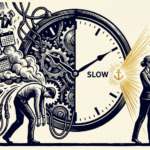
There is a dangerous chasm between knowing what you have to do and actually doing it. You may have read the previous chapters, understood the theory of emptying your mind, and agreed with natural planning, yet still remain paralyzed. Why? Because your environment is not designed for action. It is designed for accumulation.
In this fourth chapter, we enter the practical implementation phase. This is where philosophy hits the ground. David Allen posits a fascinating premise: to make the system work, you don’t need more willpower. You need to outsmart your own laziness. You must prepare your physical and mental environment in such a way that being productive is easier than not being productive.
The Art of Tricking Your Own Brain
Productivity is not a matter of character; it is a matter of mechanics. The secret lies in using intelligent “tricks” that facilitate doing the right thing. Allen suggests that we have two versions of ourselves: an awake, intelligent, and ambitious part (the “Boss Self”) and a lazy, reactive, and forgetful part (the “Employee Self”).
The goal of the system is to allow your “Boss Self” to organize the environment so that your “Employee Self” can execute tasks almost automatically, without having to think. It’s like leaving your running shoes at the door the night before; you are setting a positive trap for your future self. If you have to search for the shoes, you won’t go running. If they are there, blocking the door, you will.
The ultimate goal is not to act better based on how we feel, because often we will feel tired. The goal is to make it so easy to act that we end up feeling better simply for having moved forward.
Building Your Command Bridge
To lead your life, you need a cockpit. You cannot manage an empire, or even a family, from the corner of the kitchen table surrounded by crumbs and old bills. You need a physical space that your brain unequivocally identifies as your command center.
This is non-negotiable. You need a writing surface and, most importantly, space for a physical inbox. And here comes a rule that often breaks domestic harmony but saves mental sanity: this space must be yours. Exclusively yours. It is not shared with a spouse; it is not shared with coworkers. Your inbox is sacred. If someone else puts their papers there, the system collapses because your brain stops trusting that what is inside is “your” responsibility.
And don’t fool yourself into thinking that because you have an office, you don’t need a space at home. Your personal life requires management. You need identical and interchangeable systems in both places. And if you are a modern nomad living in planes and hotels, your briefcase must become a portable micro-office, equipped with everything necessary to take advantage of those dead times in waiting rooms.
The Tools of Low Friction
You don’t need NASA technology to start. In fact, analog tools are surprisingly effective at reducing friction. You need stackable paper trays (at least three), an endless supply of paper, pens that work, paperclips, and a trash can large enough that you don’t feel bad throwing things away.
But there is one tool Allen highlights above all others, a small device that seems trivial but has a profound psychological impact: the label maker.
It may seem obsessive, but there is a neurological reason behind it. If you label a folder with a hand-scrawled scribble, your brain interprets it as “temporary information” or “trash.” If you use a printed label, with clear and uniform typography, your brain registers it as “official data” and “established order.” A well-labeled file changes your perception of control. It motivates you to keep the system clean because it looks professional.
The Filing Bottleneck
This is where most attempts at organization die. The lack of a functional general reference filing system is the biggest killer of productivity. The rule is brutally simple: if it takes more than sixty seconds to file something, you won’t file it. You will leave it in a pile “for later.” And that pile will grow into a mountain of guilt.
To avoid this, your filing system must be at your fingertips. Literally. You must be able to grab a folder and put it away without getting up from your chair. If you have to walk to a metal filing cabinet on the other side of the room, physical resistance will win the battle.
And forget about organizing by complex categories, colors, or projects. That requires too much thinking. The only system that works long-term is pure alphabetical, A to Z. A single place for everything. Car invoice? Under C. Washing machine warranty? Under W.
Keep the drawers loose. If you have to shove papers to make them fit, your subconscious will resist putting anything new away. Always have fresh folders ready to be used. The goal is for the barrier to entry for filing a paper to be zero.
The Two-Day Immersion
Now that you have the space and the tools, you need the time. And here, half-measures won’t do. You cannot implement this system in fifteen-minute gaps between meetings. You need a massive time block.
Allen recommends setting aside two full days, preferably a weekend, to perform the “take-off.” It is major surgery on your workflow. Gathering everything in your house and office can take about six hours, and processing it all another eight.
Trying to do this during office hours is productive suicide. Interruptions will double the time needed and break your concentration. You need to isolate yourself. And before locking yourself away in this organization retreat, you must “clear the decks.” If there are urgent calls that will worry you, make them first. If there are fires burning, put them out. Only when the immediate horizon is clear can you dive into the depths of your accumulated clutter and emerge victorious.
Reclaim 50 Hours a Month: The Real Impact of Eliminating Context Switching with GGyess
We have talked about plastic trays, label makers, and physical filing cabinets. These are vital tools for the physical world. But let’s be honest: in 2025, 90% of your “clutter” isn’t on papers on your desk. It is in your browser tabs.
David Allen taught us that physical friction (having to get up to file) kills productivity. Today, that friction has mutated. Now it is called Context Switching.
Context switching happens every time you jump from drafting an email in Gmail to checking a task in Asana, then to finding a file in Drive, and then to answering a message in Slack. Each jump is micro-friction. Modern studies show that it takes about 23 minutes to regain total focus after an interruption or abrupt change of task.
If we apply Allen’s “cockpit” philosophy to the digital world, the problem is evident: we don’t have a single control station. We have ten open applications competing for our attention.
GGyess is the answer to this design problem. It is the digital materialization of the “perfect desk” Allen described.
Imagine having your “inbox,” your “projects,” your “calendar,” your “reference file” (cloud storage), and your communication system on a single screen.
By consolidating your work environment in GGyess, you eliminate the friction of jumping between applications.
- Filing is immediate: You don’t search across three different clouds; everything is linked to the project.
- Action is fluid: You don’t copy tasks from a chat to a planner; the conversion is automatic.
- Focus is total: By not leaving the platform, your brain doesn’t have to “reboot” its context every five minutes.
The impact of this is measurable and astounding. Users who centralize their operations in GGyess report reclaiming an average of 50 hours per month.
That is 50 hours that were previously lost to the “digital trash” of loading times, multiple logins, searching for scattered information, and the mental fatigue of context switching.
You have already prepared your physical space. Now is the time to prepare your digital space. Stop working in a fragmented environment that drains your energy. Build your ultimate command bridge in the cloud.
Reclaim your time, eliminate friction, and center your life with GGyess.
Start today and discover what you will do with those extra 50 hours a month at GGyess.com