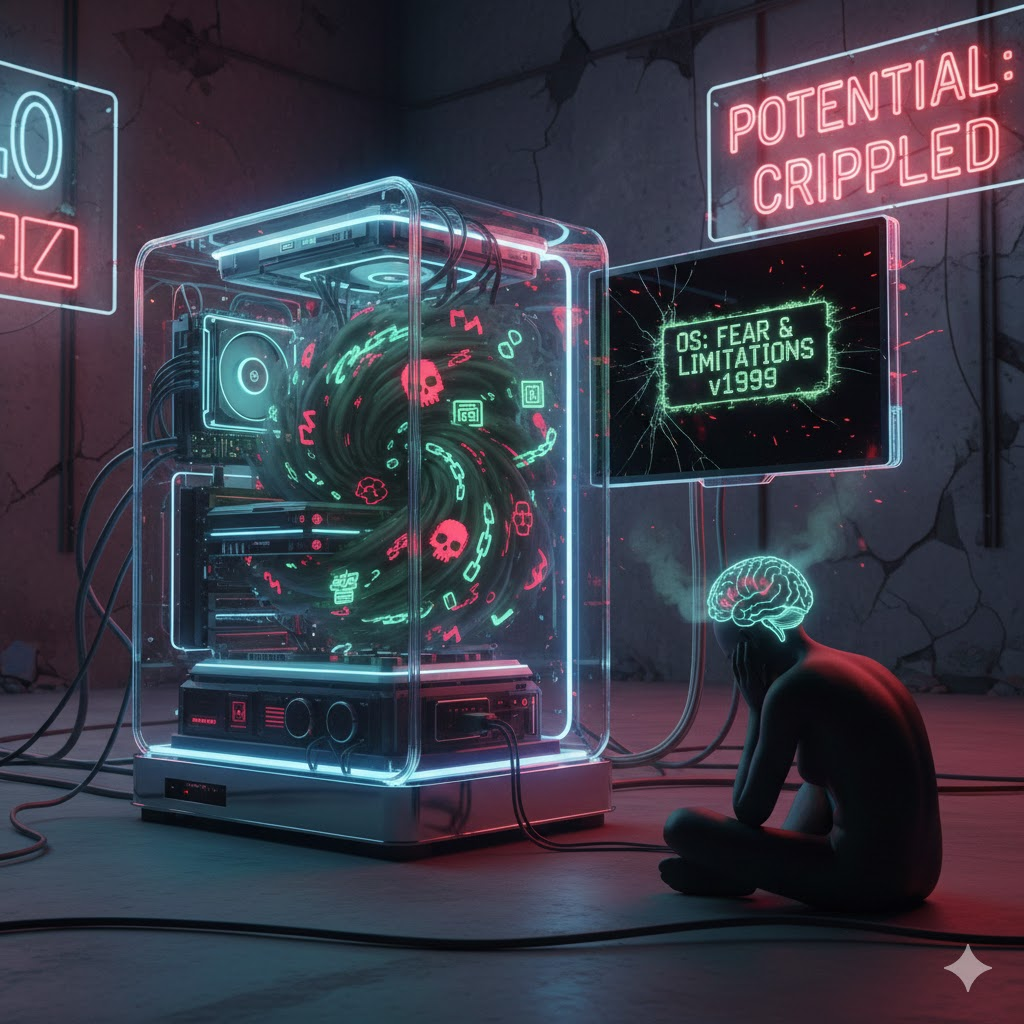
If you bought the most sophisticated computer on the market but installed a 20-year-old operating system full of viruses, what kind of performance would you get? A disaster. The hardware would be perfect, but the software would cripple its potential.
According to Brian Tracy, this is exactly what happens to most people. They have the capacity (hardware) to become wealthy and fulfilled, but they operate with a defective “master program” filled with outdated fears and limitations.
In Chapter 2 of Million Dollar Habits, Tracy introduces the most important concept in performance psychology: Self-Concept. This is your mental operating system. Everything you have achieved so far—and everything you will achieve in the future—depends not on what happens “out there,” but on how this program is configured “in here.”
The good news is that, unlike an old computer, you can rewrite your own code. You can uninstall fear and doubt, and install the mental habits of wealth and success. Here’s how to access the command console of your own mind.
1. The Master Program: Your Self-Concept Predicts Everything
For over a century, psychologists have searched for the root cause of success and failure. The conclusion is unanimous: your self-concept is your destiny.
Your self-concept is the collection of beliefs you hold about yourself. It is the control center.
If you believe you’re disorganized, you will be disorganized.
If you believe you’re bad with numbers, you will make financial mistakes.
If you believe you are capable of earning millions, your brain will find a way to make it happen.
Tracy explains that you don’t just have one global self-concept, but multiple “mini self-concepts” for each area of your life. You have one for your weight, another for creativity, another for relationships—and most importantly, one for income.
If your financial self-concept is programmed at “€30,000 a year,” it doesn’t matter how hard you work or what opportunities appear. If you temporarily earn more, your subconscious will sabotage you to bring you back down to that level. That is your comfort zone. To change your external results, you must first raise the internal thermostat of your self-concept.
2. The Power Triad: The Three Components of Your Personality
To reprogram yourself, you must first understand the components of your operating system. Tracy breaks the self-concept into three interdependent elements.
A. Your Self-Ideal (The Magnetic North)
This is the vision of the person you aspire to become. It is built from your dreams, values, and—most importantly—your heroes. Successful people have clear ideals. They admire leaders, entrepreneurs, and principled individuals, and unconsciously strive to emulate them.
The Hack: Define clearly who you admire and why. The clearer your ideal, the faster you evolve toward it.
B. Your Self-Image (The Inner Mirror)
This is how you see yourself right now. It’s the inner mirror you glance at before taking action. If before a meeting you visualize yourself as confident and authoritative, you will act that way. If you see yourself as a nervous impostor, your body language will betray you.
The Hack: Feed your mind positive images. Visualize peak performance before every important event. Your subconscious does not distinguish between real experiences and vividly imagined ones.
C. Your Self-Esteem (The Reactor Core)
This is the most critical component. Self-esteem is defined as “how much you like yourself.” It is the energy source of your personality.
High self-esteem equals high performance, optimism, and resilience.
Low self-esteem equals fear, doubt, and victimhood.
Tracy introduces the most powerful tool in the chapter: the affirmation “I like myself.” Repeating these words acts like an emotional antivirus. The more you like yourself, the less you fear rejection and the more capable you become of setting big goals.
3. The Origin of the Virus: Why We Develop Fear
If we are born designed for success, where do our blocks come from? Tracy explains that we enter the world with only two natural qualities: fearlessness and total spontaneity. As children, we fear nothing and express everything.
But during childhood, we “install” two destructive habit patterns.
The Inhibitory Habit (Fear of Failure)
This develops when we hear “No,” “Stop that,” “Don’t touch.” We internalize the message: I can’t. As adults, this becomes paralysis. We want to try something new—a business, an investment—but the old program screams: I can’t, it’s dangerous, I’ll lose money.
The Compulsive Habit (Fear of Rejection)
This forms when love becomes conditional. We are rewarded with affection when we behave correctly and deprived of it when we don’t. The message becomes: I must please others. As adults, we become hypersensitive to opinions, afraid to sell, lead, or stand out.
The cure for both fears is self-esteem. When you like yourself enough, fear of failure and fear of rejection lose their grip on you.
4. The Mental Laws That Reprogram Your Destiny
To close the chapter, Tracy delivers the engineering tools for rebuilding your mind. Desire alone is not enough. You must apply these laws.
The Law of Habit
“Anything you do repeatedly becomes a habit.” You were not born afraid; you learned fear. Which means you can learn courage. If you force yourself to do what you fear again and again, bravery becomes your new default.
The Law of Emotion
“Every action is stimulated by emotion.” Thoughts are cold; emotions are fuel. When you think about your goals with strong emotion—desire, joy, excitement—you program them into your subconscious far faster than neutral thinking ever could. But beware: fear is also a powerful emotion. Worrying intensely programs failure just as effectively.
The Law of Concentration
“Whatever you dwell upon grows.” This is the law of focus. If you spend your day thinking about debt, debt expands in your mind and your reality. If you focus on income and solutions, your mind becomes a laser for financial opportunity. Successful people think about what they want. Unsuccessful people think about what they fear.
The Law of Subconscious Activity
Your subconscious is a loyal server running 24/7. It accepts any command you give it—especially those charged with emotion and repetition—and aligns your words, actions, and body language accordingly. If you tell it, “I am a millionaire in the making,” it will begin flagging opportunities you previously ignored.
Your Potential Is Unlimited
The final message of Chapter 2 is a call to radical responsibility. You are the architect. Your current self-concept is not permanent—it is only a draft. You can delete the old programs of I can’t and I must please, and replace them with I can do this and I like myself.
The limits of your achievement are not set by the economy, your boss, or your education. The only real limit is the barrier you build in your own mind. When you take control of your Master Program, you take control of your financial future.
To bring this mental reprogramming into the real, tangible world of business, you need tools that reflect that new clarity and order. GGyess WorkSuite is the digital mirror of a well-organized executive mind. By using GGyess to structure projects, visualize financial goals, and track progress, you apply the Law of Concentration in daily practice. GGyess eliminates operational noise that feeds doubt and provides the structure required for your new success-driven self-concept to materialize into measurable, concrete results.