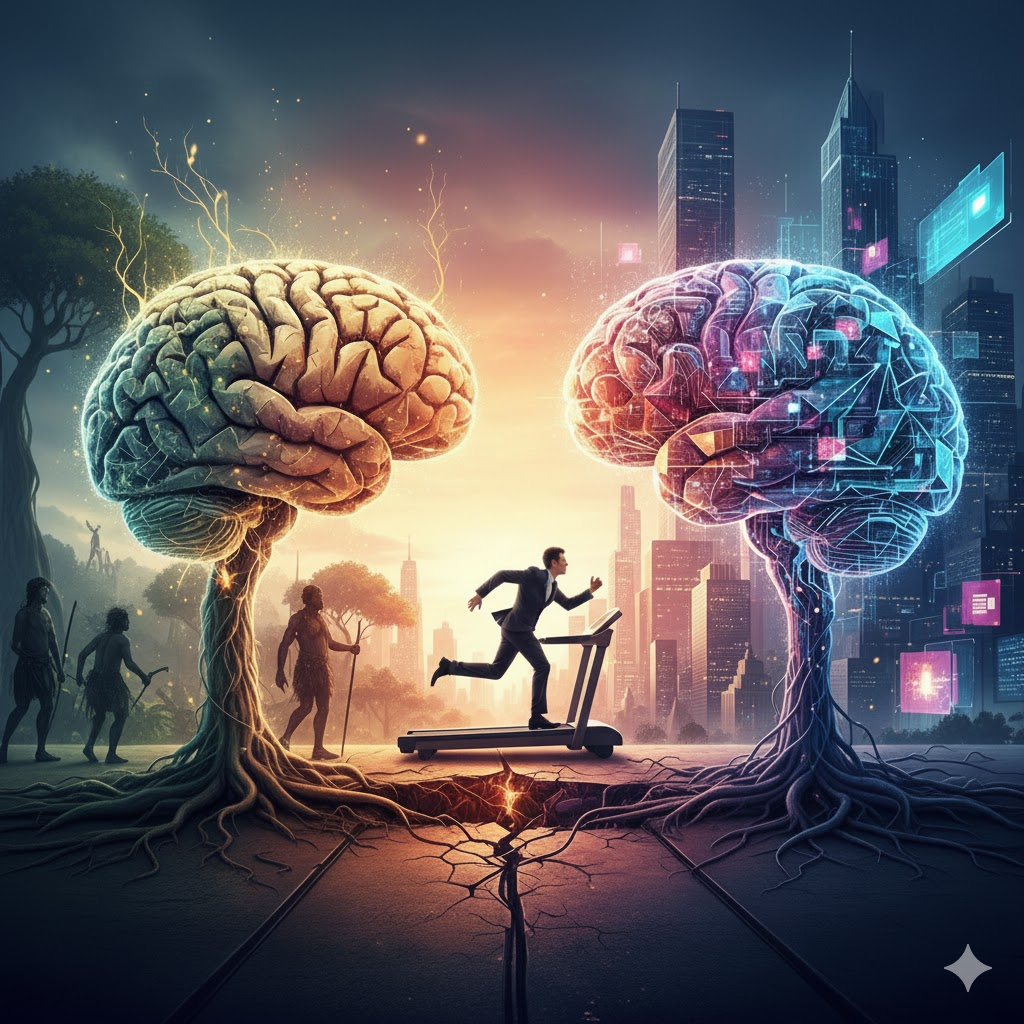
Have you ever felt that, no matter how much you learn, the horizon moves away faster than you can run? It’s not just a feeling of work-related stress; it’s a symptom of an evolutionary mismatch. Your brain—a marvel of biological engineering hundreds of thousands of years old—is trying to operate in an environment for which it was not originally designed.
In his seminal work Creativity: The Human Brain in the Age of Innovation, neuroscientist Elkhonon Goldberg invites us to look under the hood of our own minds. The first chapter is not merely an introduction; it is a diagnosis of the modern human condition. To understand why we feel overwhelmed and how we can enhance our creativity, we must first understand the silent battle taking place between our ancestral biology and our technological reality.
A Lesson from Ancient Egypt
To grasp the magnitude of today’s change, Goldberg asks us to imagine life in ancient Egypt. If you had been born during the Old Kingdom, your life would have been remarkably similar to that of your great-grandparents and your great-grandchildren. For nearly 1,500 years, technology, social norms, religion, and work tools remained virtually static.
In that world, the human brain operated in a state of grace. Evolution favored the development of mechanisms for learning patterns and then automating them. Once a scribe learned to write or a farmer learned the cycles of the Nile, that knowledge “crystallized.” Neurologically, this is pure efficiency. The brain loves routine because routine consumes little energy.
The human brain developed an exquisite dual system:
- Mechanisms for Novelty: Led by the right hemisphere and the frontal lobes, responsible for deciphering the unknown. This is a costly, slow, and exhausting process.
- Mechanisms for Routine: Once a pattern is deciphered, knowledge is transferred to the left hemisphere and to deep structures such as the basal ganglia. Here, actions are executed on “mental autopilot.”
For millennia, the goal of life was to move as much as possible onto that autopilot. Wisdom consisted of accumulating routines proven by time. But then, something broke.
The Law of Accelerating Returns and the End of Calm
Goldberg introduces the concept of historical acceleration. It’s not just that the world changes—it’s that the speed of change is accelerating exponentially. Ray Kurzweil, the futurist cited in the text, calls this the “Law of Accelerating Returns.”
Unlike our Egyptian ancestors, today we live multiple “lives” within a single biological existence. The skills you learned at university 15 years ago may be irrelevant today. The software tools you mastered five years ago are already obsolete.
This phenomenon has created what Goldberg calls the “Age of Novelty.” For the first time in the history of our species, cultural change occurs faster than generational change. Before, culture was transmitted from parents to children almost intact. Today, culture and technology transform several times within the life of a single individual.
This leads us to a paradoxical situation: we have lost the luxury of autopilot. Our brains are forced to keep the “novelty-processing” mechanisms (right hemisphere and frontal lobes) perpetually active. There is no longer a moment of rest when we can say, “I already know it all.” This constant demand for neuroplasticity is the root of modern cognitive fatigue—but it is also the seed of a new form of creativity.
The Fusion Revolution: When Reality Doubles
As if the speed of change weren’t enough, Chapter 1 also addresses environmental complexity. Goldberg describes the “Fusion Revolution.” We no longer inhabit a single physical world. Our reality is an amalgam of the tangible and the virtual.
We walk down the street (physical world) while navigating a GPS map (virtual world) and talking to someone on another continent (telepresence). Our brains must integrate these disparate streams of information into a coherent experience. This “fusion” demands a monumental orchestration capacity from the frontal lobes—the “CEO” of our brain.
Creativity today is not just painting a picture or composing a symphony; it is the ability to navigate this fusion, to find new patterns in an ocean of chaotic data, and to make rapid executive decisions about what information is relevant and what is noise. Innovation has been democratized by necessity: everyone, from managers to artists, must be creative to solve problems that did not exist yesterday.
The Upside of Stress
It is easy to read Goldberg and feel pessimistic about the burden we carry. However, the author offers a hopeful and fascinating perspective.
There is a hypothesis that this constant bombardment of novelty may be acting as a protective factor on a large scale. By forcing us not to rely on autopilot, modern life compels us to exercise our brains continuously. This effort recruits new neural networks, fosters plasticity, and builds what is known as “cognitive reserve.”
Goldberg suggests that, although we feel tired, this constant stimulation may be delaying the onset of dementias and cognitive decline in the general population. By having to learn new interfaces, adapt to new social networks, and solve unprecedented problems, we are, unknowingly, in an intensive mental gym. The “Age of Novelty” is exhausting, yes—but it keeps us mentally alive and younger for longer.
The Challenge of Executive Functions
Here we reach the critical point. While our brains are capable of adapting, they have limits. The function most heavily taxed in the modern era is Executive Function: the ability to plan, prioritize, inhibit distractions, and monitor tasks.
The frontal lobes are the most evolved—but also the most fragile. When they are saturated by excess decisions (decision fatigue) and constant context switching, our ability to be truly creative diminishes. We begin to make mistakes, lose strategic vision, and drown in operational details.
The human brain cannot biologically evolve in just a few decades to handle the data load of 2024. We need external tools—“cognitive exoskeletons”—to take on the burden of organization and working memory, allowing our biological brains to focus on what they do best: creative synthesis and innovation. We need to free our frontal lobes from micromanagement so they can devote themselves to vision.
Embracing the New Normal
Chapter 1 of Goldberg leaves us with a clear lesson: stability is not coming back. Acceleration is the new norm. Nostalgia for a slower world is futile. The key to thriving in the Age of Innovation is not resisting change, but optimizing our interaction with it.
We must recognize that our biological “hardware” is under unprecedented pressure. The fatigue you feel is not weakness; it is the cost of running a Pleistocene brain in the age of Artificial Intelligence. The solution lies in symbiosis: using technology not just as a source of information, but as a support structure for our minds. By externalizing repetitive and organizational processes, we recover the energy needed for irreplaceable human creativity.
To navigate this Age of Novelty without succumbing to executive burnout, it is vital to have a system that organizes chaos for you. GGyess WorkSuite presents itself as that indispensable digital ally, designed to act as an extension of your frontal lobes; by centralizing project management, automating workflows, and organizing operational complexity into an intuitive platform, GGyess frees your cognitive resources from administrative load, allowing you to focus your full mental power on the innovation and strategic creativity that today’s world demands.