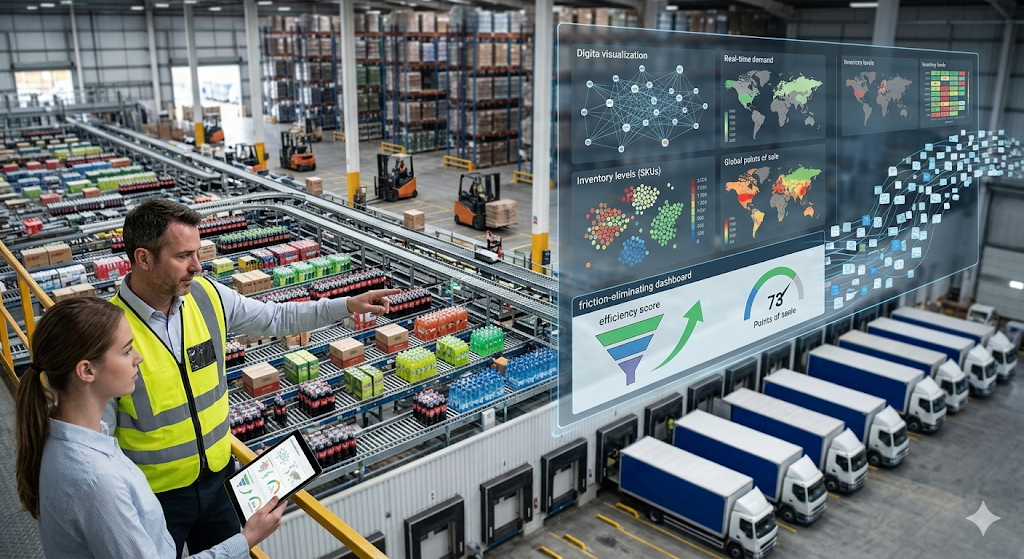
In the non-alcoholic beverage industry, success is not measured solely by the product’s fizz, but by the precision of execution. For a global giant coordinating everything from bottling plants to the last mile at the point of sale (POS), complexity is not an obstacle — it is the natural state of operations. Yet, in an ecosystem managing thousands of SKUs (Stock Keeping Units) and competing for every inch of shelf share, the true bottleneck is no longer in the physical supply chain, but in the supply chain of thought.
Today’s managers face a saturated environment. Every day, more than 13.7 billion Google searches are performed and 100 billion messages are sent through WhatsApp. Within this digital noise, a leading brand’s ability to maintain its Brand Equity depends on flawless internal coordination. The question for senior leadership is not how many tools their teams possess, but how much friction those tools eliminate from strategic decision-making.
1. The Challenge of Operational Fragmentation
In the Fast-Moving Consumer Goods (FMCG) sector, fragmentation is the silent enemy of productivity. A marketing team may be designing a campaign for the launch of a new flavor while the operations team adjusts cold-chain logistics, and the sales team negotiates premium shelf placements with retailers. When these efforts occur in digital silos, the result is misalignment.
Poor organization and lack of clear prioritization create delays that directly translate into lost market share. For high-level managers, orchestrating this symphony requires more than simple task lists; it demands a Gantt-level vision of operational reality, where progress can be visualized, bottlenecks detected, and strategy adjusted in real time.
2. From Individual Productivity to Collective Intelligence
The paradigm of “doing more” has been replaced by “doing what matters.” In the past, managers relied on multiple platforms: one for video calls, another for project management, another for reminders and shared calendars, and external silos for storing branded visual assets.
This technological dispersion creates “context fatigue.” Time lost switching between applications is time not spent analyzing market penetration or innovating the consumer experience. An organization’s digital maturity is measured by its ability to centralize communication and execution within a single ecosystem that learns from the workflow itself.
3. The Role of AI in Strategic Planning
Artificial Intelligence is no longer a futuristic promise; it is the necessary copilot for managing large-scale projects. Imagine transforming a 50-page market strategy report into an executable action plan within seconds.
In an industry where time-to-market is critical, the ability to use AI assistants to break down complex objectives into detailed tasks, assign responsibilities according to workload, and predict completion dates provides a disproportionate competitive advantage. This is not about replacing human judgment, but about freeing managers from administrative micromanagement so they can focus on visionary leadership.
GGyess: The Command Center for Modern Leadership
After understanding the high-pressure dynamics within leading corporations, we present GGyess, an all-in-one platform designed to transform operational chaos into organized, strategic growth.
GGyess has evolved by eliminating the complex distinctions of previous suites to deliver a unified and powerful productivity experience. We no longer talk about add-ons; we talk about a robust core that integrates everything a team leader needs.
The WorkHub Revolution (Formerly Planily)
The heart of organization within GGyess is now the WorkHub. This module is the ultimate space for organization, collaboration, and execution.
- Adaptive Views: Manage your projects through Kanban boards, Gantt charts for complex timelines, or calendar and table views depending on the project’s needs.
- Generative AI for Projects: Simply enter a campaign brief or business objective, and GGyess AI will instantly break down the task structure, suggest deadlines, and help organize the workflow.
- Workload Management: Visualize who is doing what and ensure no team member becomes overloaded, optimizing the organization’s human capital.
Real-Time Communication and Synchronization
GGyess understands that high-level decisions cannot wait for endless email chains. That is why it integrates direct and efficient communication tools:
- Integrated Video Calls: Conduct team meetings, brainstorming sessions, or quick check-ins without leaving your workspace, eliminating the need for third-party software.
- Appointments Management: A robust system for coordinating schedules with suppliers, strategic partners, or internal teams, ensuring leadership time is respected and optimized.
- Smart Reminders: Configure critical alerts for project milestones, ensuring that no legal or commercial deadline goes unnoticed.
Total Control and Asset Security
For a global brand, protecting digital assets is non-negotiable. GGyess offers a Storage module where brand guidelines, social media creatives, and strategic documents can be centralized while remaining directly connected to the tasks where they are used. Additionally, the role and permission system ensures that only authorized personnel have access to sensitive business information.
Conclusion: The Next Level of Execution
Leadership in the beverage industry requires a vision that encompasses both global scale and local detail. GGyess is not just a productivity tool; it is a strategic ally that enables managers to regain control over their time and the time of their teams.
By consolidating video calls, advanced planning within the WorkHub, reminders, and powerful AI into a single clean and professional interface, GGyess positions itself as the standard for teams seeking operational excellence without complexity.