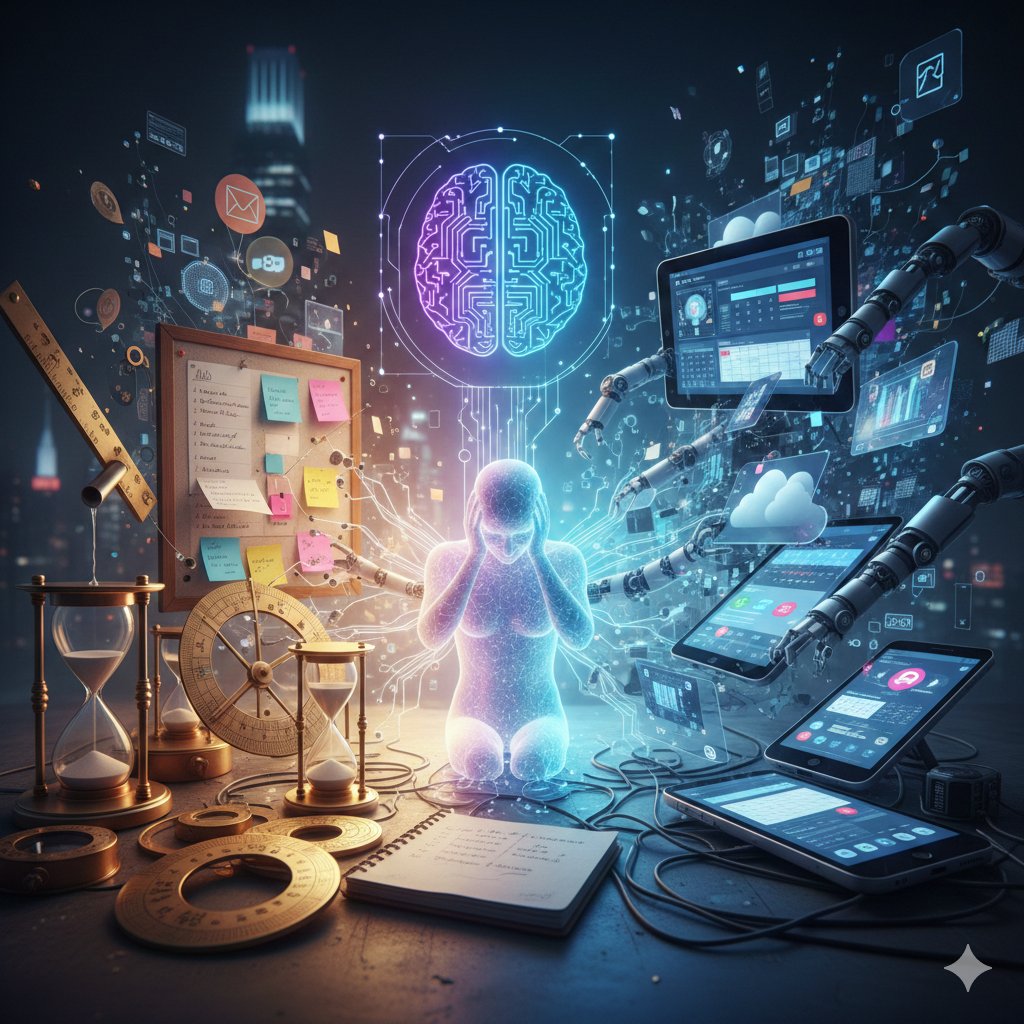
Humanity has always had a complex relationship with time. From the clepsydras of ancient Mesopotamia to Swiss wristwatches, our history is a relentless quest to measure, fragment, and ultimately master the hours of the day. However, in the 21st century, we face an unprecedented paradox: we have never had so many tools to save time, yet we have never felt so overwhelmed by the lack of it.
Task management—a discipline once limited to a to-do list in a notebook or a corkboard with sticky notes—has mutated into something much denser. We no longer just manage tasks; we manage constant information flows, multi-channel notifications, scattered cloud files, and the psychological pressure of a productivity that never sleeps. In this landscape of saturation, the great technological question of our era arises: Is Artificial Intelligence a real necessity for managing our work, or is it simply the latest accessory of an industry that overcomplicates what should be simple?
The Anatomy of Modern Chaos
To understand if AI is necessary, we must first diagnose why conventional methods are failing. The problem is not a lack of will. Millions of professionals religiously apply techniques like Pomodoro, the Eisenhower Matrix, or the GTD (Getting Things Done) method. The problem is the cognitive load that the digital environment imposes on us.
In a traditional management system (a spreadsheet, a physical planner, or basic list software), the user remains the engine of all operational logic. You must classify the task, decide the optimal time to perform it, manually search for the resources needed to execute it, and remember to update the status of every item so the system reflects reality.
This constant effort of “managing the management” consumes precious mental energy that should be dedicated to creative or technical execution. This is what psychologists call decision fatigue. By the end of the day, we have spent so much mental fuel deciding what to do next that we have very little left to do it well.
The Rise of AI as a Cognitive Assistant
This is where Artificial Intelligence comes into play. Unlike traditional software, which is a passive container of information, AI has the capacity to process, interpret, and propose. It doesn’t just store data; it understands the context of that data.
1. From “What” to “How”: Ending Blank Page Syndrome
One of the greatest obstacles to productivity is ambiguity. A task labeled “Launch Q3 sales strategy” is so large and vague that the brain tends to procrastinate to avoid the pain of deciphering where to start.
AI changes this radically. By possessing natural language processing capabilities and a deep knowledge of workflow structures, it can break down a macro goal into actionable micro-steps in milliseconds. This “intelligent fragmentation” eliminates initial friction and allows the user to move directly into action.
2. Data-Driven Prioritization, Not Panic-Driven
Most people prioritize based on perceived urgency or who shouts loudest in the company chat. AI can analyze variables the human eye ignores: cross-departmental dependencies, execution time history, critical deadlines, and real resource availability. An algorithm can tell you with cold objectivity: “If you don’t start this task today, next month’s project will fail.” That kind of foresight is what saves businesses.
3. Centralization of Intelligence
The great drama of the modern worker is “context switching.” We move from an email to a browser tab, then to a shared document, and then to a chat. Every jump reduces our concentration. AI-powered task management acts as a central node that “reads” through these tools, connecting the right file with the right task at the right time.
Is it really necessary? The Scaling Dilemma
If your work consists of three predictable daily tasks, the short answer is no: AI would be overkill. But for any professional handling multiple projects, remote teams, or a growing volume of information, AI ceases to be a luxury and becomes essential infrastructure.
The need for AI arises when the complexity of the environment exceeds the biological bandwidth of our short-term memory. When we try to hold the status of 50 different tasks in our heads, we make mistakes, forget details, and—most seriously—live in a state of chronic stress. AI acts as a life-support system for our productivity, maintaining order while we focus on strategic value.
Leadership and the Future of Work
We are not just talking about crossing items off a list. We are talking about how leadership changes when task management is intelligent. A leader who doesn’t have to chase their team to ask, “How is this going?” is a leader who can dedicate time to innovation, company culture, and the well-being of their people.
AI is not here to replace human judgment; it is here to liberate it. By automating the mechanical part of organization (tracking, reminding, breaking down, logical assignment), technology gives us back our humanity. It allows us to return to being thinkers instead of mere data processors.
Discovering GGyess
If you are looking to take the leap from productivity theory to intelligent execution, GGyess stands as the comprehensive solution that brings everything discussed above to life. It is not simply a project manager; it is an ecosystem designed for those who have understood that their time is too valuable to spend on manual micro-management.
In GGyess, Artificial Intelligence is not an ornament; it is the engine of your efficiency. The platform allows you to take any idea, no matter how abstract, and turn it into a detailed action plan in a matter of seconds.
How does GGyess transform your day-to-day?
- Instant Project Creation: By describing a goal in plain language, the GGyess AI automatically generates a task breakdown, estimating what you need to reach the finish line.
- Visual Flexibility: Because not all projects look the same, GGyess allows you to visualize your work in the format that best suits the moment: from the agility of a Kanban Board and the temporal structure of a Gantt Chart, to the clarity of a Calendar or the precision of a Table.
- Absolute Centralization: GGyess eliminates the need to navigate through ten different tabs. Your files, documents, and team communications live in the same place as your tasks. This drastically reduces exhaustion from context switching.
- Noise-Free Collaboration: The platform ensures teams stay aligned through clear assignments and total progress visibility, allowing communication to be fluid and always based on real work.
Ultimately, technology should serve to make you the master of your own schedule. GGyess offers the necessary structure so you can stop “surviving” your to-do list and start leading your growth. Whether you manage an expanding startup, a creative team, or your own professional career, the use of an intelligent tool is no longer a debate—it is the logical step toward success.
The question is no longer whether AI is necessary to manage your tasks. The real question is: How much longer will you wait to let technology work for you?