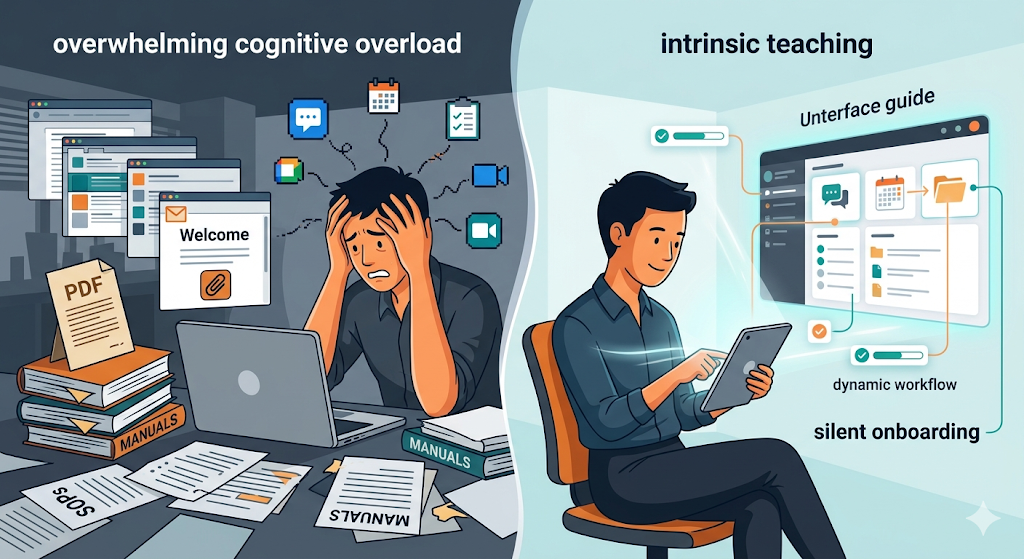
In the life cycle of any scaling organization, there is a universally dreaded ritual: the onboarding of a new hire. Traditionally, this process is an exercise in overwhelming cognitive overload. On their first day, a talented new employee is handed a laptop, a generic welcome email, and a 50-page PDF manual detailing the company’s Standard Operating Procedures (SOPs). They are then granted access to a fragmented labyrinth of software—a chat application, a separate task manager, an isolated calendar tool, and an external video conferencing platform.
Leadership expects this employee to read the manual, memorize the workflows, and immediately begin producing value. But a month later, the new hire is still asking where to find project files, missing crucial context in meetings, and failing to adhere to the company’s preferred task structure.
When a highly competent professional fails to adapt to your workflow, it is rarely a failure of their intellect or work ethic. It is a failure of your organizational design.
From a pedagogical perspective, handing someone a static manual to teach them a dynamic workflow relies on “abstract transmission”—the flawed assumption that reading about a process is the same as experiencing it. To build a truly scalable, elite organization, founders and operational leaders must abandon the employee handbook. Instead, they must design a digital environment that teaches intrinsically. They must embrace the philosophy of Silent Onboarding.
The Interface as the Educator
In the physical world of industrial design, the best objects do not require instructions. A well-designed door does not need a sign that says “Push”; it features a flat metal plate that visually and physically affords pushing. The design of the object communicates its function instantly, bypassing the need for written explanation.
This concept, known as an “affordance,” is the cornerstone of Silent Onboarding in the digital workspace. When your operational infrastructure is elegantly designed, the interface itself becomes the educator. The spatial arrangement of tasks, the visual hierarchy of deadlines, and the flow of communication implicitly teach a new hire how the company operates, values its time, and executes its vision.
If your team uses a stitched-together “Franken-stack” of disparate applications, the interface teaches chaos. It teaches the new hire that knowledge is fragmented, that communication requires searching for links, and that the “real” work happens somewhere else.
Conversely, when an organization centralizes its operations into a singular, unified workspace—a comprehensive WorkHub—the environment teaches order. When an employee logs in, they don’t have to guess how to categorize their day. The system allows them to instantly switch between Kanban, Gantt, Calendar, or Table views. This fluid visual transition acts as a cognitive map. Without reading a single SOP, the new hire visually absorbs how the company structures sprints, manages long-term dependencies, and respects chronological deadlines. The UX design does the heavy lifting of cultural assimilation.
Cognitive Apprenticeship in the Digital Era
Before the industrial revolution, complex skills were not taught in classrooms with textbooks; they were taught through “cognitive apprenticeship.” A master blacksmith did not give an apprentice a manual. Instead, the apprentice was placed directly into the workshop. By simply being in the environment, observing the master at work, and assisting with gradually more complex tasks, the apprentice absorbed the trade.
In the modern knowledge economy, your digital workspace is the workshop.
However, if your company isolates its communication from its execution, apprenticeship is impossible. If a new hire is added to an isolated video call to discuss a project, but the project board is hidden in another tab, they are blind to the actual process. They hear the strategy, but they do not see the execution.
To recreate cognitive apprenticeship digitally, communication must be native to the task. When video calls are built directly into the central WorkHub, the learning dynamic shifts completely. A new hire joins a native video sync and watches their project lead actively drag task cards, upload files, and adjust deadlines on the shared canvas in real-time. They are no longer passively listening to a meeting; they are actively observing the master craftsmen shape the work. The context is absolute, and the learning is immediate and experiential.
AI Scaffolding: Generating the Curriculum of Work
One of the most potent pedagogical strategies is “scaffolding”—providing temporary, structured support to help a learner achieve a complex goal they could not accomplish independently. In the workplace, scaffolding takes the form of breaking massive projects down into actionable, sequential steps.
Traditionally, this required a senior manager to sit down with a new hire and manually dissect a project brief for them. Today, embedded artificial intelligence acts as an automated curriculum designer, providing instant scaffolding.
When a new team member is handed an abstract objective, they do not need to freeze in panic or constantly interrupt a senior manager for guidance. Instead, they can simply write what they need done in plain language, and the system’s AI breaks it into detailed, actionable tasks with deadlines, priorities, and owners.
This is a profound evolutionary leap in employee training. The AI does not just do the administrative work; it models the anatomy of a successful project. By seeing how the AI deconstructs a vague brief into a prioritized checklist with intelligent timelines, the new hire learns exactly how the organization expects problems to be solved. Over time, the employee internalizes this structure, eventually developing the ability to architect complex projects without the AI’s assistance. The technology scaffolds their cognitive development, turning novices into strategists at an unprecedented speed.
Appointments as Cultural Boundaries
How a company manages its calendar tells a new employee everything they need to know about the company’s culture. If anyone can book a meeting at any time, the culture values availability over deep work. If scheduling requires endless email chains and external booking links, the culture accepts operational friction as a normal cost of doing business.
Integrating appointment scheduling directly into the centralized workspace serves as a powerful, silent lesson in time management.
When a new hire sees that appointments are natively synced with the team’s active task boards and project deliverables, they understand that time is treated as a finite, protected resource. A natively embedded appointment system teaches the employee that a meeting is not just an interruption; it is a measurable operational event that directly impacts the team’s capacity to deliver. This architectural choice naturally trains employees to block off their calendars for focused execution and to treat client bookings as strategic milestones rather than administrative chores.
The Invisible Mentor: Architecting Smart Reminders
The final component of Silent Onboarding is the elimination of the “nagging manager.” In a poorly designed system, leadership must constantly follow up with new hires to ensure deadlines aren’t missed and protocols are being followed. This dynamic breeds anxiety for the employee and resentment for the manager.
A unified workspace replaces human nagging with architectural support through intelligent, contextual reminders.
Because the WorkHub houses the project deadlines, the upcoming appointments, and the specific task assignments, it possesses a holistic understanding of the employee’s responsibilities. Instead of a barrage of panic-inducing notifications from disparate apps, the system acts as an “invisible mentor.” It issues proactive, highly targeted nudges directly within the environment where the work is taking place.
These smart reminders guide the new hire’s attention, gently correcting their focus before a deadline is missed. This allows the employee to build autonomous, reliable work habits without feeling micromanaged. The system enforces the discipline, leaving human managers free to focus on actual mentorship, strategic guidance, and creative support.
Eradicating the Manual
We have moved beyond the point where companies can scale effectively by forcing humans to memorize abstract operational rules. The speed of modern business demands that your infrastructure do the teaching for you.
When you design a workspace that merges visual logic, embedded communication, and intelligent automation, you eliminate the learning curve. You create an environment where doing the work and learning how to do the work are the exact same motion.
This profound fusion of spatial design, organizational pedagogy, and absolute productivity is the foundation of the new GGyess. Stripped of unnecessary distractions and fragmented features, GGyess is a pure, uncompromising operational ecosystem. By centralizing your entire company into a single, intuitive WorkHub, GGyess allows your team to seamlessly generate AI-scaffolded task structures, collaborate via native video calls, manage built-in appointments, and stay on track with smart, contextual reminders. It is an environment designed to eliminate friction, protect deep focus, and silently train your team to execute at an elite level. Discard the manual, and let the architecture of GGyess teach your organization how to scale.