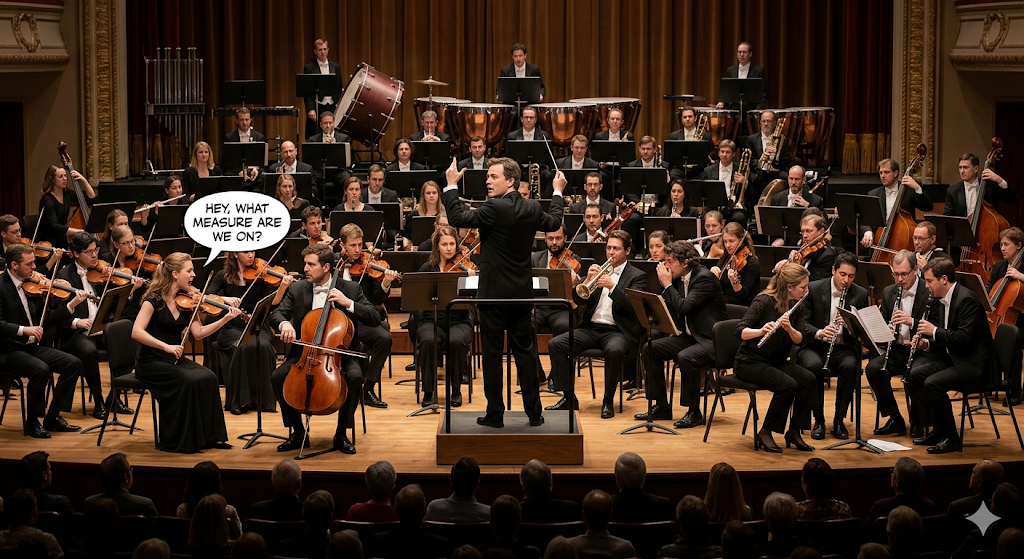
Imagine you’ve bought front-row tickets to hear the best symphony orchestra in your city. You arrive at the theater, take your seat, the lights dim, and the curtain rises. More than a hundred musicians are on stage: violins, cellos, trumpets, timpani, and flutes.
The conductor raises the baton. You expect to hear a celestial melody, but instead you witness absolute chaos.
The first violinist stops playing, turns to the cellist and shouts: “Hey, what measure are we on?” The trumpet player pulls out their phone and sends a message to the percussionist: “I think we came in a bit late—can you confirm?” The woodwind section calls a quick five-minute meeting in the corner of the stage to align on which notes they’ll play next.
The noise is unbearable. There is no music—only a hundred incredibly talented people interrupting each other trying to figure out what they’re supposed to do.
If this scene seems absurd in a theater, you should ask yourself why you accept it every day in your office.
Modern collaborative work has become a cacophony of interruptions. A chat ping here, an email ding there, a phone vibration and a pop-up notification in the corner of your screen. We have teams full of brilliant “musicians” who can’t play two notes in a row without someone interrupting them.
Today we’re going to turn off the noise. We’re going to understand why the corporate obsession with “immediate responses” is destroying our ability to create—and how you can transform your noisy team into a perfectly synchronized orchestra.
The Notification Epidemic and the End of “Deep Work”
To understand the damage caused by digital noise, we must talk about how the human brain works when it tries to create value.
Work falls into two major categories: shallow work and deep work.
Shallow work consists of logistical tasks that don’t require much concentration: answering emails, scheduling meetings, or filling out forms. You can do it while listening to a podcast or chatting with someone.
Deep work, on the other hand, is the activity that truly grows your company. It’s writing complex code, designing a campaign, drafting an article, or building a financial strategy. To enter this state of “flow,” your brain needs at least 20 minutes of uninterrupted concentration.
This is where the tragedy of the modern office appears. On average, a knowledge worker is interrupted by a notification or a colleague every 11 minutes.
If you’re interrupted every 11 minutes, your brain never reaches the state of deep work. You are forcing your best talent to operate on the surface—reacting to external stimuli instead of creating.
When your work culture demands that everyone keep notifications on and respond to chats within five minutes, you are prioritizing noise over music. You are saying:
“Your availability to answer a trivial question is more important than your ability to finish the critical project in front of you.”
The Orchestra’s Secret: The Silent Score
Let’s return to the theater. Why can an orchestra of a hundred people perform a 45-minute Beethoven symphony without saying a single word?
Because they have a score.
The score is the single source of truth. Each musician has a sheet in front of them telling them exactly which notes to play, at what speed, and most importantly when to stay silent and wait. The trumpet player doesn’t need to ask the violinist if it’s their turn. They simply read the score, count the measures silently, and enter at the exact moment their intervention is needed.
They also have the conductor, who produces no sound but sets the overall rhythm and ensures all sections stay aligned.
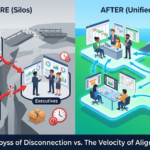
In your company, if your team needs to send 50 chat messages a day just to know “where we are” or “whose turn it is,” it means they don’t have a score. They’re improvising blindly.
To achieve asynchronous collaboration (working together without needing to be online at the exact same time) and reduce distractions, you must write a flawless digital score for your team.
How to Tune Your Team: 4 Steps Toward Asynchronous Harmony
Turning a noisy group into an orchestra requires establishing new rules for digital collaboration. Here are the steps to implement a work culture where silence is respected as the company’s most valuable asset.
Step 1: Create the Central Score (Centralize Tasks)
The first step is to take work out of noisy channels (chats and emails) and move it to a visual management board.
Each project should have its board. Each task should have a card with a very clear description (the musical notes), a deadline (the tempo), and a designated owner.
If the score is well written and accessible to everyone, 80% of your team’s daily questions (“What should I do today?” “When is this due?”) answer themselves just by looking at the screen.
Step 2: Define the Entrances (Automated Dependencies)
In music, cymbals know they must sound right after the great crescendo of the violins. In your company, this is called dependency management.
If the development team cannot start until the design team finishes, they shouldn’t be sending messages every two hours asking “Almost done?”
Tasks should be linked. When the designer marks their task as Completed, the system automatically “gives the cue” to the developer.
Synchronization happens without a single word being exchanged.
Step 3: Encourage Notification Hygiene
As a leader, you must destigmatize silence.
Set clear expectations: “In this company, we don’t expect immediate responses unless the server is on fire.”
Encourage your team to turn off pop-up notifications, close their email inbox, and use Do Not Disturb mode during two-to-four-hour blocks of deep work.
If someone needs to leave a comment about a project, they place it in the corresponding task card. The recipient will read that comment when they finish their focus block—not before.
Step 4: Chat Is the Cafeteria, Not the Concert Hall
We’re not saying you should eliminate informal communication. Corporate chat tools are excellent for building culture, sharing memes, celebrating birthdays, or asking quick logistical questions (“What time is the client meeting?”).
But you must draw a firm line:
No project decisions, no file approvals, and no task assignments should ever happen in chat.
If the work lives in the score, chat returns to what it was always meant to be: a place for casual interaction and light coordination that doesn’t interrupt deep work.
The Symphony of Success: Why Silence Is Profitable
When you implement an asynchronous culture based on a visual score, the change in your company’s mood is dramatic.
The anxiety of FOMO (fear of missing out) disappears. Your employees stop feeling like they need to check their phones compulsively on Sunday afternoons.
Mental exhaustion and burnout drop dramatically, because people finally feel they have control over their time and attention.
From a profitability standpoint, the impact is astonishing. A team working in uninterrupted deep-work blocks produces deliverables of much higher quality—with fewer technical or creative errors—in half the time it would take a hyperconnected and constantly distracted team.
GGyess: The Perfect Music Stand for Your Masterpiece
Having the intention to create a no-interruption culture is useless if your software tools betray you. If your platforms emit visual and sound alerts for every small change, or if your ecosystem forces your team to jump from one app to another asking where things are, the noise will always return.
For the music to flow, you need a music stand and baton designed for operational silence.
You need GGyess.
We built GGyess understanding that your team’s attention is sacred. In our platform, the score is always clear. When you organize your projects in GGyess, you create a visual map where each person knows exactly what their role is.
Our flexible views (Kanban, Gantt, or Calendar) allow each “musician” to see their section of the melody in the way they understand best, while you—as the conductor—have the Gantt view to ensure the timing of the entire orchestra fits perfectly.
Remember the problem of mistimed entries? In GGyess, the flow is naturally asynchronous.
When a team member needs you to review a document, they upload it directly to their task card and tag you. GGyess doesn’t shout—GGyess notifies intelligently.
You receive a grouped and contextual alert. When you’re ready to review, you open the card, see the file, read the history of why that decision was made, and leave your approval.
No interrupted chats.
No unnecessary “alignment” video calls.
But the real silent magic comes from our integrated Artificial Intelligence.
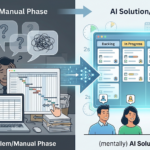
When you need to start a new “movement” (a new project), instead of calling your team into a noisy two-hour brainstorming session to figure out who does what, you simply dictate your vision to GGyess AI.
Within seconds, the AI acts like an expert arranger: it breaks your big idea into individual tasks, assigns the instruments (roles), establishes dependencies, and creates the complete score for you.
Your team receives a structured, organized action plan ready to execute from minute one.
In GGyess, we’ve designed notifications to be useful, not addictive. You can customize exactly what you want to be notified about, ensuring your workspace remains a sanctuary for concentration.
Teamwork shouldn’t sound like rush-hour traffic filled with honking horns and desperate shouting. It should feel like the masterful execution of a work of art—where each person contributes their talent at the precise moment, with total clarity and confidence.
Turn off the noise of notifications. Write a score everyone can follow—and let your team finally make real music with GGyess.