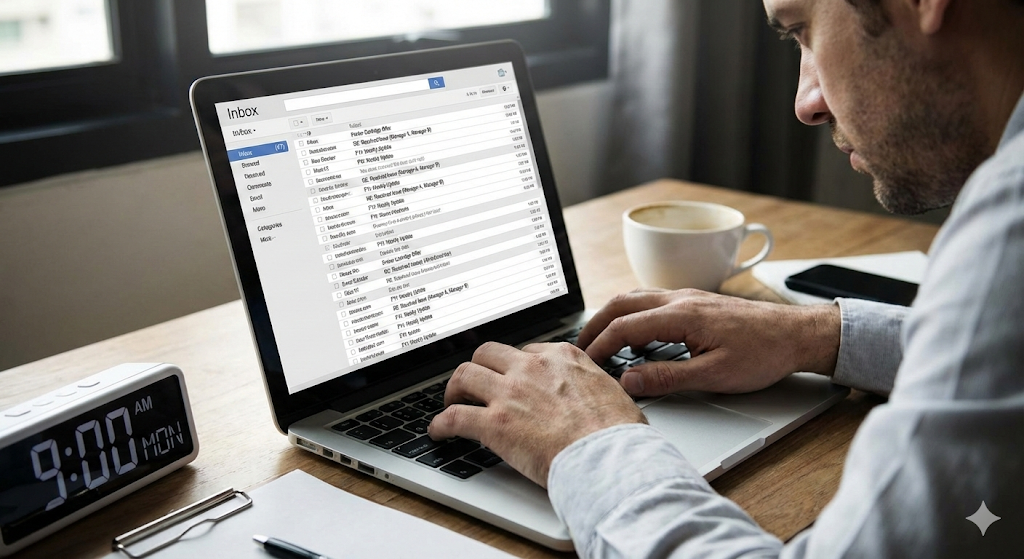
It’s 9:00 AM on Monday. You open your laptop. You haven’t started working, but you are already losing. Your inbox shows (47) unread emails.
- Three are “FYIs” that require no action.
- Five are “Reply All” chains where two managers are arguing about an issue that was already resolved on Friday.
- One is crucial: the budget approval the team needs now. But it is buried under a printer cartridge offer.
You spend the next hour sorting, archiving, and replying. By the time you finish, your mental energy (the kind you should be using for strategy) is drained.
Welcome to the Tyranny of Email.
Email was invented in the 70s to send digital letters. It was never designed to manage complex projects, remote teams, or dynamic workflows. Yet, in 2026, we keep using it as if it were the only option.
It is time to say it loud and clear: Internal email is dead. Or at least, it should be if you want your company to survive.
Today I am going to tell you how High-Performance Organizations are migrating their operation to Visual Boards in GGyess, and why they will never go back.
The Problem: Email is an “Information Graveyard”
Email has three fatal flaws for modern management:
- It is Opaque: If Juan writes to Maria about Project X, you (the CEO) don’t see it. Information lives in private silos. When Juan goes on vacation (or quits), that knowledge disappears with him.
- It Lacks Context: A subject line that says “Urgent question” tells you nothing. You have to open it, read the thread of 10 previous messages, and download three attachments to understand what they are talking about.
- It is Reactive: Email arrives when it wants, not when you need it. It is a to-do list created by other people for you.
Continuing to manage your company by email is like trying to play chess by mail in the middle of a fire. It is too slow.
The Solution: The Visual Revolution (WorkSuite)
Imagine walking into the office on Monday and, instead of a list of 50 cryptic emails, seeing a Board. In GGyess WorkSuite, you don’t see messages; you see the reality of your business in real-time.
You see a Kanban Board with clear columns:
- To Do
- In Progress
- Blocked (Needs Help)
- Done
At a glance, you know the “Web Launch” is stuck because the card is red in the “Blocked” column. You didn’t have to read any emails to know that. You saw it in 3 seconds. This is called Visual Management. And it changes the rules of the game.
From “Infinite Threads” to “Contextual Comments”
Remember that email chain titled “Re: Re: Fwd: Design changes” that has 35 replies and no one knows which is the final version of the file? In GGyess, that chain disappears. The conversation happens inside the Task.
- You create the task: “Design Main Banner.”
- The designer uploads the file right there.
- You comment on the task: “Change blue to green.”
- The designer replies: “Done, here is v2.”
All the history, files, and decisions live together in one place. If you hire a new marketing manager in 6 months, he can enter that task and read the entire history in order. He doesn’t have to ask you to forward old emails. It is the perfect Institutional Memory.
The Peace of Mind of “Status: Done”
Email never ends. Another one can always arrive. It is a source of infinite anxiety (the famous Inbox Zero is a myth). In a visual system like GGyess, tasks have an end.
When you move a card to the “Done” column, your brain releases dopamine. It’s over. There is no ambiguity. You and your team can go home knowing exactly what was achieved today.
Plus, it eliminates micro-management. You no longer have to send emails asking “How are you doing with this?” You simply look at the board. If the card moved, it advanced. If not, you ask. It is radical transparency without being intrusive.
How to Make the Transition (Without Your Team Rebelling)
We know what you’re thinking: “My team hates learning new tools. They are used to email.” Cultural change is hard, but here is the roadmap to do it with GGyess:
Phase 1: The “Zero Internal Attachments” Rule Prohibit sending file attachments via internal email. “If you want me to review the report, upload it to the task in GGyess and tag me (@CEO).” This forces people to enter the platform.
Phase 2: The Board Meetings In your weekly meetings, do not use PowerPoints or meeting minutes. Project the GGyess Kanban Board on the screen. Review tasks card by card. “Why is this still ‘In Progress’ since last week?” This makes the board the Single Source of Truth. If it isn’t in GGyess, it doesn’t exist.
Phase 3: Notification Centralization Use the GGyess Notification Module intelligently. Configure it to receive alerts only for what matters (direct mentions or urgent tasks). That way, the little email you receive will be relevant. The noise disappears.
The ROI of Silence
How much is your attention worth? Studies indicate that it takes us 23 minutes to recover focus after an interruption (like an email). If you receive 20 unnecessary emails a day, you are basically never focused.
By moving your operation to Visual Boards:
- You reduce internal email by 90%.
- You reduce status meetings by 50%.
- You increase execution speed because information is accessible.
If you have a team of 10 people earning $30/hour, and you save them 1 hour of email management a day… You are saving $1,500 dollars a week. The GGyess MasterSuite subscription costs $9.99 a month. It is the most profitable investment you will make this year.
Conclusion: Stop Being a Professional Mailman
You didn’t found a company or become a Director to spend your day answering emails. Your job is to lead, create, and solve complex problems.
Email is a cage. Visual Boards are the key. Free your team from the inbox and give them a space where they can see their work, collaborate with context, and feel like they are moving forward.
Next Monday can be different. It can be visual, silent, and productive.
Close your Outlook. Open GGyess. Start working for real.