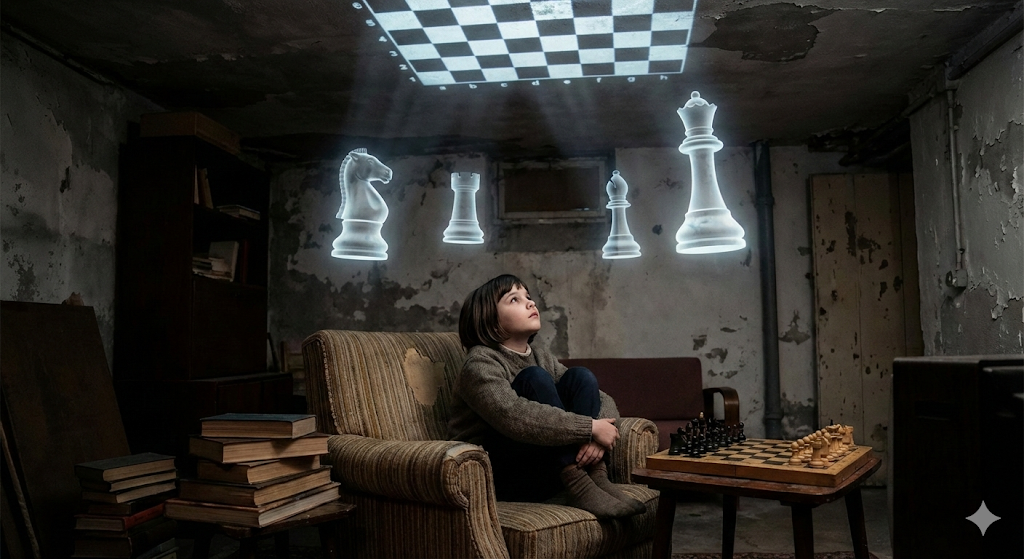
Lexington, Kentucky. A dark basement. A prodigy girl staring intently at a 64-square board. For Beth Harmon, chess wasn’t a game; it was a controllable world in the midst of the chaos of her life.
Remember that iconic scene where Beth lies in bed, looks at the ceiling, and sees giant chess pieces moving on their own? She wasn’t hallucinating (well, the green pills helped, but that’s another story). She was visualizing. She was simulating the future.
In digital marketing, the difference between a rookie (the one playing blitz games in the park) and a Grandmaster (the one playing in Moscow) is exactly that: The ability to see the future.
- The rookie wakes up on Tuesday and thinks: “What do I post today?” They move a piece by instinct. Sometimes they win, sometimes they lose.
- The Grandmaster knows what they are going to post on the Tuesday three weeks from now, because it is part of an opening they designed to set up the checkmate for the end-of-month launch.
If you feel like your marketing strategy is a series of reactive moves to “survive the day,” you need to stop playing checkers and start playing chess.
Today we are going to see how GGyess becomes your “digital ceiling,” allowing you to visualize, plan, and execute with the cold precision of Beth Harmon.
The Opening: Visualize the Full Board (Visual Calendar)
Beth never looked at just one piece. She looked at the complete structure. In marketing, your “board” is your month.
The number one mistake agencies and entrepreneurs make is “Tunnel Vision”: focusing so much on today’s post that they forget the month’s narrative. You post a funny meme today, a serious offer tomorrow, and a picture of your dog the day after. There is no coherence. You have lost the game before starting because you don’t control the center of the board.
The GGyess Solution: The GGyess Visual Planner is your ceiling. Instead of a boring to-do list, you see your strategy deployed visually.
- Drag & Drop: See that you have three sales posts in a row in the second week? That is a beginner’s mistake. You drag one to the end of the month and swap it for an educational video.
- Visual Harmony: Just as Beth looks for a solid pawn structure, you look for an aesthetic feed. GGyess shows you how the Instagram grid will look before you publish anything.
When you see the full month, you stop thinking about “loose posts” and start thinking about “campaigns.” You move the pieces to surround the king (your target client).
The Middlegame: Variation Analysis (Analytics)
Beth Harmon didn’t just play; she studied. She spent entire nights reading Chess Review, analyzing past games by Borgov and Capablanca. She looked for patterns. “Why did White lose on move 15?”
Most marketers have a phobia of data. They post something, it gets few likes, they feel bad, and they forget it. That isn’t strategy, it’s ego. To improve, you have to be able to analyze your defeats with the same coolness as your victories.
The GGyess Solution: The GGyess Analytics module is your library of past games. You don’t need to be a Russian mathematician to understand it. GGyess translates data into insights:
- “Your carousels on Thursdays at 6:00 PM have 40% higher retention than videos on Mondays.”
- “The audience stopped watching this video at second 3.”
This allows you to adjust your tactics in real-time. If you see an opening (content type) isn’t working, you discard it. If you see the “Queen’s Gambit” (your video tutorials) is working, you repeat it. Stop guessing. Start knowing.
The Endgame: Time Management (The Clock)
In competitive chess, the clock is as much an enemy as the opponent. Beth sometimes arrived late, ran, got stressed. But when she sat down, time stopped. She entered Hyperfocus.
In your work, the clock is notifications, emails, calls. It is impossible to map out a brilliant strategy if you are interrupted every 4 minutes. You need an environment that protects your brain.
The GGyess Solution: This is where we apply the “One Thing Mode” we talked about earlier. When Beth looks at the ceiling, everything else (the orphanage, the janitor, the noise) disappears. Only the board exists.
When you activate this mode in GGyess to draft a strategy or plan a launch:
- The interface simplifies.
- Distractions are hidden.
- It’s just you and your goal: “Plan Q1.”
It is the only way to produce Deep Work in a broken attention economy.
The Theory: Don’t Reinvent the Wheel (Templates & AI)
Beth memorized openings: The Sicilian, The Caro-Kann. She didn’t invent the first 10 moves every time; she used what already worked to get to the creative part fast. You waste hours writing from scratch every time. “Hello everyone, today I want to talk to you about…” That is exhausting and inefficient.
The GGyess Solution: Use the GGyess AI as your opening book.
- Need an educational post? Use the “Expert Tip” template/prompt.
- Need a sale? Use the AIDA formula (Attention, Interest, Desire, Action) pre-loaded in the AI.
The AI gives you the base structure (the first moves). You put the final talent to close the game. This allows you to play “simultaneous games” (manage multiple clients) without mental exhaustion.
The Adjournment: Working as a Team
In the series, there is a crucial moment in Moscow. Beth is alone against Borgov. She asks for an adjournment (pauses the game until the next day). That night, she isn’t alone. Benny, Harry, and the others call her from New York. They analyze the game together. They give her the winning solution. Beth wins because, for the first time, she plays as a team.
Modern marketing is too complex for “lone wolves.” You need your designer, your copywriter, your client.
The GGyess Solution: Task Comments and Shared Boards in GGyess are your call to New York. When you get stuck on a campaign, you don’t suffer in silence. You tag your team in the task: “@Team, Borgov has blocked my right flank (the competition lowered prices), what do we do?”
Real-time collaboration inside the platform allows you to find moves you hadn’t seen alone. You win because you have more brains thinking on the same board.
Conclusion: Your Turn, White Moves
Marketing, like chess, is a game of perfect information. Both sides see the board. The difference is who processes that information better and who has the courage to sacrifice a pawn (time/money) to win the game.
Beth Harmon went from a girl in a basement to world champion because she respected the game, studied the tools, and visualized her success.
You have an advantage Beth didn’t have. You don’t need to imagine the board on the ceiling. You have it on your screen.
Stop moving pieces at random. Start playing with strategy.
Log in to GGyess, open your Visual Calendar, and prepare your next Checkmate.