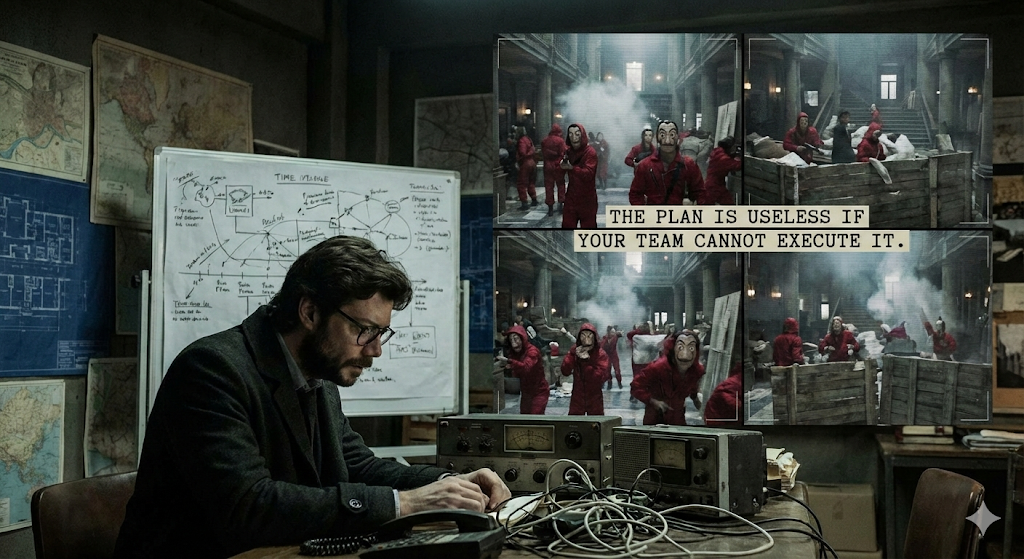
If you’ve seen Money Heist (La Casa de Papel), you know that the real protagonist isn’t Tokyo, nor Berlin, nor the money. The real protagonist is The Plan.
Sergio Marquina, alias “The Professor,” is the archetype of the obsessive Project Manager. He spent years planning every minute, every contingency, and every gram of gold melted inside the Royal Mint of Spain.
But there is a painful lesson the series teaches us season after season: Having a perfect plan in your head (or on a paper whiteboard) is useless if your team cannot execute it in real-time.
In the series, The Professor relied on old analog radios and risky phone calls to coordinate a highly unstable team locked in a building. The result was constant chaos, internal mutinies, and Plans B, C, and Z improvised on the fly.
If The Professor had access to a modern management tool like GGyess WorkSuite, the heist would have lasted half the time and with much less drama.
Today we are going to analyze how you can apply The Professor’s strategic mindset to your business (without committing crimes, please) and how GGyess allows you to control the chaos when you have a “Tokyo” on your team about to ruin everything.
Lesson 1: The Gantt Chart is Your “Master Whiteboard”
In his hideout, The Professor had walls full of clippings, red strings, and timelines. He understood something many managers forget: Dependencies. You can’t start printing bills if you haven’t taken control of the machines. You can’t open the vault if you haven’t hacked the security system. In project management, if Task A gets delayed, Task B collapses.
The GGyess Solution: The Professor would use the GGyess WorkSuite Interactive Gantt Chart. Instead of red strings on the wall, he would have a clear digital timeline.
- Milestone 1: “Entry and Hostage Taking” (Hour 0).
- Milestone 2: “Start Printing” (Hour 1 – Depends on Milestone 1).
- Milestone 3: “Escape Tunnel” (Duration: 48 hours).
If Rio takes longer than expected to hack the alarm, The Professor would only have to drag that task bar in GGyess, and automatically the entire subsequent schedule would adjust, notifying Nairobi that she must delay production. No panic calls. Just immediate visual adjustment.
Lesson 2: Skill-Based Assignment
The gang’s success lies in specialization.
- Nairobi: Quality Control and Production (Operations Manager).
- Rio: Technology and Security (IT).
- Helsinki and Oslo: Brute force (Heavy Logistics).
- Berlin: Field Leadership (Team Lead).
The problem arises when roles blur. When Tokyo tries to lead (a role for which she is not emotionally equipped), disaster strikes.
The GGyess Solution: In GGyess, you can assign Roles and Specific Tags to each team member. It’s not just about putting a name on a task; it’s about defining permissions and responsibilities. The Professor would create the “Royal Heist” project and assign:
- Task: “Melt the gold” -> Assigned to: Nairobi.
- Task: “Watch the hostages” -> Assigned to: Denver.
If Denver tries to mark a technical task of Rio’s as “Completed,” the system wouldn’t allow it if he doesn’t have the proper permissions. This maintains the operational hierarchy and prevents the “cowboys” on the team from taking decisions that aren’t theirs to make.
Lesson 3: The “Chernobyl Rule” (Critical File Management)
Remember how many times they were about to be discovered because someone left physical evidence or a plan where they shouldn’t have? Or when they needed to consult an architectural blueprint urgently and had to describe it over the radio? Decentralized information is dangerous. If only Berlin has the building plan in his pocket, and Berlin is captured, the team is blind.
The GGyess Solution: The Professor would use the File Management module integrated into each task.
- In the Task “Drill the vault,” the PDF with the structural blueprints would be attached.
- In the Task “Negotiation with police,” the script of psychological protocols would be there.
All files would live in the GGyess encrypted cloud. Accessible from any authorized device, but impossible to lose. If Bogotá needs to see the water pump schematic, he opens the task on his mobile and there it is. He doesn’t depend on anyone sending it to him.
Lesson 4: Managing “Tokyo” (The Chaos Factor)
We all have a “Tokyo” in the office. That talented, passionate person who is also impulsive and prone to skipping processes. Tokyo hates boring to-do lists. She acts on instinct. And that usually breaks the workflow for the rest. To manage creative but chaotic profiles, you can’t use micromanagement (because they rebel, like Tokyo against Berlin). You need to give them Visibility and Controlled Autonomy.
The GGyess Solution: Here is where the Kanban Board comes into play. It is visual. It is tactile. It is simple. You don’t give Tokyo an Excel sheet. You give her a board with three columns:
- To Do
- Doing
- Done
She only has to move her “Watch the Perimeter” card to “Done.” That small act of moving the card releases dopamine and gives a sense of progress. And for The Professor, seeing the board updated in real-time means he doesn’t have to call her every 5 minutes asking “Where are you?”, which prevents her from exploding.
Lesson 5: Secure Communication (The End of Walkie-Talkies)
Much of the series’ drama comes from communication problems. The police intercept the radios. The Professor loses signal. Someone doesn’t hear a vital order. In a business project, the equivalent is the “Broken Telephone” of WhatsApp + Email + Slack. Information fragments and context is lost.
The GGyess Solution: Contextual Task Comments. Instead of having a giant group chat where everything mixes (memes, orders, questions), GGyess allows talking inside the task. If there is a problem with the gold smelting, Nairobi doesn’t send a generic WhatsApp. She writes a comment inside the “Smelting” card in GGyess: “Temperature isn’t rising, we need more power.” Everyone involved receives the alert with the exact context. The solution is recorded right there for the future. It is surgical communication, proof against interception and misunderstandings.
Conclusion: Be The Professor, Not the Hostage of Your Project
The difference between a successful heist and a season in jail is execution. And execution depends on the tools you use to coordinate your team.
You also have a critical mission (launch that product, close that quarter, organize that event). You have a team with diverse talents and egos. And you have a clock ticking against you. Don’t try to manage it all with sticky notes and willpower. That works in fiction, but in reality, it leads to burnout.
The Professor spent 20 years planning. You can set up your WorkSuite in GGyess in 20 minutes.
Ready for plans to go right? (And we promise no one will have to wear Dalí masks in the office).
Create your free account on GGyess and start planning your next big (market) heist.