If you’ve ever designed a perfect strategic plan in Excel, only to watch it fall apart because of an office rumor, a sudden market shift, or an “irrational” human error, then you’ve fallen into Chesterton’s trap.
You treated the world as if it were a clock, when in reality it is an organism.
In the final chapter of her intellectual journey, Donella Meadows delivers the hardest lesson for any leader, engineer, or manager to accept: You cannot control systems. They are too complex, too dynamic, and too alive. The illusion of total control is precisely what leads to the greatest disasters.
But not being able to control them does not mean you are powerless. It means you must change your role. You must stop being a machine operator and become a surfer or a dancer. You must learn how to live in a world of systems. These are the rules for surviving the logical trap.
1. Listen to the Rhythm Before You Dance
Imagine stepping onto a dance floor where complex, unfamiliar music is playing. If you try to impose your own rhythm, you’ll stumble and embarrass yourself. The first thing you must do is stand still and listen.
In business management, we do the opposite. A new CEO arrives and, in their first week, announces a “total restructuring.” They launch solutions before understanding the system’s music. Meadows advises us: “Feel the beat of the system.”
Before intervening, observe.
- How has the system behaved over the last 10 years? (Not just the last quarter.)
- What patterns repeat again and again?
- Where are the delays?
The system’s history matters more than its current snapshot. If you ignore the system’s memory, it will reject your transplant. Patience is not passivity; it is the diagnostic phase required to avoid killing the patient.
2. Expose Your Mental Models to the Light
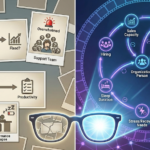
We all wear glasses. You see “efficiency opportunities”; your employee sees “layoff threats.” You see “a free market”; your competitor sees “an unfair monopoly.” None of these models is the truth. They are simplifications we use to navigate reality.
The problem arises when we believe our model is reality. We become rigid. We defend our view with pride instead of curiosity. To live in a world of systems, you must practice radical mental flexibility.
- Admit your model is incomplete.
- Invite others to challenge your map: “What am I ignoring?” “How does this look from your department?”
Rigidity is death in a changing system. The ability to say, “I was wrong—the system works differently than I thought,” is the number one survival skill.
3. Honor, Respect, and Distribute Information
If the system is an organism, information is its blood. If you cut the flow or poison it, the organism develops gangrene.
Chesterton said the world is a “trap for logicians” because logicians assume data is pure. But in organizations, we lie. We hide bad news to avoid upsetting the boss. We polish quarterly reports. Meadows is blunt: “Do not distort, delay, or withhold information.”
A system that lies to itself cannot self-correct. Most corporate crises (think Enron or Volkswagen) were not technical failures; they were information failures. Someone knew something was wrong, but the system punished the truth. To lead well, you must create a culture where the bearer of bad news is rewarded, not executed. Transparency is the only antidote to chaos.
4. Care for What Matters, Not Only What Can Be Measured
We live under the tyranny of the spreadsheet. If we can count it (money, hours, units), we pay attention. If we can’t (morale, trust, aesthetic quality, mental health), we ignore it.
The world may look “mathematical,” as Chesterton said, but what matters most is invisible to mathematics.
- You can measure the cost of an hour of training, but not the cost of ignorance.
- You can measure today’s sales, but not the loyalty you’re losing by cutting quality.
When we manage systems based only on what’s quantifiable, we create monsters. We produce cheap food with no nutrients. We build efficient hospitals with no compassion. You must learn to speak about quality with the same seriousness as quantity. If you don’t defend intangible values, the numbers will consume your organization’s soul.
5. Act for the Good of the Whole (Avoid Suboptimization)
Departmental ego is the cancer of systems. Purchasing wants to save money by buying cheap parts. It succeeds (local victory). But those parts fail, and the warranty department collapses (global failure).
Living in a world of systems requires higher loyalty. You don’t work for your bonus; you work for the health of the whole. This is hard because it requires sacrificing small wins. Sometimes sales must sell less so production can maintain quality. Sometimes the CEO must earn less so the company can be resilient during a crisis.
Hierarchies and boundaries must be permeable. We must constantly remember that we are all crew members on the same ship—and if the ship sinks, it doesn’t matter how clean your cabin was.
6. Be a Learner, Celebrate Complexity
Finally, Meadows invites us to abandon arrogance. The world is infinitely fascinating and complex. You will never fully understand it—and that’s wonderful.
Instead of trying to be the “expert” with all the answers (a fragile and exhausting position), be the perpetual learner.
- Use trial and error. Run small experiments. If they fail, celebrate the learning and adjust.
- Don’t seek the final, perfect solution—because it doesn’t exist. Seek the best solution for now, and stay alert enough to change it tomorrow.
Embrace paradox. Accept that you can plan and still be surprised. That you can lead and still serve.
Conclusion: Dancing With the System
Chesterton’s warning reminds us that the world is not a logical puzzle to be solved once and for all. It is an ongoing mystery. Trying to control a complex system with rigid rules is like trying to hold water in your hands: the tighter you squeeze, the more it slips away.
The alternative is lived systems thinking. A posture of humility, curiosity, and respect. It is understanding that we are not owners of reality, but partners in it. When you stop fighting complexity and start using its own forces—leverage points, feedback, self-organization—you discover that while you can’t control the waves, you can surf them with an elegance that pure logic will never give you.
To “dance” with the system instead of tripping over it, you need a tool that lets you hear its rhythm in real time. GGyess WorkSuite gives you that deep listening capability: by centralizing information and making it transparent to everyone (breaking the hidden-data trap), it allows you to visualize not only quantifiable numbers, but also the qualitative health of your workflows. GGyess gives you the flexibility to adapt your mental models and reconfigure processes on the fly, enabling you to lead not from the illusion of static control, but from the reality of dynamic, adaptive, whole-system-aware management.