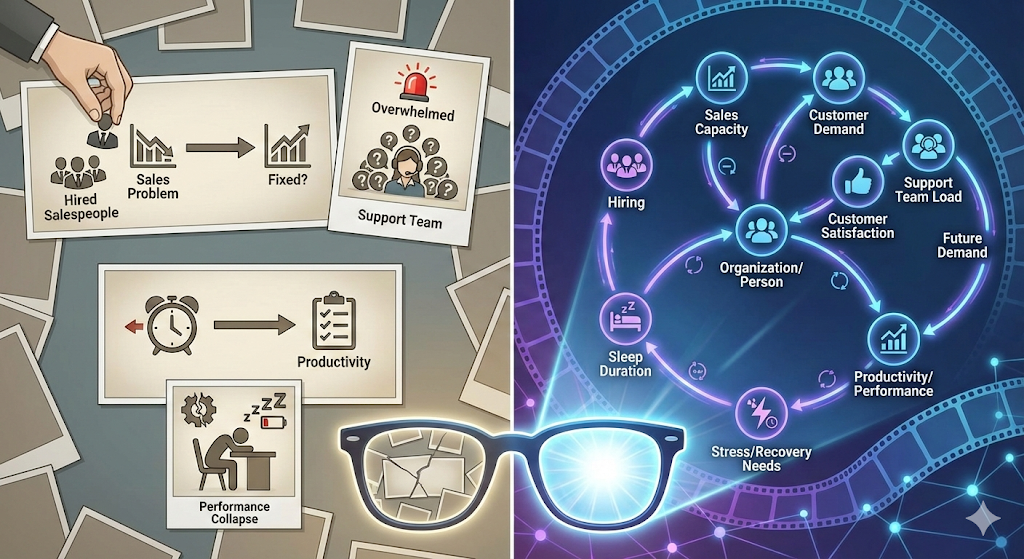
Have you ever tried to fix a sales problem by hiring more salespeople, only to discover three months later that you’ve overwhelmed your customer support team? Or tried to boost your productivity by sleeping one hour less, only to end the week so exhausted that your performance collapses?
We live obsessed with events. We see the world as a series of static snapshots: “Sales are down,” “The project is delayed,” “The server crashed.” And naturally, we respond with linear solutions: “Lower prices,” “Push the team harder,” “Restart the server.”
But reality is not a collection of photos; it’s a movie. And more importantly, reality is not linear. It is systemic.
To understand why our best intentions so often fail—or why companies and people behave in such counterintuitive ways—we need a new pair of glasses. We need to stop looking at things and start looking at the connections between things. We need to understand the basic principles of systems.
What a System Really Is
A system is not just a bunch of things thrown together. A box full of nuts and bolts is not a system; it’s a collection. But assemble those bolts into an engine, and you suddenly have a system.
The fundamental difference lies in three components: elements, interconnections, and purpose.
Elements are the visible parts. In your company, they are employees, computers, and the money in the bank. They are the easiest to see and, therefore, where we tend to focus when something goes wrong. “Let’s replace the manager,” we say, assuming that will fix everything.
Interconnections are the rules of the game. They are the flows of information, hierarchies, incentives, and processes that determine how the elements relate to one another.
Purpose (or function) is what the system actually achieves, not necessarily what it claims to achieve. A company may say its purpose is “to make the world a better place,” but if its interconnections reward short-term profit above all else, its true systemic purpose is quarterly earnings.
Here’s the key insight: interconnections and purpose matter more than elements. You can change every player on a soccer team, but if the rules and the goal remain the same, it’s still the same game. Change the rules, and you’ve created a completely new system—even with the same players.
Stocks and Flows
To understand how any system behaves—from your business to your stress level—imagine a bathtub.
The water in the tub is the stock: the accumulated state of the system at any given moment. It can be cash reserves, customer trust, organizational culture, or reputation.
The faucet is the inflow.
The drain is the outflow.
This simple metaphor explains many strategic failures. We obsess over flows—daily sales, hiring, marketing spend—while ignoring what truly matters: the stock. If customers are leaving because of poor service, opening the marketing faucet wider doesn’t fix the system; it only masks the leak at an ever-increasing cost.
Stocks have memory. They don’t change instantly. This inertia is why organizational change feels so slow and frustrating.
The Engines of Change: Feedback Loops
Systems regulate themselves through feedback. There are only two types of loops, constantly competing with each other.
Reinforcing loops are engines of growth—or collapse. Money earns interest, which generates more money. Visibility creates popularity, which creates more visibility. Panic causes withdrawals, which deepens panic. These loops drive exponential outcomes.
Balancing loops are thermostats. Their job is stability. When something drifts too far, the system pushes back. A company that grows too fast may see quality drop, customers leave, and demand slow down, giving the organization time to rebalance.
Many leaders get frustrated because they push for change without realizing they are triggering balancing loops designed to preserve the status quo. The system isn’t stubborn; it’s behaving exactly as it was designed to behave.
The Invisible Enemy: Delays
If systems responded instantly, managing them would be easy. But they don’t. There are always delays: the time it takes for a new hire to become productive, for a campaign to impact sales, or for a cultural shift to take hold.
The danger is making decisions based only on what we see right now, ignoring what’s already “in the pipeline.” We overcorrect, stack interventions, and when they all take effect at once, the system overshoots.
This is why businesses so often swing from scarcity to excess without understanding what happened in between.
The Trap of Linear Thinking
We confuse symptoms with structure.
Event: “The server crashed yesterday.”
Pattern: “The server crashes every time we launch a promotion.”
Structure: “Marketing growth is outpacing technical capacity.”
If you only react to events, you’ll spend your life firefighting. Systems thinking forces you to look at the structure that produces those events. Organizational behavior is rarely about bad luck or incompetent people; it’s about how the system is designed.
Becoming a Systems Architect
Adopting this mindset changes your role. You stop being a reactive operator and become a conscious architect.
You begin asking where the delays are, which loops are resisting change, which reinforcing loops can enable sustainable growth, and whether you’re protecting your stocks—culture, reputation, team wellbeing—or merely chasing short-term flows.
The world cannot be managed with linear tools. It must be navigated by understanding currents, inertia, and invisible structures.
To make these stocks and flows visible inside your organization, intuition isn’t enough. GGyess WorkSuite functions as a systemic control panel: it centralizes data, connects teams through clear workflows, and exposes delays before they turn into crises. Instead of reacting to events, you gain the ability to redesign the structure that determines your future results.