
In today’s digital ecosystem, effective communication with search engines has transcended simple keyword matching. The modern web, driven by artificial intelligence (AI) algorithms, demands a more sophisticated communication layer: structured data. This framework is not only a technical optimization, but a fundamental requirement for establishing authority and clarity in an environment where machines need to understand the content.meaningof the content, not just the words that compose it.
1.1 From Ambiguity to Authority: The Mandate of the Semantic Web
The evolution of search engines represents a paradigm shift from lexical indexing to semantic understanding. Algorithms are no longer limited to identifying the presence of a keyword on a page; they now seek to understand entities (people, places, organizations, concepts) and the relationships between them.1In this context, structured data functions as the mechanism through which website administrators can explicitly define the meaning of their content, removing ambiguity for crawlers.2
To standardize this communication, major search engines, including Google, Microsoft, Yahoo, and Yandex, collaborated to create Schema.org. This project establishes a universal, shared vocabulary of markup that allows websites to describe their content in a way that machines can unambiguously understand.5By using this vocabulary, a website might indicate that “Apple” refers to the technology corporation and not the fruit, or that a series of numbers corresponds to a product rating and not an address. These definitions form the building blocks of Google’s Knowledge Graph and feed the contextual understanding of AI models.
Preparing content for an AI-dominated future isn’t a passing trend, but a strategic necessity. AI systems, like the Large Language Models (LLMs) that power Google’s AI Overviews, operate most efficiently and accurately when they can process predefined, structured information. Natural language processing to infer meaning from unstructured text is computationally expensive and error-prone.3By implementing schema, a website ceases to be a simple document for machines to “read” and becomes an optimized data source for machines to “ingest.” This positions content as a primary and trusted source for the next generation of search engines and AI, optimizing for machine understanding, not just ranking.8
1.2 Implementation Frameworks: JSON-LD as the Modern Standard
There are three main formats for implementing the Schema.org vocabulary on a web page: Microdata, RDFa, and JSON-LD.2Although all three are technically valid, Google explicitly recommends and prefers the use of
JSON-LD (JavaScript Object Notation for Linked Data)for strategic and practical reasons.13
Unlike Microdata and RDFa, which embed schema attributes directly into the HTML tags of user-visible content, JSON-LD is implemented as a unified script block, typically in the <head> section of the page.11This decoupling of visible HTML offers significant advantages:
- Ease of Maintenance:Because it’s contained in a single block, schema code is easier to manage, update, and debug without the risk of disrupting the page’s layout.
- Scalability:It’s easier to implement and modify markup on a large scale, as changes can be made in the script template rather than editing multiple individual HTML elements.
- Less prone to errors:Separation reduces the likelihood of syntax errors that can occur when nesting schema attributes within a complex HTML structure.
- Dynamic Implementation:JSON-LD can be dynamically injected into a page using JavaScript or through tag managers like Google Tag Manager, providing unmatched flexibility for complex websites or those using restrictive content management systems (CMS).13
For these reasons, JSON-LD has established itself as the professional standard for implementing structured data.
1.3 Tangible Impact on SERPs: Enhanced Results and Enhanced Visibility
The implementation of structured data results in one of the most visible and powerful benefits of technical SEO: obtainingenriched results(formerly known as rich snippets). It’s crucial to understand that schema in itself isn’t a direct ranking factor; its value lies in its ability to qualify a page for these enhanced presentations in search engine results pages (SERPs), which in turn indirectly boosts performance.2
The benefits of obtaining enriched results are well documented and multifaceted:
- Greater Visibility and Attention:Rich results are more visually appealing than standard blue links. They incorporate elements such as star ratings, product images, recipe cooking times, or FAQ dropdowns, making them stand out and capture user attention in a competitive SERP.8
- Increased Click-Through Rate (CTR):The additional information and visual appeal of rich results lead to significantly higher CTRs. By providing more context upfront, users can pre-qualify the result’s relevance to their query, increasing the likelihood of a click.8Google’s own case studies show that sites like Rotten Tomatoes and Food Network saw increases in click-through rates and visits of 25% and 35%, respectively, after implementing structured data.13
- More Qualified Traffic:By offering key information like price, availability, or ratings directly in the SERP, clickers already have a deeper understanding of what they’ll find on the page. This results in higher-quality traffic, with visitors more likely to engage with the content, which can lead to lower bounce rates and higher conversion rates.22
Discover how to build a memorable brand Download your guide here
Section 2: The Semantic-Social Bridge: Forging a Unified Digital Identity
The most advanced structured data strategy isn’t limited to the website. Its true power is unleashed when used as a technical bridge to connect the site’s entity with its authority signals on external platforms, primarily social media. This integration creates a single, consistent, and verifiable digital identity, which is the cornerstone of trust and authority in the modern search ecosystem.
2.1 Establishing the Canonical Entity: Organization and Person Schema
The first step in building this unified identity is to explicitly define the core entities on the website itself. This is achieved through two fundamental types of schema:
- Schema de Organization:This markup should be implemented on the homepage and the “About Us” page to define the company as an entity. It includes essential properties such as name (company name), URL (canonical URL for the site), logo, and contact information.11It acts as the brand’s “digital birth certificate.”
- Schema de Person:This markup is used on author pages, profiles of key team members, or founders. It establishes individual experience and credibility through properties such as name, jobTitle (title), worksFor (organization they work for), and image.28
These schemas create the foundation for the brand’s identity and its key representatives, anchoring it to the website’s domain.
2.2 The sameAs Property: The Cornerstone of Cross-Platform Authority
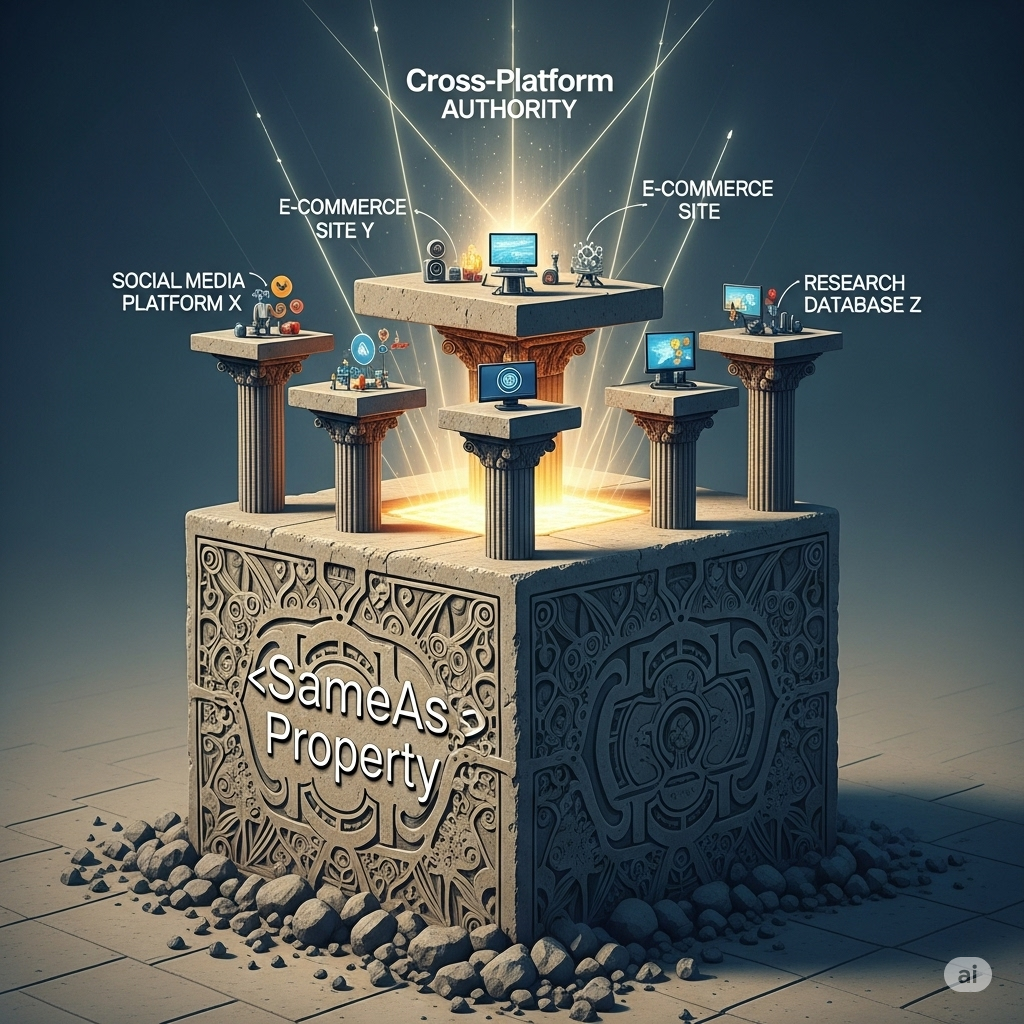
The sameAs property is the critical connector that links the entity defined on the site with its presence on the rest of the web. This property explicitly declares to search engines that the Organization or Person described on the website is the same.same entitythan a specific profile on another platform, such as LinkedIn, X (formerly Twitter), Facebook, or a Wikipedia entry.17
Selecting profiles for sameAs should be strategic, prioritizing high-authority accounts that are actively managed and relevant to the brand’s niche. The quality of connections is more important than quantity.31
Below is an example of JSON-LD for an Organization that uses the sameAs property to connect to its social profiles:
JSON
{
“@context”: “https://schema.org”,
“@type”: “Organization”,
“name”: “Your Company Name”,
“url”: “https://www.susitioweb.com”,
“logo”: “https://www.susitioweb.com/logo.png”,
“sameAs”:
}
This code snippet creates an unambiguous network of identity signals, allowing search engines to consolidate the authority of diverse sources into a single canonical entity anchored to the website.17
This approach is a direct strategic tool for Google’s E-E-A-T (Experience, Expertise, Authoritativeness, Trustworthiness) assessment. Google’s algorithms need to verify authority and trustworthiness through external signals, as it’s difficult to assess them based solely on a site’s content.28Social media profiles and other authority platforms are where expertise is publicly demonstrated and authority is built. Ownership
sameAs provides a direct, machine-readable link between the site’s content (e.g., an expert’s article) and these external credibility checks (e.g., that expert’s LinkedIn profile with a broad industry following). This transforms an abstract social media presence into a concrete, verifiable signal that strengthens the site’s E-E-A-T assessment—a crucial ranking factor, especially for YMYL (Your Money or Your Life) topics.
2.3 A Comparative Analysis: Schema.org vs. Open Graph and Twitter Cards
It’s essential to clarify a common misunderstanding: Schema.org, the Open Graph (OG) protocol, and Twitter Cards are not competing technologies, but rather complementary ones. They should be used together, as they serve different functions.6
- Schema.org:Its purpose is to helpsearch enginesto understand content to improve indexing, ranking, and rich results. Speak the language of Google and Bing.6
- Protocolo Open Graph (OG):Created by Facebook, its function is to control how link previews (title, description, image) are displayed when shared onsocial media platformssuch as Facebook, LinkedIn and Pinterest.35
- Twitter Cards:These are Twitter’s proprietary version of OG tags, offering more specific types of “cards.” If Twitter Cards aren’t found, Twitter will use OG tags as a fallback.35
The omission of OG tags and Twitter Cards doesn’t directly affect search engine SEO, but it does have a negative impact on content performance on social media. A link without these tags generates inconsistent or unattractive previews, drastically reducing CTR on social media and damaging brand perception in that context.37
2.4 Strategic Implementation for Maximum Cohesion
For a cohesive digital strategy, every shareable page on a website should include all three types of markup. The content in the og:title and og:description tags should align with the page’s title and meta description tags for consistency. However, it can be adapted to be more conversational or engaging for a social media audience. The og:image tag is especially critical, as a high-quality, correctly sized image is a key driver of social engagement.
Section 3: Amplifying Social Proof and Interaction with Structured Data
Once the digital identity is established, the next step is to codify the interactions and social proof generated on social media and translate them into credibility signals on the website. This strategy creates a virtuous cycle where social activity directly improves search visibility.
3.1 Translating Social Trust into Search Credibility: Review and AggregateRating
Social media campaigns often seek to generate customer testimonials and reviews. An effective strategy is to direct users to leave these reviews on the main website or a trusted third-party platform, then mark this user-generated content (UGC) with the Review and AggregateRating schemas.12
The most direct benefit of this tactic is the opportunity to obtain the iconic star rating in search results. This rich result is one of the most influential in CTR, as it provides an immediate and visually prominent trust signal.19An example of JSON-LD for a product with an added rating would be:
JSON
{
“@context”: “https://schema.org/”,
“@type”: “Product”,
“name”: “Product Name”,
“aggregateRating”: {
“@type”: “AggregateRating”,
“ratingValue”: “4.8”,
“reviewCount”: “125”,
“pavement”: “5”
}
}
This code clearly communicates the average rating and number of reviews to search engines, turning social sentiment into a tangible competitive advantage in the SERPs.39
3.2 Structuring Dynamic Content: VideoObject, Event and SocialMediaPosting
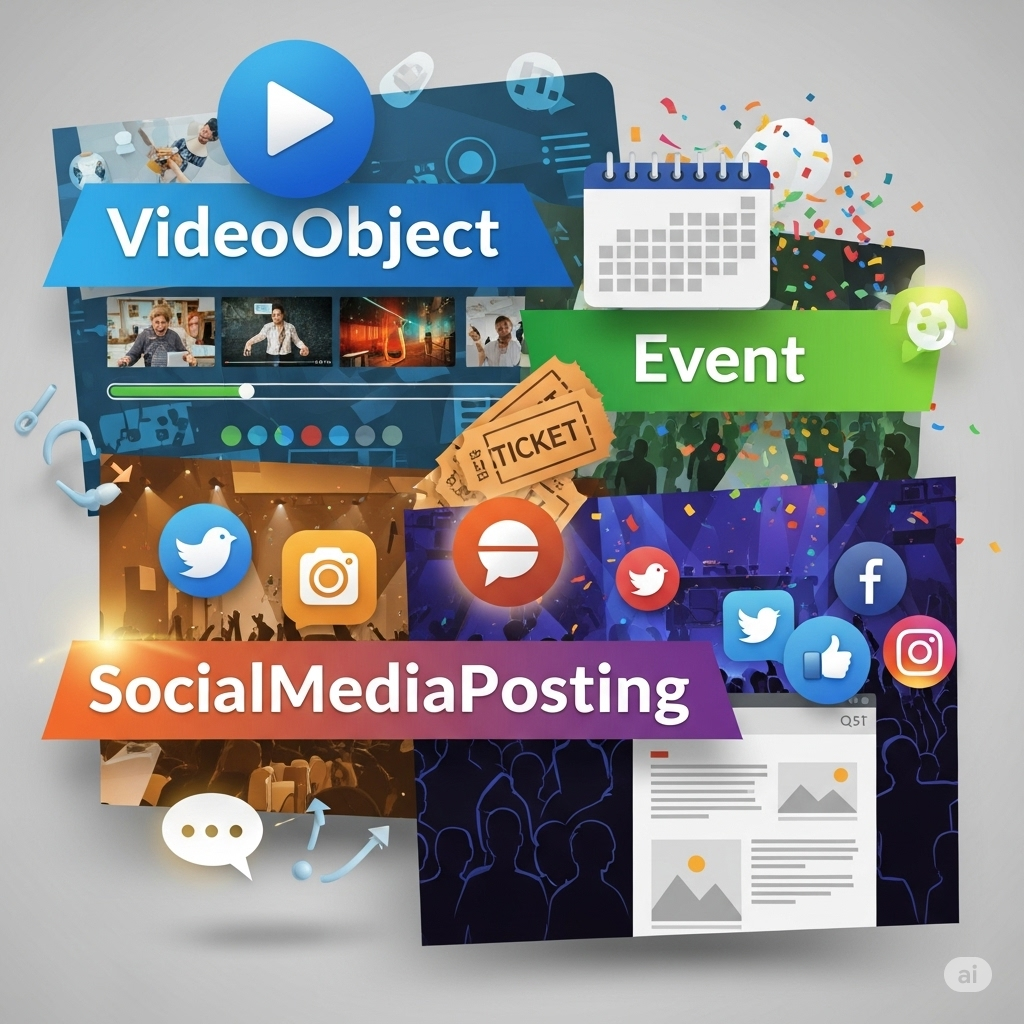
Content that performs well on social media, such as videos, live events, and featured posts, should have a website counterpart, properly marked up with the appropriate schema to maximize its reach.
- VideoObject:For videos from YouTube or other platforms embedded on your site, the markup should include properties such as name, description, thumbnailUrl, and uploadDate. For longer videos, the hasPart property can be used to define chapters or key moments, allowing Google to display direct links to specific sections of the video in search results.16
- Event:For webinars, live Q&A sessions, or physical events promoted on social media, the Event schema allows you to display crucial details such as name, start date, location (which can be a Virtual Location), and offers (for ticket sales) directly in the SERPs, increasing visibility and attendance.45
- SocialMediaPosting:This type of schema is specifically designed to mark up social media posts embedded on your website, further strengthening the connection between platforms and contextualizing the content for search engines.12
The following table provides a framework for aligning social media marketing activities with the technical implementation of schema, transforming schema from a reactive task to a proactive strategic tool.
| Social Media Activity | Corresponding Content on the Website | Recommended Schema Markup | Key Properties to Include | Strategic Objective |
| Live Q&A on Instagram with an expert | Event page with the recording | Schema de Event, schema de VideoObject | name, startDate, performer (as Person), location (as VirtualLocation), recordedIn (linking to the VideoObject) | Appear in event-related search results; showcase experience. |
| Customer testimonial campaign (e.g. on Facebook) | Page dedicated to customer reviews | AggregateRating schema, individual Review schemas | ratingValue, reviewCount, itemReviewed, author, reviewBody | Earn star ratings in the SERPs; build social proof. |
| “How to” tutorial series on YouTube | Blog post that embeds the video | Schema de VideoObject, schema de HowTo | name, description, thumbnailUrl, uploadDate, hasPart (para capítulos), step (para HowTo) | Get rich video results; capture “how-to” queries. |
| Product Launch Announcement | Product page | Schema de Product, Schema de Offer | name, image, brand, description, sku, price, priceCurrency, availability | Qualify for rich product results and shopping carousels. |
Section 4: Preparing Your Strategy for the AI and Conversational Web
Integrating a schema and social signaling strategy not only optimizes for the present, but also prepares digital assets for the future of search, which will increasingly be dominated by AI and conversational interfaces.
4.1 Feeding LLMs: Why Structured Data is Crucial for AI Overviews
Google AI Overviews (formerly SGE) works by synthesizing information from multiple reliable sources to provide a direct answer at the top of the SERP.48Websites that present their information in a clear, structured manner with well-defined entities are easier for these AI systems to analyze. In essence, a robust schema acts as a “cheat sheet” for AI, making the content a more compelling and reliable source to cite in these generative responses.8While there is no specific schema “for AI Overviews”, a solid foundation of AI markup exists.
Organization, Article, Product, etc., increases the citability of the content.18
This optimization represents a fundamental shift in the purpose of SEO. The goal is no longer simply for a page to beindexedfor a user to find it, but the information on the page isintegratedin the machine’s global knowledge graph. A website with a complete schema is transformed from a collection of documents into a searchable database. Information such as opening hours, product prices, or event dates becomes data fields that an AI can query directly. Synergy with social media through sameAs further solidifies the entity’s place within this global graph.
4.2 The E-E-A-T Imperative in the Age of AI
In a digital environment saturated with content, much of which can be generated by AI, the importance of Google’s E-E-A-T guidelines becomes paramount.9Search engines need to prioritize sources that demonstrate experience, expertise, authority, and trustworthiness.
The unified digital entity, built through a clear Organization and Person schema on the website, and verifiably linked via SameAs to active and authorized social media profiles, constitutes the most powerful and machine-readable signal of trust and experience that a brand can generate.28This strategy directly addresses the need for AI systems to find and prioritize reliable sources to build their responses.
4.3 Optimization for Conversational Interfaces: Voice Search and Beyond
Search is evolving toward more conversational queries, a behavior typical of voice search and AI assistants.54Structured data is a key tool for capturing this type of traffic.
- Schema of FAQPage:This is the primary tool for optimizing Q&A content. Marking this format structures information in a way that perfectly aligns with conversational search intent, making it ideal for both rich results displayed in SERPs and direct answers provided by voice assistants.15
- Schema Speakable:This more advanced feature allows editors to explicitly mark sections of an article that are best suited for audio playback by assistants like Google Assistant. It’s a direct optimization for voice-first platforms, telling the system which fragments to read aloud.54
Section 5: A Roadmap for Integrated Implementation and Analysis
This final section provides a practical, step-by-step framework for implementing and measuring the success of the unified strategy described in this report.
5.1 The Audit and Discovery Phase
The process begins with a thorough audit of existing structured data. Tools like Screaming Frog or Semrush’s Site Audit feature can be used to crawl the site and identify the current schema, as well as any errors or warnings.11In parallel, an audit of the brand’s presence on social networks must be carried out to identify the most authoritative and active profiles that will be used in the properties.
sameAs.
5.2 Strategic Prioritization and Generation
Not all schemas have the same impact on all businesses. Implementation should be prioritized based on business goals and the most important content types. For example, e-commerce sites should focus on the Product and Review schemas, while content publishers should prioritize the Article and Author schemas. For code generation, there are multiple tools, from manual creation for complete control, to the use of schema generators like those offered by TechnicalSEO.com or Rank Ranger, and plugins for CMSs like WordPress that simplify the process.25
5.3 Validation and Monitoring: The Feedback Loop
Code validation is a critical step that must be performedbeforeof the implementation. Two key Google tools should be used:
- Rich Results Test:Checks if the page is eligible for Google-specific rich results and allows you to preview its appearance.64
- Schema Markup Validator:Validates general code syntax according to Schema.org standards, without Google-specific checks.7
Once implemented, continuous monitoring is essential.Google Search Consoleis the primary tool for this task. The Rich Results Status reports (previously in the “Enhancements” section) track valid items, those with warnings, and those with critical errors. The Performance report allows you to filter by appearance in search to measure the impact on clicks and impressions of pages that receive rich results.67
5.4 Final Thesis: The Future is the Unified Entity
In conclusion, in a digital ecosystem where AI is increasingly the intermediary between information and the user, success no longer stems from channel optimization in isolation. The winning strategy is to build a single, coherent, and authoritative digital entity. This approach uses the website as the canonical source of truth, employs Schema.org markup as the technical language to communicate that truth to machines, and leverages social media profiles as the primary, verifiable proof of authority and trust. This unified entity is what will be understood, trusted, and amplified by the search engines of today and tomorrow.
Map out your “Canonical Presence” across the web. Before you code, you must strategize. Use the Planily module within GGyess to organize your entity roadmap. Set up Kanban boards to manage the rollout of Organization and Person schemas, ensuring every team member is aligned on which social profiles are being used for your sameAs declarations. Architect your entity at GGyess.com
Sources cited
- Organization of Schemas, acceso: agosto 25, 2025, https://schema.org/docs/schemas.html
- What Is Schema Markup & Why Is It Important For SEO? – Search Engine Journal, acceso: agosto 25, 2025, https://www.searchenginejournal.com/technical-seo/schema/
- Schema Markup: What It Is and Why It Matters in 2025 – Backlinko, acceso: agosto 25, 2025, https://backlinko.com/schema-markup-guide
- How to Boost Your SEO by Using Schema Markup – Neil Patel, acceso: agosto 25, 2025, https://neilpatel.com/blog/get-started-using-schema/
- www.humanlevel.com, access: August 25, 2025,https://www.humanlevel.com/blog/seo/que-son-los-datos-estructurados-y-schema-org#:~:text=Schema.org%20es%20un%20lenguaje,mejorar%20la%20experiencia%20de%20usuarios.
- The Structured Data Dilemma: Schema vs. Open Graph | Yext, acceso: agosto 25, 2025, https://www.yext.com/blog/2017/07/schema-vs-open-graph
- Getting started with schema.org using Microdata, acceso: agosto 25, 2025, https://schema.org/docs/gs.html
- The Benefits of Schema Markup & Why It’s Important for SEO, acceso: agosto 25, 2025, https://www.schemaapp.com/schema-markup/benefits-of-schema-markup/
- The AI Search Engine Revolution in 2025: How to Adapt and Optimize Your SEO, accessed August 25, 2025,https://www.seoinhouse.es/la-revolucion-de-los-buscadores-con-ia-en-2025-como-adaptarte-y-optimizar-tu-seo/
- How AI Impacts SEO Strategies – ROI UP Group, accessed August 25, 2025,https://roiupgroup.com/es-es/agencia-digital/agencia-seo/publicaciones-de-seo/como-la-ia-afecta-a-las-estrategias-seo
- What Is Schema Markup and How to Implement Structured Data? – Semrush, accessed August 25, 2025https://es.semrush.com/blog/que-es-schema-guia/
- Schema Markup Types & Examples for SEO | RevenueZen, accessed August 25, 2025https://revenuezen.com/schema-markup-types/
- Introduction to how structured data markup works…, accessed: August 25, 2025,https://developers.google.com/search/docs/appearance/structured-data/intro-structured-data?hl=es
- Intro to How Structured Data Markup Works | Google Search Central | Documentation, acceso: agosto 25, 2025, https://developers.google.com/search/docs/appearance/structured-data/intro-structured-data
- How to Implement FAQ Schema: Best Practices & Examples – AirOps, acceso: agosto 25, 2025, https://www.airops.com/blog/faq-schema-markup-example
- Video Schema: What It Is & How to Implement It – Semrush, acceso: agosto 25, 2025, https://www.semrush.com/blog/video-schema/
- Using Local Business Schema and JSON LD Markup for SEO, acceso: agosto 25, 2025, https://chazedward.com/how-to-use-schema-for-local-seo/
- AI-powered features and your website | Google Search Central, accessed August 25, 2025https://developers.google.com/search/docs/appearance/ai-features?hl=es-419
- How Schema Markup Can Boost Your Website’s Rankings, acceso: agosto 25, 2025, https://www.digitalstrike.com/how-schema-can-boost-your-rankings/
- What is structured data, or Schema Markup, and how to implement it to improve your SEO – Wanaleads, accessed: August 25, 2025,https://wanaleads.com/datos-estructurados-schema-para-seo/
- Why is Schema Markup Important for SEO? Complete 2025 Guide – SEOSpace, acceso: agosto 25, 2025, https://www.seospace.co/blog/why-is-schema-markup-important
- What Are Rich Snippets & Why They Are Important For SEO – Atropos Digital, acceso: agosto 25, 2025, https://www.atroposdigital.com/blog/what-is-a-rich-snippet
- What Are Rich Snippets? Types and Importance in SEO – UNIR, accessed August 25, 2025https://www.unir.net/revista/marketing-comunicacion/rich-snippets/
- Rich Snippets: What They Are and How to Use Them to Improve SEO | Arsys Blog, accessed August 25, 2025https://www.arsys.es/blog/rich-snippets
- Rich Snippets: Everything You Need to Know to Improve Your CTR, accessed August 25, 2025https://bysidecar.com/es/trends/rich-snippets-que-debes-saber-mejorar-ctr
- How to Leverage Aggregate Rating Schema for Better Search Visibility – NotificationX, acceso: agosto 25, 2025, https://notificationx.com/blog/leverage-aggregate-rating-schema/
- Organization Schema Markup | Google Search Central | Documentation, acceso: agosto 25, 2025, https://developers.google.com/search/docs/appearance/structured-data/organization
- An SEO guide to understanding E-E-A-T – Search Engine Land, acceso: agosto 25, 2025, https://searchengineland.com/guide/google-e-e-a-t-for-seo
- How to use Author schema for E-E-A-T? – Aubrey Yung, acceso: agosto 25, 2025, https://aubreyyung.com/author-schema/
- Author Schema Markup & SEO: How It Works, Examples – Positional, acceso: agosto 25, 2025, https://www.positional.com/blog/author-schema
- How to Implement sameAs Schema on Your Website – Rank Math, acceso: agosto 25, 2025, https://rankmath.com/kb/sameas-schema/
- How to Set Up sameAs Schema for Better E-E-A-T | Weekend Growth, acceso: agosto 25, 2025, https://weekendgrowth.com/sameas-schema/
- JSON-LD Social Network Profiles Example Code, acceso: agosto 25, 2025, https://jsonld.com/social-network-profiles/
- sameAs schema best practices – Local Search Forum, accessed: August 25, 2025,https://localsearchforum.com/threads/sameas-schema-best-practices.49793/
- What Are Open Graph Tags And Why It Matters – SEO Setups, acceso: agosto 25, 2025, https://seosetups.com/blog/open-graph/
- Open Graph Tags vs Schema for SEO: Key Differences Explained – OpenGraph.io, acceso: agosto 25, 2025, https://www.opengraph.io/og-tags-vs-schema
- What is Open Graph? The Beginner’s Guide to Social Media Tags | by Makarenko Roman, acceso: agosto 25, 2025, https://medium.com/@makarenko.roman121/what-is-open-graph-the-beginners-guide-to-social-media-tags-3c0fb5e9b865
- How to Fix Your Social Sharing Link Previews – Prerender.io, acceso: agosto 25, 2025, https://prerender.io/blog/how-to-fix-link-previews/
- The Easiest Way of Adding Aggregate Rating Schema using Coding – SEO Hacker, acceso: agosto 25, 2025, https://seo-hacker.com/easiest-adding-aggregate-rating-schema-coding/
- 4 Ways To Integrate Schema Markup For Local Business Reviews – Marketer Interview, acceso: agosto 25, 2025, https://marketerinterview.com/4-ways-to-integrate-schema-markup-for-local-business-reviews/
- Video (VideoObject, Clip, BroadcastEvent) Schema Markup | Google Search Central | Documentation, acceso: agosto 25, 2025, https://developers.google.com/search/docs/appearance/structured-data/video
- How To Add Video Structured Data to YouTube Embeds – RankYa, acceso: agosto 25, 2025, https://www.rankya.com/structured-data/how-to-add-video-structured-data-to-youtube-embeds/
- VideoObject Schema Markup (Structured Data) Json-ld generator | Honey & Jam, acceso: agosto 25, 2025, https://honeynjam.com/tools/schema-markup-generators/video
- How to Add VideoObject Schema Markup for Better SEO, acceso: agosto 25, 2025, https://seo-hacker.com/how-to-add-videoobject-schema-markup/
- Learn About Google Event Schema Markup | Google Search Central | Documentation, acceso: agosto 25, 2025, https://developers.google.com/search/docs/appearance/structured-data/event
- JSON-LD Event Example Code, acceso: agosto 25, 2025, https://jsonld.com/event/
- Event – Schema.org Type, acceso: agosto 25, 2025, https://schema.org/Event
- What are Google AI Overviews and how do they affect SEO? – Unlimited Growth, accessed August 25, 2025https://unlimitedgrowth.online/blog/google-ai-overviews/
- Does SEO Still Work? How AI Impacts Your Online Visibility – Nonica Studio, accessed August 25, 2025https://nonicastudio.com/es/estrategias-y-tendencias-marketing-digital/impacto-ia-seo
- AI Overviews in Spain: Analysis of 100,000 SEO searches – SE Ranking, accessed: August 25, 2025,https://seranking.com/es/blog/ai-overviews-en-espana/
- Do AI Overviews Affect Google’s SEO? – Andres Macario, accessed August 25, 2025https://andresmacario.com/afectan-las-ai-overviews-al-seo-de-google/
- AI Overviews: How Google’s New Search Changes SEO and SEM – IEBS, accessed August 25, 2025https://www.iebschool.com/hub/ai-overviews-como-cambia-el-seo-y-el-sem-con-la-nueva-busqueda-de-google-seo-sem/
- What is Schema Markup & how does it affect SEO during website migrations | Specbee, acceso: agosto 25, 2025, https://www.specbee.com/blogs/how-schema-markup-impacts-seo-during-website-migrations
- Voice Search: How Does It Work and How Does It Affect SEO? – Bloo Media, accessed August 25, 2025https://bloo.media/blog/busqueda-voz-funcion-como-afecta-seo/
- Voice Search: How Does It Work and How Does It Affect SEO? – Cima Digital, accessed August 25, 2025https://cimadigital.com.ar/seo/busqueda-por-voz-como-funciona-y-como-afecta-al-seo/
- Mark Up FAQs with Structured Data | Google Search Central | Documentation, acceso: agosto 25, 2025, https://developers.google.com/search/docs/appearance/structured-data/faqpage
- FAQ JSON-LD Snippet (Schema Markup Example), acceso: agosto 25, 2025, https://jsonld.com/faq-json-ld-snippet/
- FAQPage JSON-LD Schema Generator, accessed: August 25, 2025,https://saijogeorge.com/json-ld-schema-generator/faq/
- FAQ Page Schema Markup JSON-LD Code Generator & Examples, acceso: agosto 25, 2025, https://classyschema.org/FAQPage
- Schema Speakable Markup Language (BETA) | Google Search Central, accessed August 25, 2025https://developers.google.com/search/docs/appearance/structured-data/speakable?hl=es-419
- What is structured data (schema) and how does it help with SEO – YouTube, accessed: August 25, 2025,https://www.youtube.com/watch?v=imB0TP1rIsA
- Schema Markup Generator & Validator – JSON-LD, accessed August 25, 2025,https://www.rankranger.com/schema-markup-generator
- Schema Markup Generator (JSON-LD) | TechnicalSEO.com, accessed August 25, 2025https://technicalseo.com/tools/schema-markup-generator/
- Schema Markup Testing Tool | Google Search Central, acceso: agosto 25, 2025, https://developers.google.com/search/docs/appearance/structured-data
- Rich Results Test – Search Console Help, acceso: agosto 25, 2025, https://support.google.com/webmasters/answer/7445569?hl=en
- Rich Results Test – Google Search Console, acceso: agosto 25, 2025, https://search.google.com/test/rich-results
- Rich result report overview – Search Console Help, acceso: agosto 25, 2025, https://support.google.com/webmasters/answer/7552505?hl=en
- Google Search Console Tools, acceso: agosto 25, 2025, https://search.google.com/search-console/about